A new European emergency response framework is coming for future migration crises. Announced in Ursula von der Leyen’s State of the Union speech, it would allow the EU to temporarily relax standard procedures when strictly defined criteria are met. What those criteria will be remains unclear.
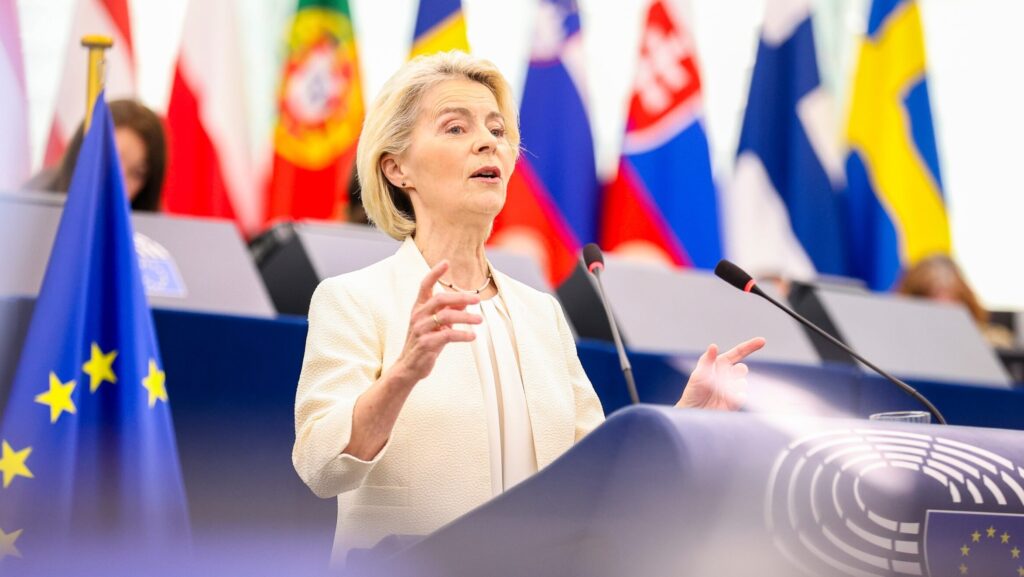
A mass-migration crisis on Spain’s North African border has prompted Brussels to prepare a new emergency mechanism for future surges. In her address on Wednesday morning, Commission President unveiled the European Emergency Response Framework.
The announcement followed summer events in Ceuta, the Spanish enclave on Morocco’s coast, where large numbers of migrants attempted to enter the territory. “Our tools need to evolve, especially for emergency situations. Europe need the means to protect its borders at all times. Especially in scenarios when mass movements are engineered and weaponised,” Ms von der Leyen said.
It is us, Europeans, that decide who comes to our Union and under what circumstances. And not the smugglers and the traffickers. — Ursula von der Leyen, European Commission President
The framework will not be a permanent change to EU migration rules. It is designed as an emergency switch: it would only be triggered under a strictly defined set of criteria and would allow “time limited and strictly defined flexibility” in standard procedures. What those criteria will be, and exactly which rules could be relaxed, remains to be seen.
“Ceuta is Europe”
Von der Leyen emphatically declared that “all of our external borders are European borders”. Turning directly to Spain, she said: “Ceuta’s border is a European border. Because Ceuta is Spain. Ceuta is Europe. And Europe will be there for you.”
She thus reaffirmed her support — albeit only in words for now, as the funding Spain requested to manage the enclave’s migration situation has not yet been released.
Referring to the EU Pact on Migration and Asylum, she reiterated that responsibility is shared by all and requires corresponding solidarity. However, that solidarity is in deep crisis following political skirmishes between Italian Prime Minister Giorgia Meloni and her Spanish counterpart Pedro Sánchez over the suspension of Schengen rules.
Nevertheless, Ms von der Leyen remains confident. “We are on the right way. We have seen a 55 per cent reduction in illegal arrivals over the past two years. And a further 35 per cent drop this year. That is real progress.”
Green light for Frontex-led returns
The president signaled between the lines that the European Border and Coast Guard Agency, commonly known as Frontex, will be tasked with handling returns, as authorised by the Return Regulation.
A reform of the agency is expected in two weeks, when more details about its annual budget, tools and resources will emerge. The plans include strengthening Frontex, particularly to speed up returns. “It is us, Europeans, that decide who comes to our Union and under what circumstances. And not the smugglers and the traffickers,” Ms von der Leyen stated.
Furthermore, the Commission aims to strengthen early-warning systems, including through cooperation with third countries. “We will ensure that we can detect and anticipate online trends,” she explained, likely with the assistance of Europol or eu-LISA.
A Mediterranean plan for youth employment
To facilitate legal entry pathways for migrant people, Ms von der Leyen announced a Mediterranean Youth Skills and Jobs initiative. It will focus on employment, training, and apprenticeships. “We must work with our neighbors to boost investment. To offer young people meaningful prospects, so they are not compelled to gamble with their lives.”
For Ms von der Leyen, this is key also to reducing irregular migration. “Uphold the rights of individuals seeking protection. Facilitate safe, legal migration with new Gateway Offices in partner countries. And defend the freedoms of our Schengen area,” she concluded.