Germany faces another test from the far right on Sunday as voters in Mecklenburg-Western Pomerania choose a new state parliament. The AfD could finish first for the second time this month, although a late recovery by the governing Social Democrats has turned the election into a close contest.
The vote comes two weeks after the AfD secured a record 43.8% in neighbouring Saxony-Anhalt. That result left it just short of a parliamentary majority and delivered a serious defeat to Chancellor Friedrich Merz’s Christian Democrats.
Polls in Mecklenburg-Western Pomerania do not identify a clear winner. The latest ZDF Politbarometer places the SPD on 37% and the AfD on 36%. However, another recent survey gave the AfD 38%, five points ahead of the SPD.
We are not a harmful party; we are a normal party.
— Leif-Erik Holm, AfD candidate for minister-president
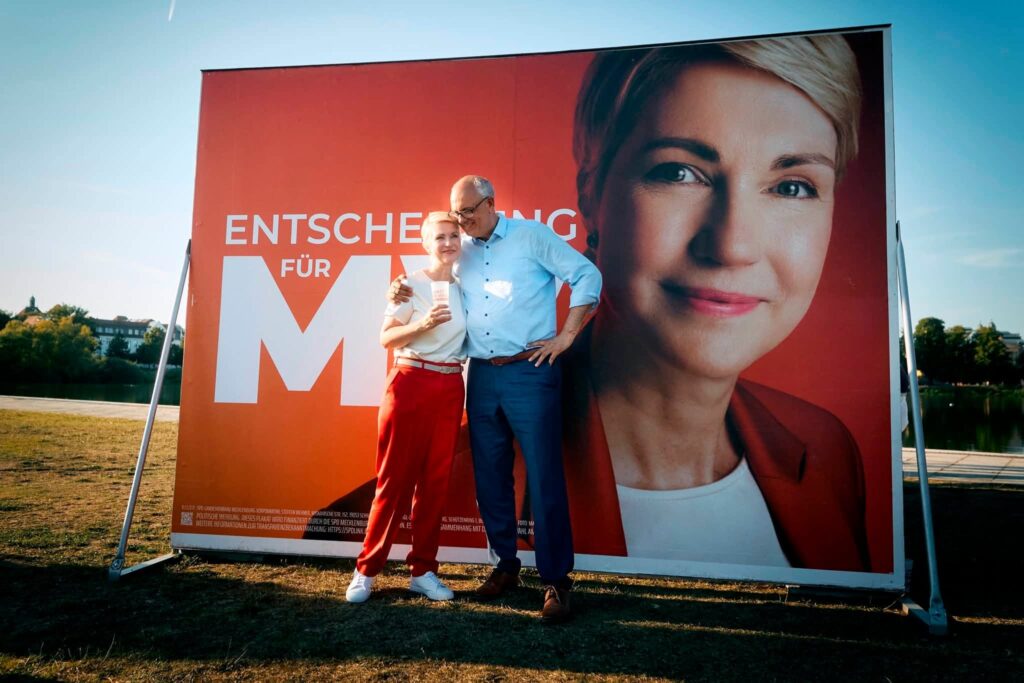
Voters will elect at least 71 members of the state parliament on 20 September. The SPD has governed the eastern state since 1998 and currently rules with the Left under Minister-President Manuela Schwesig.
First place may not put the AfD in power
Even if the AfD finishes first, it may remain outside the government. The SPD, CDU, Left, Greens and FDP have ruled out cooperation with the party. The BSW has also said that it would not help elect an AfD minister-president, according to ZDF.
AfD candidate for minister-president Leif-Erik Holm nevertheless argues that the party should no longer remain politically isolated. “We are not a harmful party; we are a normal party,” he said during a televised debate with Ms Schwesig. He promised to invite other parties to negotiations if the AfD emerged as the strongest force.
Forming a government without AfD could prove complicated. The latest poll places the Left on 9%, CDU on 6% and the Greens exactly on the 5% threshold required to enter parliament. Small changes could therefore determine whether Ms Schwesig can assemble a majority without the AfD.
Her personal popularity may provide the SPD with an advantage. In a hypothetical direct contest for minister-president, 61% preferred Ms Schwesig and 30% chose Mr Holm. Germany’s state leaders are selected by their parliaments rather than directly by voters.
Migration, energy and Merz shape the contest
The campaign has exposed sharp differences over migration and energy. Mr Holm has demanded faster removals of people without permission to remain in Germany, arguing that doing so could reduce xenophobia. He also supports a new energy mix that could include nuclear power and renewed imports of Russian gas through Nord Stream 2.
Ms Schwesig has accused the AfD of threatening jobs and social cohesion. “The AfD is hostile to business,” she said during an election debate. She cited concerns that workers with migrant backgrounds could leave the state if the party came to power. She has also called for a cap on fuel prices, an important issue in a largely rural state where many residents depend on cars.
The result will carry consequences beyond Schwerin. Mr Merz’s CDU is polling at just 6%, down from 13.3% at the previous state election, leaving it only one percentage point above the 5% electoral threshold. Falling below it would see the party lose its seats in the state parliament and intensify pressure on the chancellor after the CDU’s collapse in Saxony-Anhalt.
An AfD victory would not automatically produce Germany’s first AfD-led state government. However, a second consecutive first-place finish would strengthen its claim to have become the dominant political force across much of eastern Germany.