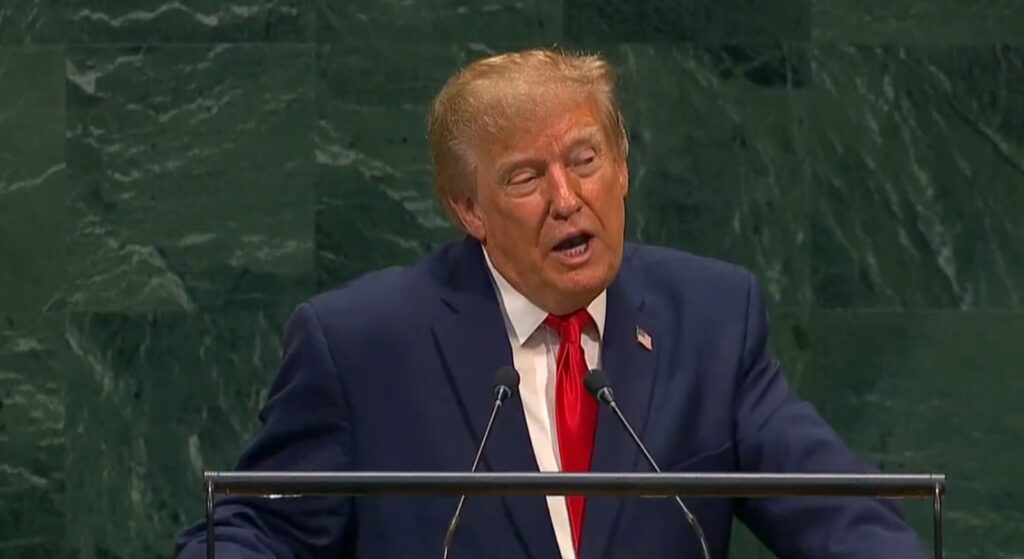
Maybe the US will not invade Denmark to usurp Greenland after all. On Tuesday, the three entities’ leaders signed an agreement granting Washington expanded military access to the Arctic island.
It took eight decades, a diplomatic crisis, and a president who refused to rule out force. But on the sidelines of the 81st UN General Assembly in New York, the nightmare appeared to be finally over.
US President Donald Trump, Danish Prime Minister Mette Frederiksen, and Greenlandic Prime Minister Jens-Frederik Nielsen signed a new security agreement covering Greenland on 22 September. It marks the largest expansion of American military infrastructure on the Arctic island since the Cold War.
The deal opens two new US military sites: Narsarsuaq, a former Cold War airbase in southern Greenland whose population has dwindled to a few dozen, and Mestersvig on the east coast, currently home to the Sirius Dog Sled Patrol, an elite Danish special forces unit. Both join the existing Pituffik Space Base. The full text had not been publicly released at the time of signing.
For Greenland, this is not only an agreement about us. It is an agreement with us. — Jens-Frederik Nielsen, Greenland’s prime minister
Mr Trump framed the moment in sweeping historical terms, in his very own alternative-reality way. “For many decades, probably centuries, almost every president at least mentioned it, but most of them just mentioned it,” he said about a Greenland–US security arrangement. “Some really wanted to make a deal and never got done. But we’re getting it done.”
A crisis resolved, up to a point
The agreement ends—or at least suspends—a standoff that rattled NATO in January, when Mr Trump’s repeated calls for US control over Greenland, and his refusal to rule out military or economic coercion, forced Denmark and Greenland’s government into urgent negotiations.
Greenland is a semi-autonomous territory of the Kingdom of Denmark, sitting between the Arctic Ocean and North America, with vast energy resources and immense strategic value.
The deal Mr Trump ultimately signed is a retreat from his most expansive ambitions. Greenland remains within the Kingdom of Denmark. Its right to self-determination, and Danish sovereignty, are explicitly recognised.
Arctic security now falls under NATO’s collective watch rather than solely under a bilateral US–Danish arrangement — a point Danish Foreign Minister Lars Løkke Rasmussen had stressed in the run-up to the signing.
Ms Frederiksen was emphatic on this point. “We are making sure that (adversaries) will not be allowed to get any control, or significant influence,” she said, “and we are making sure that more allies are present in the Arctic at the same time.”
What the agreement does (not) say
The legal architecture of the deal remains opaque. It is unclear whether the agreement amends the 1951 defence treaty (the existing legal basis for the US military presence) or establishes an entirely new framework. What is clear is its ambition. Mr Nielsen described it as bringing “the 1951 defense agreement into 2026”, built on 75 years of security cooperation.
Mr Nielsen was also careful to stress Greenland’s agency in the process. “For Greenland, this is not only an agreement about us,” he said. “It is an agreement with us.”
That distinction mattered. Throughout the months of negotiations, Greenland’s government had insisted that any deal account for the rights and livelihoods of its 57,000 people, scattered along a coastline three times the size of Texas.
(Asking) allies to pay our part of the burden, I think, is only fair. The Kingdom of Denmark has done exactly that. — Mette Frederiksen, Denmark’s prime minister
Mr Trump, for his part, claimed “the deal gives the US permanent control over security, and all other needs, in Greenland”. Denmark did not respond to that characterisation directly, but both Ms Frederiksen and Mr Nielsen were consistent in asserting that sovereignty and self-determination remained intact. This is a tension the unpublished text will eventually have to resolve.
The Arctic’s new geometry
For Ms Frederiksen, the agreement carried a broader message about the state of the Western alliance. “In other words, we are strengthening our common security, boosting our common deterrence, showing our adversaries who we are, and we are doing it together,” she said.
She also addressed Mr Trump’s long-running complaints about burden-sharing directly and without defensiveness. “When you, Mr President, have asked allies to pay our part of the burden. In fact, I think it’s only fair. The Kingdom of Denmark has done exactly that,” she managed simultaneously to compliment and rebuff the US strongman.
The deal gives the US permanent control over security, and all other needs, in Greenland. — Donald Trump, US president
The strategic logic behind the expansion is not hard to follow. The Arctic is warming, opening new shipping lanes and exposing new vulnerabilities. Russia and China have both increased their presence in the region.
During the Cold War, the US maintained 17 installations and more than 10,000 personnel in Greenland. That footprint shrank dramatically after 1991. The new agreement begins to reverse that.
A three-win deal
Mr Nielsen called the deal a “win, win, win”. The same could be said about Wednesday’s ceremony. Mr Trump’s triumph, apart from ‘getting Greenland’, consisted in staying awake for much of the occasion.
Ms Frederiksen, who last year as EU presidency chief could not contain her amusement at some of the US president’s wilder antics, managed to flatter the strongman straight-faced. Mr Nielsen succeeded in framing the agreement, of sorts, as Greenland doing the US a favour by providing its Western ally with its own indispensable security assistance.
Mr Nielsen, indeed, framed Greenland’s position with clarity. “Greenland matters for North American security and for transatlantic security, and this agreement reflects that,” he said. The only person to sign the agreement with his left hand then added that the deal “should put to rest any doubt today and in the future about where Greenland’s loyalty lies”.
Whether it also puts to rest Mr Trump’s appetite for more remains the open question. The agreement may well be, as Mr Nielsen put it, a triple win. Provided all three parties read the same text, that is.