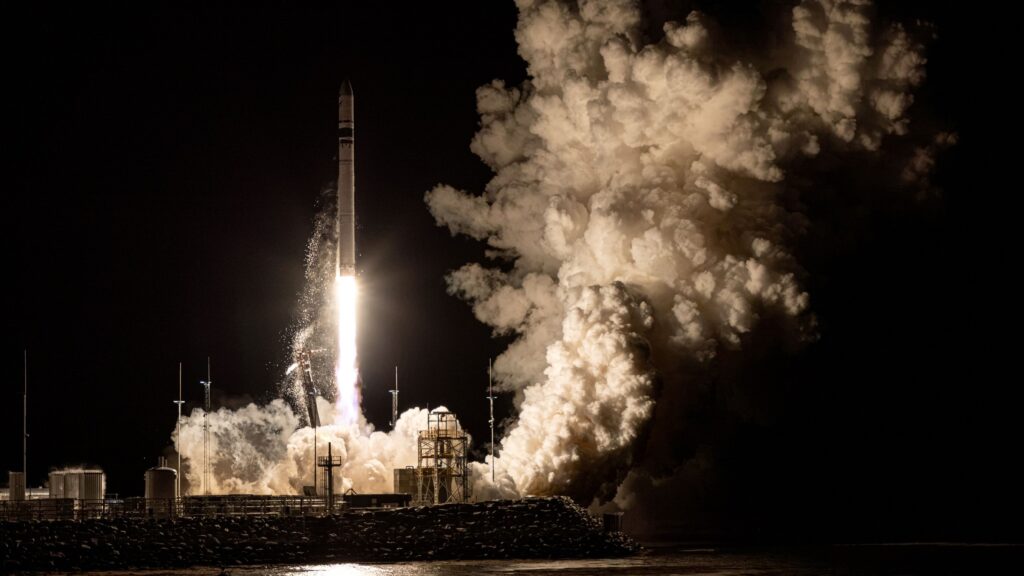
A landmark launch has opened a new chapter for Europe’s space industry. Now comes the harder question: how to turn that breakthrough into a competitive and viable business.
On 5 September, a 28-metre rocket lifted off from a spaceport above the Arctic Circle and, seven minutes later, did something no privately built European vehicle had done before: it reached orbit from continental European soil.
German company Isar Aerospace has shifted the narrative for how Europe can compete in space. Spectrum, the rocket that reached orbit, is not Europe’s most powerful rocket. The Ariane 6 flies bigger and heavier. But what made Spectrum such an accomplishment was how it was built: privately, on venture capital, in a way Europe had never managed for a launcher before.
“Now that they made it, the narrative switches,” said Matija Renčelj, Director of Strategy & Operations at the European Space Policy Institute (ESPI). “It’s proof that we can develop capabilities in a different way,” he said.
The competitor in question is SpaceX, which has figured out how to dominate private spaceflight by reaching orbit more cheaply on each launch. Spectrum still can’t compete on price, but it offers the first chance at a real private European alternative.
“It’s a big moment for Europe, but not necessarily for the immediate capabilities that it unlocks,” Mr Renčelj says. “It’s a moment from which we will see maybe even more confidence given to private initiative, entrepreneurship, risk-taking by public actors,” he continued.
Europe is still playing catch-up
Days before the launch, the European Space Agency awarded Isar a €197.8 million contract under the European Launcher Challenge, paid out against milestones rather than as a lump-sum subsidy.
Europe is playing catch-up—fewer than ten orbital launches in 2025 against more than 190 for the United States—but it’s doing so its own way.
Mr Renčelj is realistic about how long that takes to pay off. “There is a period of time in which you have to throw money at it and it won’t yield any results immediately,” he says. Much of this workforce, he notes, is learning from scratch: building rockets takes longer than building apps because the hardware is so expensive, though he expects things to speed up as the sector matures.
But European space players face different challenges than that of the US. “SpaceX has grown to become this conglomerate that goes well beyond launch and treats launch as an enabler of its connectivity business,” he notes. It isn’t just a launch company; it’s a connectivity company that happens to launch.
Europe, by contrast, stays fragmented — all parts of the industry kept in their own separate boxes. “Can we still be competitive with SpaceX if we keep most of our sector segmented?” Mr Renčelj asks. The firms winning elsewhere are the ones pulling multiple parts of the supply chain under one roof. That is the outstanding question.
Who will own the market
Industry wide, the direction of travel is towards consolidation. In the US, the firm Rocket Lab is buying the satellite operator Iridium, going from a company that sells rides to orbit to one that owns the service at the far end.
Even the big established European players, France’s Ariane and Italy’s Avio, run launch as a business of its own, a strategy that only works because the same companies also build missiles for European governments, which gives them a scale that launch alone never could.
To really compete in launch, Mr Renčelj argues Europe still needs to spread its bets: “May the best one win and corner others out of the market.”
Isar has said 60 per cent of its demand over the past year shifted towards defence customers. Europe’s launch future, in other words, may be shaped less by commercial markets than by how fast Europe rearms.