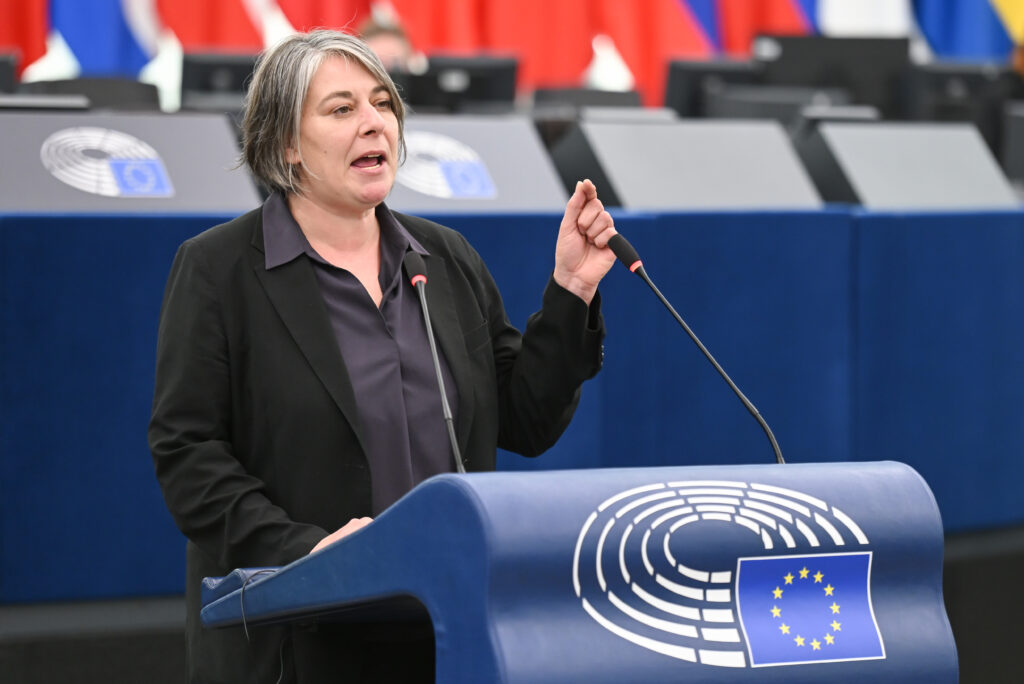
The EU’s credibility on the world stage is eroding as its commitment to international law increasingly clashes with its actions. From sanctions to humanitarian aid, its inconsistent approach is fuelling a culture of impunity, warns Cecilia Strada, an Italian Member of the European Parliament who is leading its work on a report on multilateralism.
As international rules come under increasing pressure, the European Union is struggling to reconcile its stated commitment to human rights with the way it deals with countries that violate them.
Ms Strada (S&D/IT), who is leading the European Parliament’s work on a report on multilateralism, argues that the problem is not a lack of diplomatic or legal tools, but the political will to use them consistently. “It is deeply saddening to be a Union of goods but not a Union of rights or foreign policy,” she says in an interview with EU Perspectives.
You are working on a report on the current situation of international law and the risks to multilateralism, democracy and the European Union. Why now?
I think this report is crucial right now because we are witnessing right before our eyes the collapse of things we once took for granted: the established international order and respect for rights, treaties, and institutions like the International Criminal Court. Clearly, everything is being called into question today.
My report comes from the Committee on Development, so I had to be careful not to stray into areas that fall under the Committee on Foreign Affairs mandate; the focus had to be on cooperation, humanitarian aid, and humanitarian space. But we inevitably arrive at that point anyway, because it is precisely within the humanitarian space that, in recent years, we have seen violations of international humanitarian law and international law on a scale I had frankly never witnessed in my life.
It is deeply saddening to be a Union of goods but not a Union of rights or foreign policy.
— MEP Cecilia Strada
I come from the world of humanitarian workers and NGOs, and I have seen how this has evolved. To give you an anecdote: when my son, who is 16 now, was little, I had to leave for a mission in Afghanistan. To reassure my family, I used to say: “Don’t worry, I’ll be at the hospital the whole time.” Then the United States bombed the Doctors Without Borders hospital in Kunduz, and patients burned to death in their intensive care beds. That came as a shock to everyone, because something like that should never happen.
An attack by a non-state actor is extremely serious, condemnable, even, and can constitute a war crime. But when it is a recognized state actor doing the bombing, the problem becomes even greater: all the rules go out the window. And this brings us to the present day, where in 2024 and 2025 we have recorded record numbers of humanitarian workers killed, including United Nations personnel. There is, therefore, a real need to restore order to the world we live in. And I believe it all hinges on one issue: the culture of impunity we are fueling. When established rules exist, including those governing war and international humanitarian law, and are no longer respected, particularly by recognized state actors, how credible can Europe be in enforcing them?
Some war criminals face consequences. Others don’t
Are there other tools available to restore order in such fragile and vulnerable contexts?
Yes, there is one tool: justice. Law and justice. The most serious problem I see is the double standard: some war criminals rightly face consequences for their actions, while others face none at all. This is appalling from several perspectives.
First of all, it is madness from the standpoint of our own security. When justice is denied to millions of victims, those left without it may turn to seeking revenge. This can fuel radicalization and a spiral of hatred. Justice is therefore essential because, in a climate of impunity, those who commit war crimes have no real incentive to stop.
We are speaking of international justice, which complements national justice systems and steps in where national courts have failed to act or are unable to do so.
If we fail to do this, we face at least two types of problems.
The first is fueling a culture of impunity, where civilians continue to fall victim to grave violations and war crimes. Clearly, no one stops until someone tries to stop them, until they face the consequences.
The second is the credibility of the European Union. The double standard is plain for all to see. Wherever you go outside Europe, people ask: “Why do you have all these sanctions packages against Russia but zero against the Israeli government?” We are clearly losing credibility.
We lose credibility with Putin, too, because we look like we’re all bark and no bite. And we lose it with Trump. What credibility can we possibly have when the Trump administration sanctions a few judges (Editor’s note: The US has imposed sanctions on judges of the International Criminal Court in early 2025. The order was widely perceived as intended as punishment for the arrest warrants issued by the court against Israeli PM Benjamin Netanyahu and former Israeli Defense Minister Yoav Gallant.), then nine, then eleven, and now threatens sanctions against the Court as a whole? That could mean the total paralysis of its operations. And we don’t react?
For at least 18 months, we have been calling on the Commission to activate the so-called “blocking statute” (Editor’s note: The EU’s blocking statute is a regulation designed to protect EU operators from the effects of certain extraterritorial sanctions imposed by non-EU countries. It prohibits EU companies from complying with specified foreign sanctions and allows them to seek compensation for resulting damages.) to protect the International Criminal Court.
We lose credibility with Putin, too, because we look like we’re all bark and no bite. And we lose it with Trump.
— MEP Cecilia Strada
Every time, the answer is: “We are ready to use all available tools.” Yet, you don’t actually do it. Consequently, this situation makes us look weak, in addition to dealing a devastating blow to the Court and the people working there. I also wonder how they can continue to believe in European institutions when they are abandoned in this way with devastating consequences for their personal lives, too.
For me, the key issues are impunity and double standards, along with a whole range of matters directly related to humanitarian aid: protecting humanitarian space, safeguarding the press in armed conflicts, and much more. What is missing is the political will to put tools into action.
A void to fill
One option allowed under EU treaties is a voluntary action by a group of member states, the so-called enhanced cooperation. Would that be an option?
A bloc of this kind, not limited to specific dossiers, but one that allows for advancing common positions even when there isn’t consensus among all members? That could be one way forward. As long as we are unable to amend the treaties to overcome for instance the right of veto, enhanced cooperation can serve as a useful tool.
Of course, it is deeply saddening to be a Union of goods but not a Union of rights or foreign policy.
Donald Trump’s decision to nearly shut down the USAID has created a void in humanitarian aid. To what extent can Europe fill that void?
To me, the decision to shut down USAID is quite baffling, given that it was one of the United States’ primary instruments of soft power globally. Even in remote corners of Afghanistan, places where people might never have seen someone with my complexion, you would still come across a USAID box.
It was a very shortsighted decision. That said, we need to fill that void, because the consequences have a tangible impact on the lives of tens of thousands of people, including aid workers.
Waiting for the barbarians
Dubravska Suica, European Commissioner for the Mediterranean, has repeatedly said that the EU should not merely be a payer, but an active player. How can that be achieved?
For me, there is no doubt: Europeans were, and risk remaining, non-players. And you remain a non-player as long as you let yourself be treated like a doormat by any third country that is hostile toward you or exploits you. At various points in our history, we have allowed ourselves to be blackmailed and treated like doormats by Israel, Libya, and Tunisia. And the Commission itself, not so long ago, continued to describe Israel as a “good partner.”
We submitted a written question asking if it was possible to quantify the value of the EU-funded projects that had been destroyed by the Israeli army. It was a significant amount of money. The figure was current as of 2024 and was likely already an “underestimate”. But after those projects were destroyed, what happened? Nothing. You keep calling them a good partner. So, frankly, why wouldn’t they destroy those projects again?
With what credibility can we ask a random country to join the Ottawa Convention if we ourselves are withdrawing from it?
— MEP Cecilia Strada
The Association Agreement could have been called into question long ago, yet things just keep going on as before. The Association Agreement is perhaps the most glaring example of this weakness on the part of the European Union. For a long time, the blame was placed on Orbán and everything happening within Europe. Then, at a certain point, we asked ourselves: “Take Orbán out of the equation.”
A poem by Constantine Cavafy, Waiting for the Barbarians, came to mind. The barbarians were almost a solution: the Senate didn’t pass laws because, after all, the barbarians would arrive and take care of everything. Then evening falls, and the barbarians haven’t arrived. So, what do we do now without the barbarians? And what do we do now without Orbán? We need to take responsibility. Yet, we aren’t doing so.
Demining or remining?
Moving beyond the Middle East, can we find more examples of the EU going backwards in terms of humanitarian principles?
The EU invests heavily in global demining efforts and urges other states to join the Ottawa and Oslo treaties. Meanwhile, five member states are leaving those treaties and want to resume producing landmines.
Aside from the question of responsibility toward the rest of the world for such a choice, with what credibility can we ask a random country to join the Ottawa Convention if we ourselves are withdrawing from it? These are contradictions that make no sense.
With what credibility can we speak of condemning violence against civilians in Sudan, Ethiopia, and elsewhere, if the Commission simultaneously approves “take-it-or-leave-it” packages regarding countries at high risk of money laundering — adding some and removing others in a single act?
I find this problematic from a procedural standpoint as well, because I would like the freedom to say: “I want to keep Russia on the list of high-risk money laundering countries, but I do not want to remove the United Arab Emirates.” Instead, we remove them. Yet the United Arab Emirates is one of the main hubs through which gold laundering linked to the financing of the war in Sudan passes.
And then there is the issue of what will happen with return hubs in third countries. There, too, we risk violating people’s human rights while simultaneously becoming vulnerable to blackmail by these countries. What will happen when they demand even more than what they are already asking for in exchange for accepting the citizens we deport?
Therefore, respect for the law and human rights is not merely a matter of justice towards others; it is also a matter of prudence and security for ourselves. Yet, it seems to me that this perspective is lacking, at least within the institutions.