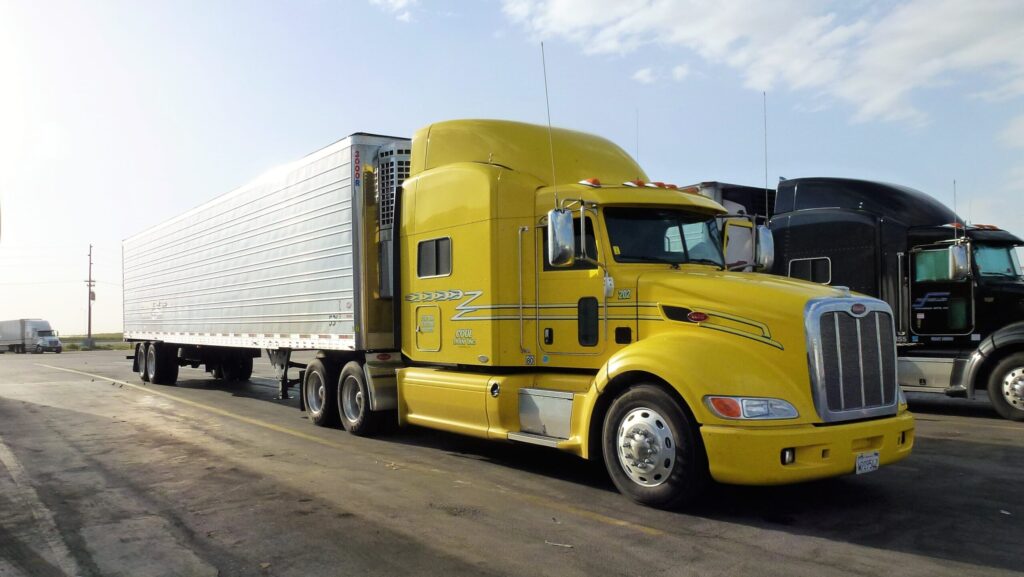
Europe’s truckmakers want the EU to give them three more years to meet key CO₂ targets. They argue that electric trucks are ready but the charging network, power grids and customer demand are not.
Zero emission models currently account for around 2.4 per cent of new heavy duty truck registrations, according to the European Automobile Manufacturers’ Association (ACEA). By 2030, the industry says that figure would need to rise to roughly one in three new trucks to meet the EU’s carbon targets. “The vehicles are ready. Now the conditions around them have to catch up,” the association says.
ACEA wants the compliance point moved to 2033. The request could reopen a sensitive debate over how quickly Europe can decarbonise road freight without putting too much pressure on one of its major manufacturing industries.
A transport operator does not buy a truck simply because the technology exists. They buy it if they can operate it reliably and profitably. — ACEA
The debate comes as MEPs prepare to vote on Wednesday on new rules governing the CO₂ classification of heavy-duty vehicles with trailers, including how the classification feeds into road charging.
Electric trucks struggle to attract buyers
ACEA argues that technology is no longer the main obstacle. Manufacturers can produce electric and other zero emission trucks, but transport companies still need a strong business case to buy them.
Heavy duty transport is a highly competitive industry with tight margins. Electric trucks generally require a higher upfront investment, while operators also need reliable charging and sufficient grid capacity. “A transport operator does not buy a truck simply because the technology exists. They buy it if they can operate it reliably and profitably,” ACEA claims.
According to the association, many of these issues vary greatly depending on location within Europe. For example, zero-emission trucks make up less than one per cent of new registration in countries such as Poland, Spain, and Italy.
In other markets, including Sweden, the Netherlands, Austria and Denmark, their share ranges from seven to ten percent. Outside of the EU, zero-emission models account for 24 per cent of new truck sales in Switzerland and 14 per cent in Norway.
These statistics highlight a challenge that EU policymakers face. A transition that works in one country may prove more challenging in another.
Charging network needs to catch up
Infrastructure sits at the centre of ACEA’s case for delaying the deadline.
The association says Europe currently has fewer than 1,000 dedicated heavy duty vehicle charging points, alongside around 2,500 chargers suitable for trucks. ACEA wants Europe to add at least 500 dedicated truck charging points every month until 2030.
Those three additional years cannot be three years of waiting. They must be three years of delivery, with clear milestones and accountability for closing the gaps in the enabling conditions. — ACEA
But installing chargers alone will not solve the problem. Public charging stations require access to large amounts of electricity to charge heavy duty vehicles.
Additionally, ACEA reports that trucking operators often experience delays for months or even years to gain access to the necessary grid connections. “A market transition cannot succeed with just one actor financially responsible for whether the entire ecosystem delivers,” it argues.
Three more years, but not for waiting
ACEA insists that moving the compliance point to 2033 should not mean putting the transition on hold. “Those three additional years cannot be three years of waiting. They must be three years of delivery, with clear milestones and accountability for closing the gaps in the enabling conditions,” the association states.
It calls for all 27 EU countries to apply CO₂ based road tolls consistently and fully exempt zero-emission trucks during the early stages of the transition.
ACEA also wants faster grid connections and changes to EU rules on vehicle weights and dimensions. Electric trucks can carry extra weight because of their technology, which can reduce the amount of cargo operators can transport.
ETS2 adds another piece to the puzzle
ACEA points to the EU’s second Emissions Trading System (ETS2) which will put a carbon price on fuels used in road transport and buildings. The association says the system should start in 2028 and help improve the economic case for cleaner transport.
ETS2 without reinvesting the revenues in infrastructure and transition support, would just mean higher fuel costs for operators without them being able to switch to zero-emission. — ACEA
“ETS2 without reinvesting the revenues in infrastructure and transition support, would just mean higher fuel costs for operators without them being able to switch to zero-emission,” the association claims.
The industry also wants the EU to complete its long running revision of rules governing truck weights and dimensions. ACEA argues that the measures need to arrive together. A charging network is of little use without grid capacity, while cleaner trucks will struggle to attract buyers if operators cannot run them competitively.
Would a delay slow the transition?
Whether an extension would hinder progress is expected to remain at the center of debates surrounding the industry’s call for a delayed deadline. An extended timeline may enable infrastructure and demand to develop more rapidly. However, it may also prompt concerns about whether reducing the level of urgency associated with investing in low emission vehicles and charging could deter such investments.
According to ACEA, manufacturers have already invested substantial sums in zero-emission technologies and introduced products into the marketplace. Based on ACEA’s position, establishing a fixed timeline while other components of the system continue to lag behind represents greater investment risk rather than less.
The association also stresses that 2033 offers no guarantee. Any additional time should come with clear targets for charging infrastructure, grids and economic measures. For now, ACEA’s proposal shifts the debate away from whether Europe can build zero emission trucks. The harder question is whether it can build the market, infrastructure and economic conditions needed to put them on the road at scale.