Poland and Norway spoke bluntly on Russia, Ukraine and Washington in Warsaw. Germany stayed guarded, Britain stuck to generalities, and Europe’s own weight was the question.
The crème de la crème of European diplomacy—foreign ministers of countries boasting the continent’s two largest militaries, and two close defence partners of the EU—gathered in Warsaw on Tuesday. Cracks in their resolve to find unity began to show.
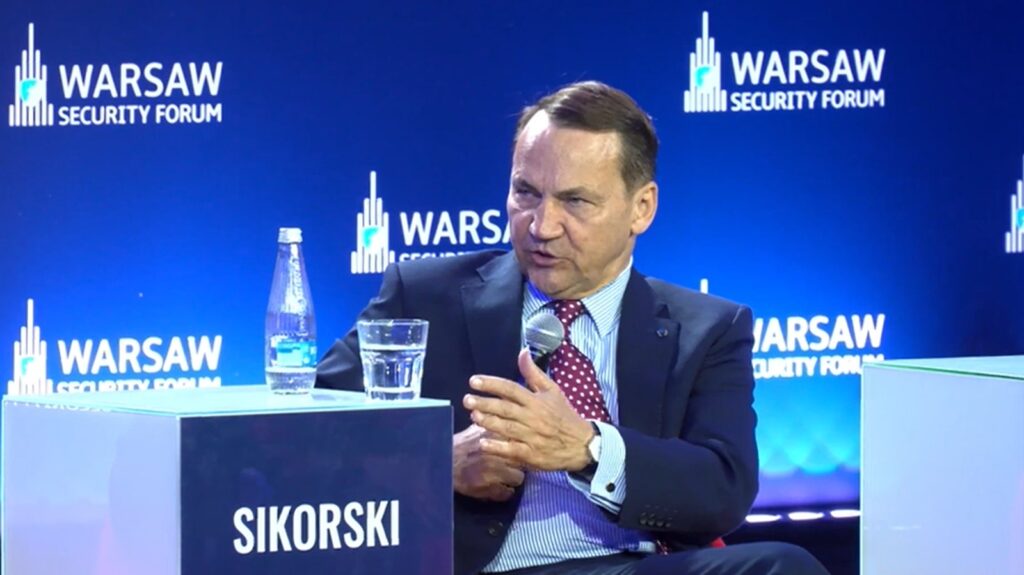
Radosław Sikorski, the foreign minister of Poland, has an unequivocal message for those who think Russia might eventually get its EU-frozen assets back. He dismissed rumours that some officials expect this money, about €300bn in all, to be returned to Moscow. “I don’t think I’m speaking just for myself in saying — over our dead bodies,” said Mr Sikorski during a panel discussion at the Warsaw Security Forum on 13 October.
I’m not so sure that Putin really thinks that he’s going to win the war. — Johann Wadephul, Germany’s federal foreign minister
The talk focused on the return of power politics to a continent between war and rivalry. A decision from the US President Donald Trump to cut a deal with the Kremlin, a move known as the diesel deal, transfixed the room. This has left European leaders scrambling for a unified response.
Mr Sikorski argued that Poland must use its influence in Washington to secure a permanent base in the East-European country’s territory. But most of all, he wants to remind the Americans that in the Russo-Ukraine war, Russian leader Vladimir Putin is the aggressor. “And you end the war by persuading the aggressor to limit his level of ambition, not by asking the victim to capitulate,” said Mr Sikorski.
A continent in the crosshairs
Minister of Foreign Affairs Espen Barth Eide of Norway sounded a similarly resolute note. He argued that Europe must take a leading role in any future negotiations. “It doesn’t really make sense that the people who are not paying much for supporting Ukraine are those who have the key role in negotiations,” said Mr Barth Eide.
The Norwegian minister noted that the global economy is shifting away from efficiency. Security of supply is now the priority. This change, which will lead to lower growth, is a reality that Europe must accept. Mr Barth Eide described this as a shift from a just-in-time model to a just-in-case economy.
He found reasons for optimism in the survival of the Ukrainian state. Despite the invasion, the government in Kyiv remains in control of most of the country. “The fact that Ukraine is there, eighty per cent under democratic control of an elected government, is already a very strong sign of this resolve,” said Mr Barth Eide.
The weight of caution
Federal Foreign Minister Johann Wadephul of Germany was careful to the extreme. He seemed hesitant to judge the state of mind of Vladimir Putin. When asked if the Russian leader believed he was winning, Mr Wadephul hedged. “I’m not so sure that Putin really thinks that he’s going to win the war,” said Germany’s top diplomat.
It doesn’t really make sense that the people who are not paying much for supporting Ukraine are those who have the key role in (the peace) negotiations. — Minister of Foreign Affairs Espen Barth Eide of Norway
Mr Wadephul had recently met Sergei Lavrov, his Russian counterpart, in New York. The German described the encounter as dire. He insisted that the result showed Russia is not ready for a ceasefire. “This is not the time to lower the sanction regime, but to strengthen it,” said Mr Wadephul. He pointed to new European sanctions against 1,600 entities.
Secretary of State Ed Miliband of the United Kingdom mostly resorted to soothing platitudes. He spoke of the importance of sending the right messages. He suggested that Europe should take up the idea of a full energy ceasefire. This would expand on the more limited ‘refinery ceasefire’ proposed by Donald Trump.
The battle for values
Mr Miliband relied heavily on platitudes when asked about the future of the continent. He could not describe the world his children would inherit. “I don’t have a crystal ball, but I know what we need to do and that is to fight for our values,” said Mr Miliband. He called the role of Europe “fundamental”. He did not specify either the values or what makes the nature of Europe’s role fundamental.
Mr Sikorski was nowhere near as vague about the long-term outlook for European security. He argued that Russia is not as powerful as it often seems. If European nations meet their defence pledges, they will build a military force that Moscow cannot beat. He urged his colleagues not to be panicky about the threat from the East.
The stakes are high for the status of the continent in the global order. Mr Sikorski warned that Europe must not become a mere bystander. “What’s at stake is not whether we will be occupied,” said the Polish minister. “It is Europe’s status in the global division of power, whether the triumvirate that is trying to divide the world into spheres of influence is composed of the United States, China and Russia. And then we are just suppliers of data and, and tourist attractions; or whether we are that third leg (of the triumvirate). And don’t ask me which I prefer.”
Humanitarian imperatives
The panellists sought to show that unity can still be the greatest asset of the West — if it has any unity left in it. Despite the friction of a confederation, leaders are making decisions. Nations are moving billions to upgrade defence industries. The message to Mr Putin is clear. Europe is consistent in its support and will continue to be so, irrespective of others.
The humanitarian dimension also remains a pressing concern. Mr Sikorski noted that accountability for war crimes is essential. This includes addressing the stealing of children and cultural erasure in occupied territories. Winning the war is a prerequisite for justice. Only then can a subsequent Russian government send those criminals to the Hague.
I don’t think I’m speaking just for myself in saying — over our dead bodies. — Radosław Sikorski, Poland’s foreign minister
Economic resilience is the final piece of the puzzle. Europe remains dependent on China for rare earth minerals. Mr Wadephul argued for a de-risking strategy to reduce this over-dominance. This will take time. However, the shift to a security-oriented economy is already underway. It is a necessary price for a continent between war and rivalry.
Stability versus regime
Mr Wadephul closed by arguing that the democratic system is inherently more stable than the Russian regime. He believes that the rule of law will prevail in the end. “In the long run, our values, our system of democracy, rule of law is more stable than this regime,” said the German minister, without offering much by way of factual support for his claim. One way or another, however, he remains optimistic.
The panel concluded that the real battle is one of commitment. Mr Barth Eide noted that values must sometimes be defended by force. “The real battle is whether we can keep up the fight for those values,” said the Norwegian. The future of the European security order depends on whether that resolve can be maintained.
The discussion in Warsaw highlighted a continent at a crossroads. While some leaders offer only words, others are preparing for a long struggle. The outcome of the war in Ukraine will cast a long shadow. Europe must decide if it will fight for leadership or if it merely follows, like in the case of the diesel deal, the decisions made in mightier power centres.