European governments keep debating how much to spend on defence. A panel in Warsaw suggested the real issues lie elsewhere: how to spend, and with whom.
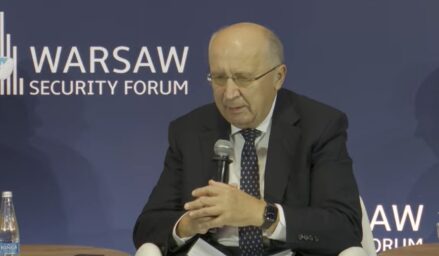
The panellists at the Warsaw Security Forum on 13 October shared a premise that security and growth feed each other. Poland spends close to five per cent of GDP on defence, said Polish Finance Minister Andrzej Domański. “You need a strong economy as there is no security without a strong economy.”
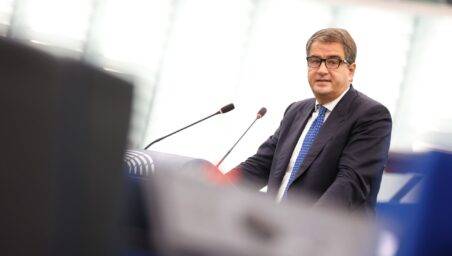
The discussion entitled Securing Europe’s Economy for a Fragmented World brought together Mr Domański, Piotr Serafin, European commissioner for budget, anti-fraud and public administration, and Guntram Wolff, professor of economics at Université Libre de Bruxelles and senior fellow at Bruegel. Maria Tadeo of Euronews moderated.
I think (the Trump-Putin diesel deal) is horrible news and it casts a lot of doubt about whether the United States is still an ally or not. — Guntram Wolff, Bruegel
Poland, the Polish minister said, is the fastest-growing economy in Europe. He expects tax revenues to rise by double digits next year. Even so, Poland runs a high deficit — and Europe, he argued, must not sacrifice long-term security for short-term economic gain.
No way back to Russia
The session opened with a jolt. Three weeks ago, the US announced a deal to buy Russian diesel. Ms Tadeo asked whether European sanctions policy could survive it. Mr Wolff gave the harshest verdict. “I think it’s horrible news and it casts a lot of doubt about whether the United States is still an ally or not,” he said. American voters, he said, would see no material difference. The deal plays into the hands of Russian President Vladimir Putin, he added.
Europe’s response is more sanctions. Mr Serafin said foreign ministers were meeting in Brussels on the biggest package yet, covering nearly 1,600 entities and individuals. Mr Domański said sanctions work. Russian growth is falling, inflation is rising, and defence takes a bigger share of the budget.
Both men said Europe had learnt its lesson. “Being addicted to cheap Russian gas was one of the reasons that made Russia stronger,” said Mr Domański. “We have understood that there is no cheap Russian gas or cheap Russian oil,” said Mr Serafin.
The budget squeeze
Money, however, is scarce. The Commission has proposed a budget of 1.26 per cent of gross national income. The budget agreed seven years ago was 1.15 per cent. Mr Serafin rejects the claim that the new figure is a massive increase.
The Irish presidency has offered a compromise. Mr Wolff said it brings the budget down to around 1.1 per cent. It does so, he argued, at a cost. “Now it has achieved that by basically cutting the future-oriented parts of the budget.”
I don’t think that we will find a resolution by the end of the year. — Piotr Serafin, European budget commissioner
Mr Serafin said the Commission dislikes those cuts. He recast the argument as a choice about pooling resources. “I think it’s high time to realise that individually, neither of our nation states will be able to face those challenges.”
He expects a deal by the end of the year. Late agreements, he said, have meant up to two years of lost investment. Mr Wolff proposed a trade-off: deeper cuts to agriculture and cohesion spending, to protect defence and competitiveness.
Borrowing and the social contract
Joint borrowing came next. Mr Wolff said rolling over existing joint debt would give some room, but would not close the substantial gaps. He backed new joint debt for long-term European investment, such as satellite infrastructure.
Mr Serafin, who also sells EU bonds, said they attract growing interest from investors outside Europe, including in Asia. Talks on new issuance, he admitted, are not going well. Only support for Ukraine goes uncontested.
Mr Domański backs joint debt if it pays for defence. He said some countries free-ride on the security others provide. Loans from the SAFE programme, he said, are much cheaper than Polish borrowing. Even so, he noted, debt remains debt.
Does heavy defence spending fit Europe’s social contract? Mr Wolff said it does, if welfare stays intact. Pointing to German numbers, he said: “No single euro is taken away from pensions, no single euro is taken away from the social system to fund military.”
Buying European
Quality of spending worries Mr Wolff more than quantity. “We see a lot of investment still in outdated and old military technology.” He also warned against buying American. “Buying only from the US the high tech stuff is not going to deliver the growth that we need.”
Mr Domański wants a European preference. “And some kind of preferences for European companies are absolutely needed.” He is sceptical of some carbon-footprint rules—which he said would not serve companies investing in Poland—and wants the scheme not to discriminate against them.
Being addicted to cheap Russian gas was one of the reasons that made Russia stronger. — Andrzej Domański, Poland’s minister of finance and economy
China tests that unity. Mr Serafin said the Commission’s talks with Beijing are only a first step. “I don’t think that we will find a resolution by the end of the year.” Mr Wolff saw a gain. “I think on China, what we’ve really seen is the power of the united Europe.”
Mr Domański attempted to close the session on a less gloomy note. Europe frets about American tariffs, he said. “But internal barriers that we have within the European Union are much, much higher.” He cited an International Monetary Fund report putting them above 40 per cent on goods and above 100 per cent on services. Whether that is an optimistic statement or not is open to interpretation.