The European Union wants one air-and-missile defence system instead of many national ones. The project, to be ready by 2040, is to cost between €55bn and €80bn.
The Council of the EU endorsed the project named the EU-FIAMD in late September as one of five European Defence Projects of Common Interest. Council decision 2026/2221 clears it for money from the European Defence Industrial Programme. The first five projects receive €325m in 2026 and 2027. The EU-FIAMD (EU Federated Integrated Air and Missile Defence including Early Warning) is expected to absorb the largest share.
The aim is a multi-layer, Europe-wide architecture. It would link space-, air-, land- and sea-based sensors to interceptors. Those interceptors must defeat cruise, ballistic, and future hypersonic threats. It is an amalgam of existing and newly born parts, not a single new defence system. It would connect national sensors, interceptors, command-and-control systems, procurement, testing, and training, with NATO interoperability as a design goal.
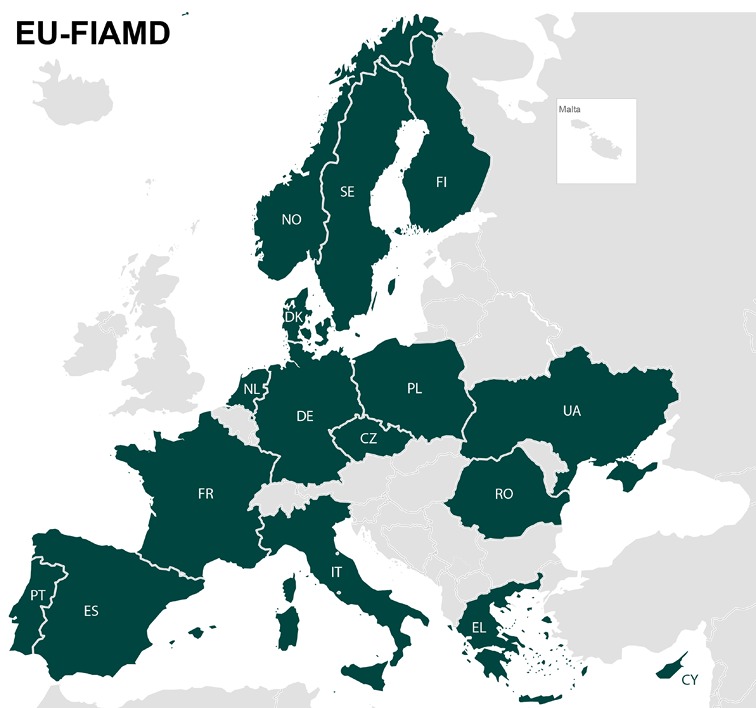
The Commission proposal listed 16 countries: Czechia, Denmark, Germany, Greece, Spain, France, Italy, Cyprus, the Netherlands, Poland, Portugal, Romania, Finland, Sweden, Norway, and Ukraine. The later implementing-act record adds Bulgaria, Hungary, and Austria. That brings the total to 19.
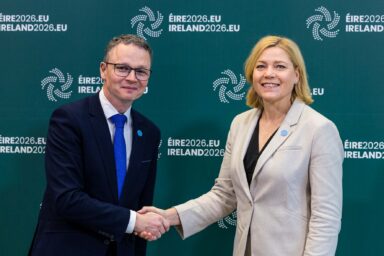
“These projects further demonstrate the practical cooperation between EU member states to provide for our own security,” said Irish Foreign and Defence Minister Helen McEntee, whose country holds the rotating presidency of the Council of the EU.
Six names, one caveat
Ms McEntee also stressed the role of partners. “Working closely with our partners Norway and Ukraine, together we are taking decisive steps to protect space, our skies, our seas, undersea cables, and our citizens who depend on them,” she said.
For Ukraine, the stakes are practical. Its weakness lies in anti-ballistic missile defences, and it braces for a new wave of Russian missile strikes this winter. By comparison, the drone and counter-drone project, DECODER, should cost €3.5bn to €5.5bn. It is the cheapest of the five.
These projects further demonstrate the practical cooperation between EU member states to provide for our own security. — Helen McEntee, Ireland’s foreign and defence minister
New interceptors, advanced sensors, secure command-and-control, and scalable production are all needed. No single company can deliver them alone — so six European primes feature most prominently, according to the background material. They are MBDA, Thales, Diehl Defence, Hensoldt, Saab, and Leonardo. These six, however, are potential suppliers, not confirmed members of any consortia — yet.
MBDA appears as the missile-system prime for the future endo-atmospheric interceptor, which would form the hit-to-kill layer. It leads the HYDIS/AQUILA studies, which the European Defence Fund pays for. These now feed the larger FIAMD work strands.
Interceptors and launchers
The fund’s 2026 work programme assigns €100m to mature the interceptor to technology readiness level six. MBDA heads a consortium that also includes Airbus, Diehl, Hensoldt, Kongsberg, Indra, and Saab.
The MBDA interceptor would use a dual-pulse motor and high-agility control surfaces. Both help it kill manoeuvring targets. A plug-and-fight architecture would let the missile fit naval vertical launch cells and truck-mounted launchers alike.
Under the fund’s interceptor contract, Diehl supplies propulsion components. Hensoldt provides the seeker and the mid-course uplink. Saab develops algorithms. National co-funding comes mainly from France, Italy, and Germany. The exact split is not yet published.
Diehl brings its IRIS-T SLM and a forthcoming interceptor with a range of 40km. Together they form the short- and medium-range layer. Diehl is also co-design authority, with MBDA, for the new missile warhead and canisterised launcher.
Sensors and data
Diehl’s open-mission-system launcher would auto-align to any NATO fire-control radar. A common missile stockpile would serve national and pooled EU inventories. Diehl and Hensoldt signed memoranda as early as in April 2022, and later in June 2025. These formalise joint product baselines and a software-defined ground-based air-defence road map aimed at FIAMD requirements.
Hensoldt is cast as the prime European sensor house. It supplies TRML-4D fire-control radars and passive emitter-locating arrays. Together they populate the sensor tier of the shield. Hensoldt also leads the task of federating sensor data. That means merging distributed tracks into a single recognised air picture. It has long teamed with Diehl on the IRIS-T SLM, and it cooperates with Leonardo on future multifunction AESA radars.
Thales supplies long-range 3-D surveillance radars of the GM-400 family. They feed the federated sensor grid. Its technologies include digital RF beam-forming, AI-assisted clutter suppression, and cross-domain data-fusing algorithms. Its interfaces would expose sensor data through the future NATO-compatible AirC2 over IP standard.
Saab, Leonardo and the shield’s layers
Thales also offers the TrustNest R-Suite secure cloud workspace. The Commission chose it as a pilot digital backbone for classified cooperation. A €6m strand of the industrial programme finances the pilot in 2026 and 2027. Radar-upgrade contracts with Finland and Estonia serve as early sensor nodes.
Saab sits in the MBDA-led consortium. It contributes seeker-tracking software and system-simulation expertise. Its Giraffe 1X/G4A multi-mission radar family is slated for mobile point-defence batteries. Saab has proven real-time sensor-to-shooter loops in the Swedish Air-Defence Battalion. That experience feeds the command design. Its open-API philosophy also fits the federated nature of the project.
A 2026 European Parliament study identified Leonardo, alongside MBDA, Diehl, Hensoldt, and Saab, as a prime contributor to a future fully European air-defence architecture. Leonardo bought a 25.1 per cent stake in Hensoldt in 2021.
The Italian company also sits in the Eurosam consortium with Thales and MBDA. Through it, Leonardo offers the SAMP/T NG as an upper-tier solution that fits the layered architecture. That proposal is under evaluation for industrial programme funding. Leonardo adds Kronos multifunction AESA naval and land radars, and missile-command channels designed for plug-in federation.
A shield for the 2030s
A related but distinct initiative, the Freya anti-ballistic-missile programme, brought together representatives of MBDA, Thales, Saab, Diehl Defence, Hensoldt, and Leonardo, among others. While this does not constitute a formal EU-FIAMD membership, it further documents industrial engagement in European missile defence.
Progress is slow. Contracts so far are mostly preparatory—studies, prototypes, and a digital backbone—and they channel about €100m plus national co-funding. Full-scale development contracts are expected in 2027 and 2028, once the budget is final. A largely sovereign, layered shield could follow in the early 2030s.
The arrangement is designed to ensure cover for the years before the EU-FIAMD system is fully operational, i.e, by 2040. If there is any European Union to defend, that is.