Serbia’s student-led election win has reopened the Union’s door, but Brussels says membership now hinges on rule-of-law reform, sanctions on Russia, and Kosovo.
Serbia’s longtime leader, Aleksandar Vučić has conceded defeat. The Student List, a movement born of street protests, won Sunday’s parliamentary election. Preliminary projections give it roughly 135-140 of 250 seats, a comfortable majority. The result could revive Serbia’s stalled bid to join the European Union.
Brussels moved fast. European Commission President Ursula von der Leyen congratulated the Student List on X. “We stand ready to support reforms on the rule of law, media freedom, the fight against corruption and strong democratic institutions, and to work together to advance Serbia’s future in the European Union,” she wrote.
Enlargement Commissioner Marta Kos tied the result to almost two years of protests. “Serbia has raised its voice,” she said. “A new chapter can begin for Serbia. The doors of the European Union are open.”
Warm words come with conditions. EU leaders offered support for reforms of the judiciary, media, anti-corruption measures, and democratic institutions. Rule-of-law reform will be the first test. The government must show independent courts, credible corruption investigations, fair elections, and less political control over public media.
Hard work to follow celebrations
Mr Vučić accepted the verdict on election night. “We still do not have final results,” he told supporters in Belgrade. “On the basis of a sample … it is clear that we have lost these elections, the Student List has won, they will have between 135 and 140 seats and we will have 105.”
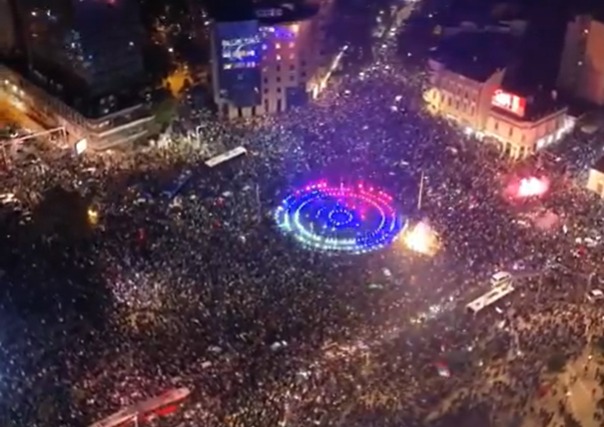
Celebrations erupted in Belgrade and other cities. “This feels like New Year’s Eve to me, like three New Year’s Eves all at once, really,” said Ivana, a 43-year-old Belgrade resident. She hopes for swift accountability for the ousted regime’s top members.
We stand ready to (…) work together to advance Serbia’s future in the European Union.
— Ursula von der Leyen, European Commission president
Some voters were more cautious. “I’m not completely sure what our candidates will do first, but I think first for tonight, we’ll celebrate. And then tomorrow, the real hard work starts,” said Jana Vasic, a Belgrade voter.
Serbia has been a candidate since 2012 and began negotiations in 2014. The process has largely stalled. The reasons include rule-of-law concerns, media freedom, corruption, electoral standards, limited alignment with EU sanctions on Russia, and the unresolved Kosovo normalisation process.
Standards matter
The numbers show the accession drift. Of 35 negotiating chapters, 22 are open and only two are provisionally closed. In July, eight member states led by the Netherlands vetoed the opening of the third cluster of chapters. They cited rule-of-law worries and Belgrade’s refusal to align with EU sanctions on Russia.
The election removes a political obstacle, but not the technical benchmarks. Brussels has long flagged the judiciary, fundamental rights, media, and corruption. None of these will be settled by a change of government alone.
Electoral standards matter, and the vote itself was flawed. Raša Nedeljkov of the monitoring group CRTA said that “A large number of irregularities continue to be recorded, while violent incidents outside polling stations are also becoming increasingly frequent.” Brussels is likely to want an electoral-law overhaul in line with OSCE/ODIHR recommendations.
The new government is likely to enjoy a single-party majority. It can pass constitutional and legislative changes quickly. The harder part is implementation and a track record. These are normally reviewed in the Commission’s spring and autumn enlargement reports.
Tests beyond the courtroom
Foreign policy is murkier. The Student List is a broad movement. Its platform has focused on domestic democratic reform, not a fully defined geopolitical alignment. Victory does not automatically mean a break with Russia and China.
Sanctions are the sharpest issue. Serbia is the only negotiating country not aligned with the EU’s Russia sanctions. Berlin, Paris, and Warsaw have made alignment a de facto precondition for moving forward with new negotiating chapters. Kosovo is another hurdle. Hard-line positions, continued ties with Moscow, and proposals for a membership referendum could all delay talks.
The doors of the European Union are open.
— Marta Kos, EU enlargement commissioner
China adds complexity. Serbia hosts a large Chinese steel plant and sees a Huawei 5G roll-out. The EU would probably ask for investment-screening rules and environmental upgrades. A clean break looks unlikely. Greater transparency and EU co-financing alternatives are the more plausible path.
Member states are split on pace. Germany is pro-enlargement but wants irreversible reforms and progress on Kosovo. The Netherlands wants action on the judiciary and media before any green light. France favours a phased model and wants alignment on Russia.
Who wants speed
Others want haste. Hungary urges rapid accession. Poland, Croatia, and Slovenia favour acceleration to strengthen the EU’s weight in the Western Balkans. Austria and Italy, tied to Serbia through banking, energy, and manufacturing, want quick progress. They also demand credible anti-corruption convictions.
The calendar offers an early test. An extraordinary intergovernmental conference could be held as early as the 25 November EU-Western Balkans summit. It would aim to unblock the third cluster, if Belgrade takes early confidence-building steps. The likeliest outcome—a conditional thaw—would see Brussels reward credible reforms while tying chapters to measurable progress.
A 12-month reform sprint could, in the best case, allow the first fundamentals chapter to close provisionally by mid-2028. Membership might then come into reach around 2030. That assumes Russia and Kosovo do not become veto points. Voters have given the students a mandate; whether it becomes institutionally solid will decide if this is a genuine thaw, or the freeze returns as the novelty wears off.