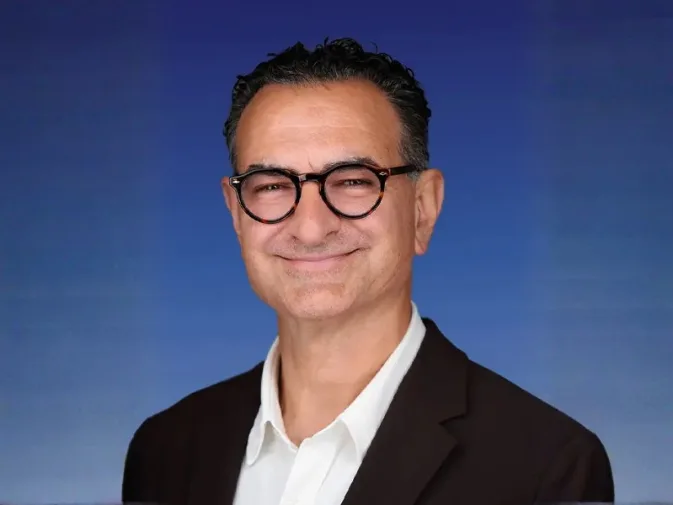
Actithera, a US start-up developing radiation-based cancer drugs, raised most of its $75.5m from European investors and runs its labs in Oslo. Yet it will treat its first patients in Australia. Its founder Andreas Goutopoulos told EU Perspectives that Europe makes early trials too hard to start.
Actithera’s money came mostly from Europe. The radiopharmaceutical start-up closed an oversubscribed $75.5m Series A round in July 2025. Eight of its nine investors are European, says Andreas Goutopoulos, the company’s founder, president and head of R&D.
It set up its preclinical labs in Oslo. There it found lab space with all the equipment and permits within weeks of closing the financing. About half of its 25 staff work in Europe.
Yet its first clinical trial will run in Australia, with a US trial expected to follow soon after. Europe comes later, because “some of the regulatory barriers in Europe are a little higher”, Mr Goutopoulos says.
Actithera develops radioligand therapies. These cancer drugs deliver radiation to tumours, using molecules that bind to tumour-specific proteins on the surface of cancer cells. Mr Goutopoulos, a former head of chemistry at the US subsidiary of German drugmaker Merck KGaA, founded the company in 2021. It is now based both in Cambridge, Massachusetts, and Oslo, Norway.
His ask to European policymakers is specific: make it easier to start early imaging studies with radiopharmaceuticals. We spoke to him at Nordic Life Science Days in Stockholm in September.
From big pharma to a one-person company
You founded Actithera five years ago. What led you to it?
I started the company five years ago, in July 2021. Before that I was in big pharma, with Merck Germany, Merck KGaA, for many years, but always in the US, where the company is known as EMD Serono. I used to be the US Head of chemistry for the company. Along with my group, we put more than a dozen compounds in the clinic, so I learned a lot in that role.
Eventually I wanted to move to the biotech side, where things move a little faster and it’s more dynamic. So, at first I worked with M Ventures, which is the VC arm of Merck, as an entrepreneur-in-residence. I helped the fund with company creation and investment decisions. Then, I also joined one of the M Ventures portfolio companies as their CSO [chief scientific officer]. Ultimately, I wanted to start a company on my own, with some new exciting ideas. I looked at various options over time, and in the end, I got excited about radiotherapeutics.
What are radioligand therapies, and why this field?
Radiotherapeutics or radiopharmaceuticals is a new class of anti-cancer drugs that deliver radiation to tumours using molecules that bind to cancer-specific proteins on the surface of tumour cells. It’s an exciting new area. Some of the very first targeted radiotherapeutics are now on the market and performing really well. Pluvicto, the most important such drug, is now making a big difference in the treatment of metastatic prostate cancer, and it’s already moving to earlier lines of treatment.
To start in this area, I identified certain areas in this space that were open opportunities, especially things that could take advantage of my training and my experience in the oral drug space. I thought that there were some concepts that I could transfer to this new area. As I looked deeper, it seemed that nobody else was doing this exact type of work. As often happens with new areas, radiopharmaceuticals appeared to be a very fertile area for innovation. These ideas at the end became the basis of Actithera.
How did you get started?
With a small seed from two VCs, M Ventures and Arkin Bio Ventures. M Ventures is based in Europe. It’s the VC arm of Merck. Arkin is in Israel. I knew them because the small biotech company I worked for before had ties to Israel. We started with a small seed of $5.3 million and I hired a radiochemist to help me. So, it was basically a two-person company. We designed molecules for several targets, and with the help of contract research organisations and academic collaborators, we generated data.
Some of that data was really good, especially for our FAP target, fibroblast activation protein, which is expressed in the microenvironment of many tumours. We had molecules that looked a lot better than some of the clinical-stage compounds in the space, when we tested them head-to-head in animals. We shared these results with several key opinion leaders, who all encouraged us to take this compound to the clinic.
And then you had to raise money?
At the same time, unfortunately, we were running out of money. My colleague also went back to academia, so it was basically just me, a one-person company, and we had to go out and fundraise. It was a very, very difficult funding environment two years ago. I ended up speaking to more than 250 investors, over at least one year, probably more.
I ended up speaking to more than 250 investors, over at least one year. — Andreas Goutopoulos, founder of Actithera
That must have been almost a full-time job?
It was. But in the end, we prevailed. I think the fact that we had ideas that were rather simple, but still novel, and the fact that we had strong data supporting those ideas and concepts allowed us to make progress with investors.
At the end, it was Hadean Ventures, here in Sweden and Norway, that offered us the very first term sheet. After that, we had a long syndication period in which we were able to attract additional investors, including some major funds. Finally, we closed the Series A round in July of 2025, with an oversubscribed $75.5 million investment from nine investors. Eight of them were from Europe and one from the US.
A US company with European money
So Actithera is a US company, funded mostly by European investors?
We are a US company. But paradoxically, we got funded by mostly European investors. I think that had to do with the fact that our seed investors were European. That was one of the factors. Another factor was probably that at the time of our fundraising, US investors were really not giving money out. It was very, very tough. At least that’s how it worked for us, because normally it’s the opposite: European companies often look to the US.
We tried in the US too, but we just didn’t get as much traction. We got traction towards the end, but it was a little too late. In any case, we are very happy with our syndicate. We have some big investors and medium and small investors, plus a big cross-over fund from the US in the mix.
What has happened since the round closed?
Since July 2025, we built the company out. It was just me in the company back then. Now we’re 25 FTEs [full-time employees], almost a full team. We also started a site in Europe.
Our European investors encouraged us to look at some options for having a site in Europe, and we looked at various possibilities. We chose Oslo because it has a really fantastic ecosystem in the radiopharmaceutical space. It was the right environment, with very well-trained scientists in this area. Within weeks after we made the decision, it paid off, because we were able to find lab space that had all the equipment and all the permits we needed to work with the radioactivity. That allowed us to move quickly, establish our work there and hire some excellent scientists.
First patients in Australia
Where do you stand clinically?
While we were building the company, we were at the same time making progress with our portfolio. Most notably we were able to successfully file our first regulatory filing to start clinical trials in Australia. A few weeks later we got allowance from the FDA to start a clinical trial in the US too. We are expecting to have our first patients enrolled in our Australian trial within the next days. The US trial will follow shortly after.
Why Australia?
One reason is that Australia has excellent expertise in the radiopharmaceutical space. They have hospitals with very good nuclear medicine departments with cutting-edge equipment. Several key opinion leaders are also based there. But there are also some significant incentives, tax incentives, in Australia. And finally, the regulatory environment is very conducive to early clinical trials, especially in the radiopharmaceutical space. That makes it a lot easier to move faster as you start. That was particularly helpful for us, being a small company.
How does that compare to the US and Europe?
We also filed in the US a few weeks later. We received the OK to proceed from the FDA as well and now we are preparing to start our US trial. In Europe, we’ll come a little later. I think some of the regulatory barriers in Europe are a little higher, that is why we could not start there. For us, speed is key. It is critical for us to generate clinical data quickly. We’re working in a very competitive area, so moving early into the clinic, into the early clinical trials, rapidly was the key driver.
The pipeline
What comes after your first candidate?
We haven’t stopped there and have an exciting early portfolio of carefully selected targets. The company made a lot of progress in advancing this early portfolio over the last year. We expect to have our second clinical candidate selected in the next few months. We have a very strong basis for other programmes as well, so hopefully we’ll have more candidates coming in 2027 and 2028.
When could these therapies reach patients?
2030 and beyond. Clinical development takes time. But we’re confident we’ll have molecules that will make a difference in the clinic.
Our first target, FAP (fibroblast activation protein), has been very recalcitrant. A lot of companies have tried to crack this target, but none of the molecules so far that have reported data from the clinic have sufficient tumour retention to result in efficacy. They have very good specificity for the tumour, but they wash out from tumours rapidly, and that’s not enough time to deliver sufficient radiation to kill enough cancer cells. We hope that our molecules will make a difference here by sticking to tumours for longer, so they can irradiate cancer cells effectively.
Which indications are you looking at?
This protein, FAP, is expressed in more than 90 per cent of solid tumours. But of course, we’re going to focus first on some of the highest-expressing indications, primarily gastrointestinal tumour types, and sarcoma as our key indications. If our molecules turn out to be as good as we think, based on our preclinical data, opportunities for many tumour types will open up. But we’re going to start with some of the highest FAP-expressing indications first.
Two sides of the Atlantic
Where is your team based?
I live in the US, and I travel to Oslo often. Almost half the team is in Europe, so it’s 50–50. The majority of those people are in Oslo. This is where we have our preclinical labs, and it’s also from where we’re leading our CMC [chemistry, manufacturing and controls] work. We also have scientists and clinicians in other countries, in Germany, Italy, Canada, and Australia who are driving our clinical development.
The other half of the team is in the US: some clinical development, but also a lot of early discovery and compound design, primarily in Cambridge, Massachusetts, where our office is. In the end, the idea is to attract the best talent, no matter where they are. We have learned how to work remotely, and the team is really fantastic. We put a lot of emphasis on having the right culture in the company to attract the best talent and enable it to work effectively.
What Europe could change
What would you need from Europe, especially to run trials and launch here later?
A more permissive regulatory environment, especially in support of early clinical trials. Specifically, in the radiopharmaceutical space there are a lot of opportunities for streamlining early clinical trials, while ensuring patient safety. We see a lot of other territories being a lot more permissive in this area. That could be a major step forward.
Just look at the requirements for entering imaging-only clinical phase. In Europe they are a lot higher. It takes a lot more documentation and a lot more work to start this type of trial here, whereas in countries like Australia, but even the US, and of course China and other areas, it’s a lot faster. Patient safety is number one. But I think there is room for improving the regulatory framework while maintaining a very good safety record. That’s very important.
Patient safety is number one. But I think there is room for improving the regulatory framework while maintaining a very good safety record. — Andreas Goutopoulos, founder of Actithera
Experts expect a wave of new radioligand therapies but warn that health systems are not ready for them. Do you recognise that?
For sure. This is a very exciting area. We are going to see a lot more activity in this space, and we are already seeing it. Because it’s a very new area, I think that the infrastructure will be trying to catch up. Infrastructure, but also personnel: having physicians trained in this space, having nuclear medicine departments fully equipped to do this type of work, and in addition, educating medical oncologists about the space. All these things are happening as we speak. It’s an evolving environment, a very exciting area. But we need to respond and prepare for what’s coming.
Did that play into your decision to go to Oslo?
I think Oslo is one of those hotspots in Europe where there is a lot of relevant expertise concentrated within a 5–6 km radius. You have academic institutions with deep expertise in this area, some of the big companies, Bayer and GE HealthCare, biotech companies like ArtBio, CROs, and hospitals that do this type of research. It’s the right ecosystem. It’s probably one of the best places in Europe for this type of work, all concentrated within a very short distance. That was what drove our decision.
If you could ask one thing of European policymakers, what would it be?
To look into how we can improve the regulatory requirements for starting this type of phase 0, imaging clinical studies that involve very small doses that still allow us to determine where in the patient’s body the drug concentrates. These are very informative clinical studies that can accelerate progress and derisk more expensive larger clinical trials. Such easement will accelerate and strengthen the field in Europe, allowing European companies to make progress.
It’s a competitive world. We see a lot of very responsive movement in China, for example. A few years ago, there was almost no such expertise in China, but now things are moving very, very fast there, with a lot of hospitals installing the right equipment, building their nuclear medicine departments, and getting a lot of scientists to enter the field. China is definitely going to be a major competitor.
Is China a region you are looking at?
For sure. We cannot ignore China. In the last few years, it has been increasingly a source of innovation, even in the radiopharmaceutical space. We are exploring how we could, for example, do some preclinical and clinical work in China and take advantage of what is being built there.