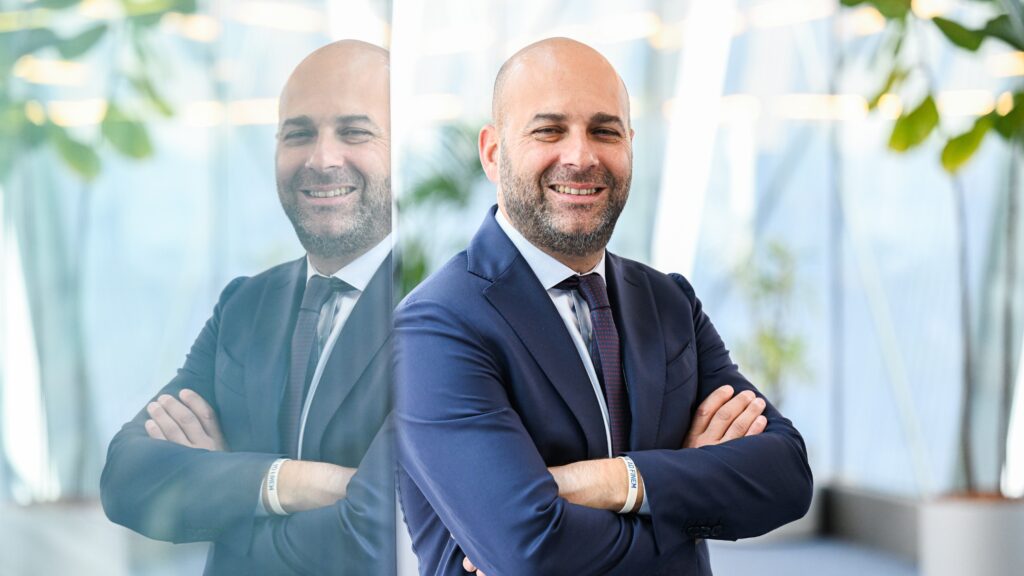
Brazil’s elections have put its relations with the EU in the spotlight. To counter China’s growing influence in the country, Europe must become a reliable partner offering Brazil more than just access to its markets, argues MEP Michele Picaro, vice-chair of EU–Brazil delegation.
Luiz Inácio Lula da Silva’s next presidential term offers continuity in Brazil’s relations with the EU. But his country’s growing economic and diplomatic ties with Moscow and Beijing present Brussels with a geopolitical challenge. How can Europe strengthen its relationship with Latin America’s largest economy without expecting Brasília to automatically follow its foreign policy lead?
In an interview with EU Perspectives, Michele Picaro (ECR/ITA), Vice-Chair of the European Parliament’s Delegation for Relations with Brazil, calls for a more pragmatic approach, built on investment, reciprocity and a level playing field for European businesses.
How do you assess the political implications of the election results for EU-Brazil relations?
The outcome of the presidential election confirms that Brazil is politically divided. I am particularly concerned about the actual observance of the rule of law and the use of the judiciary for political ends, specifically by certain members of the Supreme Court who are close to President Lula.
Respect for democracy is a fundamental prerequisite for bilateral relations based on mutual trust. It is worth remembering that Brazil is the most populous and largest country in Latin America, possessing the region’s biggest economy. It is a nation destined to play an increasingly significant role in the international balance of power.
A genuine partnership cannot be based on the expectation of an automatic alignment of positions.
President Lula’s re-election certainly represents an element of continuity in relations with the EU. Though I believe it is essential to maintain an open dialogue with all of Brazil’s political and institutional components.
After all, the relationship between two such important partners cannot depend solely on the political orientation of their respective governments. It must be built around shared objectives and long-term perspectives.
It is precisely in this direction that I intend to continue working, including in my capacity as vice-chair of the EU–Brazil Delegation. I firmly believe that closer cooperation can offer significant economic and political opportunities for both sides.
At a time of growing geopolitical tensions, how can the EU build a stronger partnership with Brazil without demanding that the country align itself with European foreign policy positions?
The starting point must be the recognition that a genuine partnership cannot be based on the expectation of an automatic alignment of positions. This, of course, does not mean abandoning our principles. Starting with our firm condemnation of the Russian aggression against Ukraine and our defense of the sovereignty and territorial integrity of states.
However, we must be aware that, under the Lula administration, Brazil has increasingly strengthened significant economic and diplomatic ties with Russia and China. This trend is drawing Brazil ever closer to production standards and values that, in the long term, could prove highly counterproductive.
Europe must demonstrate that it is a credible partner, capable of offering concrete opportunities for investment and cooperation. I emphasised this point during my institutional mission to Brazil, highlighting the potential for closer collaboration in strategic sectors ranging from energy to critical raw materials.
In such a complex international landscape, I am convinced that the best way to strengthen our relations is to build upon what unites us, without attempting to erase our differences.
What concrete initiatives should the European Parliament prioritise to strengthen cooperation with Brazil on issues such as democratic resilience, disinformation, climate policy, and social inequality?
The Parliament should focus on initiatives capable of producing concrete results, rather than exporting flawed models like the “Green Deal”.
We must begin by strengthening the dialogue between our institutions and fostering cooperation on security and the rule of law. Both of them are essential prerequisites for democratic stability.
Environmental protection must go hand in hand with business competitiveness and the safeguarding of jobs.
Within this framework, countering disinformation is also of particular importance. This requires promoting greater transparency on digital platforms and ensuring more effective protection of electoral processes, all while safeguarding pluralism and freedom of expression.
Similarly, regarding climate policies, it is necessary to move beyond ideological approaches and prioritise solutions rooted in innovation and technological neutrality with the understanding that environmental protection must go hand in hand with business competitiveness and the safeguarding of jobs.
Indeed, it is precisely through economic development that we can also contribute to reducing social inequalities, by fostering investment in training, research, and support for small and medium-sized enterprises. The goal must be to build a form of cooperation that does not remain confined to statements of principle, but instead translates into new opportunities for both European and Brazilian citizens.
If the EU–Mercosur agreement truly aims to build a strategic partnership—rather than merely opening up new markets—what is Europe prepared to offer Brazil, beyond greater access to European consumers?
I am convinced that the EU–Mercosur agreement can represent an important opportunity to strengthen relations between Europe and Brazil. Provided that it is not viewed merely as an instrument for trade liberalisation, but rather as part of a broader strategy for economic and industrial cooperation.
Europe has much to offer in terms of investment, technological innovation, and expertise especially in sectors such as energy, infrastructure, and digitalisation where there is significant potential for developing shared production chains.
Naturally, this opening must be based on the principle of reciprocity. We cannot ask our own businesses—European farmers, in particular—to adhere to exceptionally rigorous environmental and health standards, only to then expose them to competition from products that do not meet equivalent requirements. For this reason, effective oversight and truly enforceable safeguard clauses are essential to protect the most vulnerable productive sectors.
At the same time, when China’s economic presence in Latin America continues to grow, Europe must be able to position itself as a reliable and competitive partner. The real challenge, therefore, is not simply to increase the volume of trade, but to build a balanced and enduring relationship that fosters economic growth without penalising our own businesses and industries.