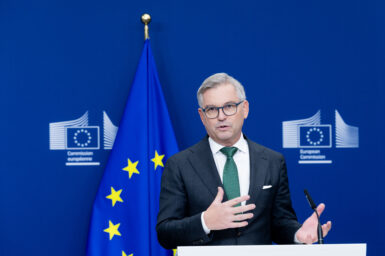
The European Clinical Research Infrastructure Network (ECRIN) gets a new chief. Former Czech Deputy Health Minister Jakub Dvořáček takes over the institution on 16 November. His aim is to improve cooperation with health insurers and open Europe up to the rest of the world.
“ECRIN was initiated by the European Commission, and its activities are endorsed by the French government. Its aim is to help the academic sector conduct studies across member countries, which it has been doing successfully. It also focuses on cooperation with countries outside Europe,” Mr Dvořáček told EU Perspectives, describing his new role.
In practice, this means that an academic institution in Canada or Australia, for example, can approach ECRIN, which will facilitate cooperation with research centres, university hospitals and other institutions across European countries.
Mr Dvořáček will succeed Professor Jacques Demotes, who helped establish the infrastructure in 2004 and has been involved in its development for more than 20 years. ECRIN currently involves 13 EU member states and supports more than 130 clinical trials. It also cooperates with EATRIS, the European Infrastructure for Translational Medicine, which helps researchers and companies translate basic biomedical discoveries from the laboratory into clinical practice.
You might be interested

Strengthening cooperation with health insurers
Jakub Dvořáček is taking on his new role with a clear vision. “I want to help strengthen ECRIN’s cooperation with health insurers across Europe. I also plan to focus on cooperation with the European Commission, for example in the area of dual-use medical products. These could include medicinal products that can be used both in haematology and to treat radiation sickness. US legislation allows clinical trials to be conducted in this area and products to be certified afterwards, whereas European legislation does not. A change would help,” Mr Dvořáček said, outlining some of his priorities.
He believes the academic sector could provide expertise that health insurers currently lack. “They only see reimbursement data. In practice, however, they cannot discuss outcome-based reimbursement,” he pointed out.
More broadly, he plans to focus on shaping the environment for academic clinical trials. “This is influenced by the upcoming European Biotech Act, the adopted pharmaceutical package and the European Health Data Space, an EU framework for harmonising the sharing of electronic health records across the bloc,” Mr Dvořáček said.
“We need to raise awareness that, beyond the pharmaceutical industry, there is an extensive network. The capacities of European university hospitals and universities are enormous, and to a large extent remain underused,” he concluded.
ECRIN is a non-profit research infrastructure that connects national networks of clinical research centres across Europe. Based in Paris, its main role is to support, advise and coordinate multinational academic clinical trials involving medicinal products and medical devices.