The Union’s newest naval vessel is to provide surveillance and to protect undersea infrastructure. The EUROGUARD is not yet in service; developers say testing is the point of the exercise.
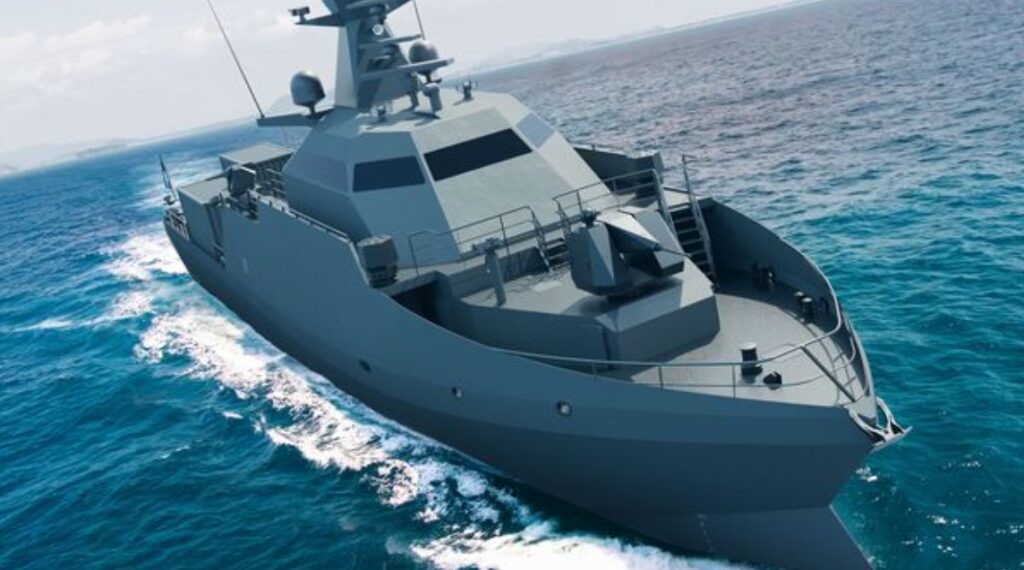
Europe has launched a new kind of naval vessel. The EUROGUARD semi-autonomous ship went through its launch in Nasva, Estonia, on the Baltic Sea. The 45-metre craft is to strengthen maritime surveillance and help protect Europe’s coasts. The European Commission says it will support member states facing growing risks at sea.
Those risks are real, according to the Commission. Threats to undersea cables, energy infrastructure, and strategic maritime routes are rising. The purpose of the vessel is to help member states respond to them.
The EUROGUARD project began in 2022. It brings together 29 organisations from 10 European countries. The Estonian shipyard Baltic Workboats coordinates the work. The European Defence Fund has contributed €65m of a total budget of about €95m.
You might be interested

The Commission frames the project as a way to strengthen Europe’s defence technological and industrial base. The programme is a development effort, not a ship class already in service. Its demonstrator, the Medium Size Semi-Autonomous Surface Vehicle, is still in the testing phase.
A vessel for many tasks
The vessel will perform a wide range of missions. These include maritime surveillance, mine detection and clearance, search and rescue, and protection of critical undersea infrastructure. When possible, it can operate with or without a crew on board. That flexibility is central to the design.
Its capabilities include autonomous navigation, threat detection, secure communications, and remote operation. The programme also calls for collision avoidance and obstacle detection. The exact level of autonomy is still under development.
The hull is built around interchangeable mission modules. Equipment can be adapted to the task rather than fixed into a single-purpose design. The idea is simple — one ship, many jobs. Whether that saves money or time will depend on how quickly modules can be swapped.
Modules can be changed as mission priorities or technologies shift. The prototype and trials are meant to show how reliably the integrated systems perform. Until then, the benefits remain intended rather than proven.
Figures on paper
The published design parameters describe a substantial craft. The vessel—45.0 metres long with a beam of 9.4 metres—has a maximum draught of 3.0 metres. Its hybrid propulsion must deliver a minimum speed of 20 knots.
Range and endurance are also ambitious. The design calls for a minimum range of 2,000 nautical miles and endurance of 10 days at sea. Displacement may reach 335 tonnes at most. Payload can rise to 100 tonnes.
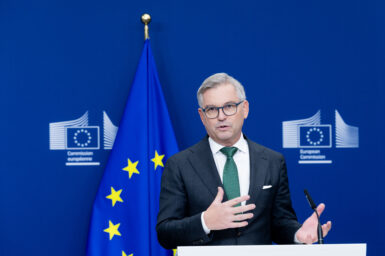
It will help protect the EU’s Eastern flank and support the EU’s Readiness 2030 ambitions. — European Commission statement
These are programme specifications. They are not independently verified results from sea trials. Readers should treat them as targets rather than proven performance. Testing will determine whether the figures hold.
The press statement was direct about the purpose. “It will help protect the EU’s Eastern flank and support the EU’s Readiness 2030 ambitions.” The vessel, it said, will also improve situational awareness and provide tailored operational capabilities.
A demonstrator, not a patrol ship
Timing matters here. On 21 May 2026, the consortium held a Critical Design Review. It presented the physical prototype hull at the Baltic Workboats shipyard in Nasva. The project continues through 2027, with completion planned by the end of that year.
The vessel is a development asset. Its job is to test mission modules, remote operation, and autonomy. It is not meant for routine patrols or deployed combat missions. That distinction matters for anyone who reads the launch as a fleet addition.
The programme lists several roles. They include maritime surveillance, mine countermeasures, drone deployment, and seabed monitoring. Anti-surface and anti-submarine support is also on the list. None of these roles has yet been shown in operation.
Promise and proof
The strategic case is about options. A single adaptable hull could be configured for different missions. According to the project’s aims, it could operate alone or alongside a larger fleet. That is an intended benefit, not a demonstrated outcome.
The programme also tests cooperation. It brings together shipbuilders, defence companies, and research organisations from several countries. The European Defence Fund presents it as a way to integrate European technologies. Its fact sheet explores whether such vessels could work independently or within a fleet.
EUROGUARD is best understood as a technology demonstrator. Its promise lies in adaptable coastal support, unmanned-system integration, and multinational industrial cooperation. Its practical military value, however, remains unproven. That will change only once integration, sea trials, and operational evaluation are complete.