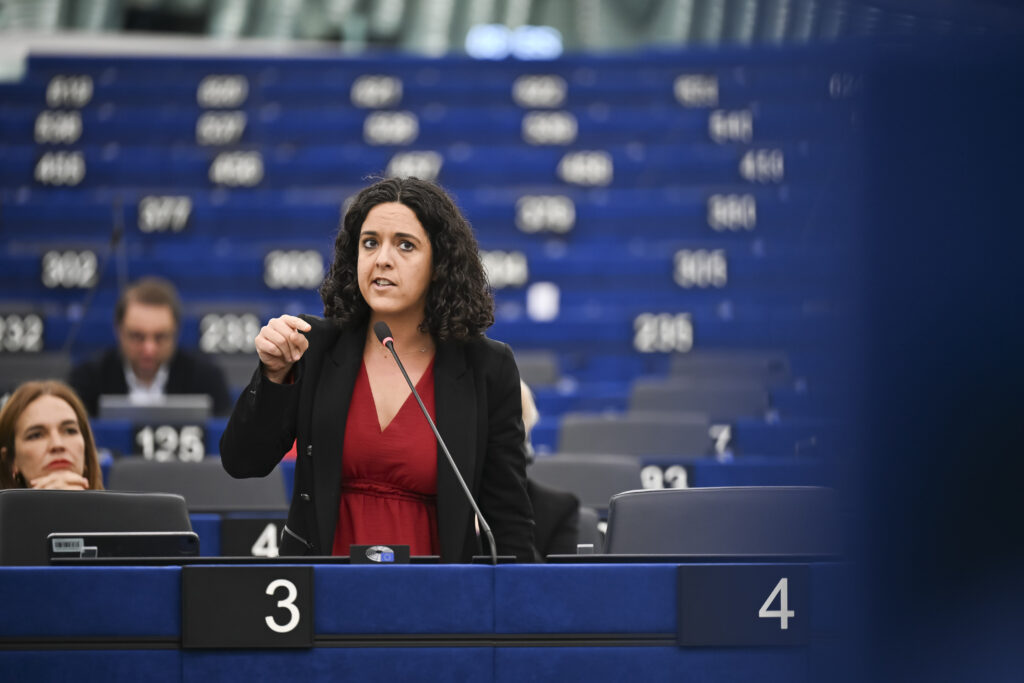
Nearly one in six women lawmakers in the European Parliament has been affected by sexualised deepfakes. An EU ban on “nudifier” tools is days away. Yet Wednesday’s debate on digital gender-based violence in Strasbourg repeatedly descended into ideological confrontation, mutual accusations, and domestic political disputes.
According to an EU-wide survey by the EU Agency for Fundamental Rights (FRA), 8.5 per cent of women have experienced cyberstalking. Seven per cent of working women experienced online sexual harassment. More than one in ten women have had their location tracked by an intimate partner. These numbers formed the backdrop to the International Day for the Elimination of Violence against Women on 25 November. Marking the date, both the European People’s Party (EPP) and the Socialists and Democrats (S&D) called for stricter rules.
“Laws alone cannot change everything. We all need to recognise our responsibility for reinforcing and perpetuating the stereotypes and beliefs that sustain inequalities and lead to all forms of gender-based violence,” said MEP Eleonora Meleti (EPP/GRC).
From smart glasses to deepfakes
Meanwhile, Heléne Fritzon (S&D/SWE), the group’s vice-president responsible for a Feminist Europe, warned about what’s happening online. She pointed to ‘rape academy’ networks, where perpetrators swap advice on drugging and sexually assaulting women. She also highlighted the misuse of smart glasses to film women without their knowledge. “When harassment drives women out of politics and digital spaces, democracy loses their voices. Technology should empower women, not become a weapon against them,” she said.
You might be interested
Every hour, an intimate partner or family member kills five women and girls somewhere in the world. In 2025, more than 47,000 lost their lives this way, according to UN figures cited by MEP Kathleen Funchion (The Left/IRL). “How many more debates? How many more women must be murdered? How many more lives must be destroyed before we treat this epidemic for what it is, an urgent crisis?” she asked.
Hadja Lahbib, European Commissioner for Equality, Preparedness and Crisis Management, took part in the debate. She told lawmakers that 99 per cent of pornographic deepfakes depict women. “When women are taken offline, it means that democracy itself is weakened,” she said. The Commission’s response centres on its Gender Equality Strategy, the Digital Services Act (DSA), and the AI Act. It also relies on the directive on violence against women, which member states must transpose into national law by June 2027.
When violence becomes a political football
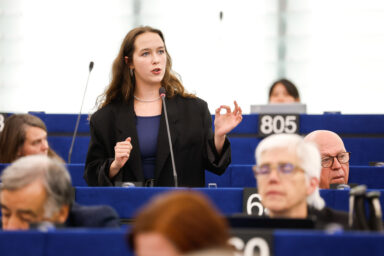
A study by the Berlin-based think tank Agora Digitale Transformation identified 50 MEPs depicted in or associated with sexualised deepfakes. Of those, 46 were women. Across national parliaments in 22 EU countries, the think tank found 138 female and nine male parliamentarians affected. MEP Lena Schilling (Greens/AUT), herself a target, told the plenary she had continued her political work despite the abuse. “If I give up, I would give up on all the girls going to school who also experienced that.”
The discussion also ventured into Grand Theft Auto VI. Some players criticised the most recent part of the franchise for introducing a female protagonist, Lucia, and removing paid sexual encounters. In the game, the main male protagonist, Jason, can buy flowers for his girlfriend, go grocery shopping, or assemble furniture. Some online commentators called these changes ‘feminist propaganda’. They accused the game’s developers of abandoning the franchise’s identity in favour of the ‘woke agenda’.
GTA 6 shows that misogyny has received a technological upgrade. — Anna Stürgkh (Renew/AUT)
MEP Anna Stürgkh (Renew/AUT) drew attention to AI-generated nude images of Lucia circulating online. “GTA 6 shows that misogyny has received a technological upgrade,” the lawmaker concluded.
Yet the debate kept drifting towards everything but how to tackle gender-based violence. Lawmakers discussed migration, abortion, masculinity, surrogacy, pornography, and domestic corruption allegations.
The 2 December test
Behind the political confrontation lies a key date. On 2 December, the AI Act’s ban on AI tools that generate non-consensual sexual deepfakes starts to apply, and companies must have their systems in line by then.
A cross-party letter signed by 81 MEPs from the Greens/EFA, S&D, Renew Europe, and The Left raises the pressure. It demands immediate investigations into non-compliant AI providers, platforms, app stores, and advertising services from the first day of the nudifier ban. The signatories also call for new and expanded DSA proceedings against Meta. They want structural funding for enforcement and victim support as well.