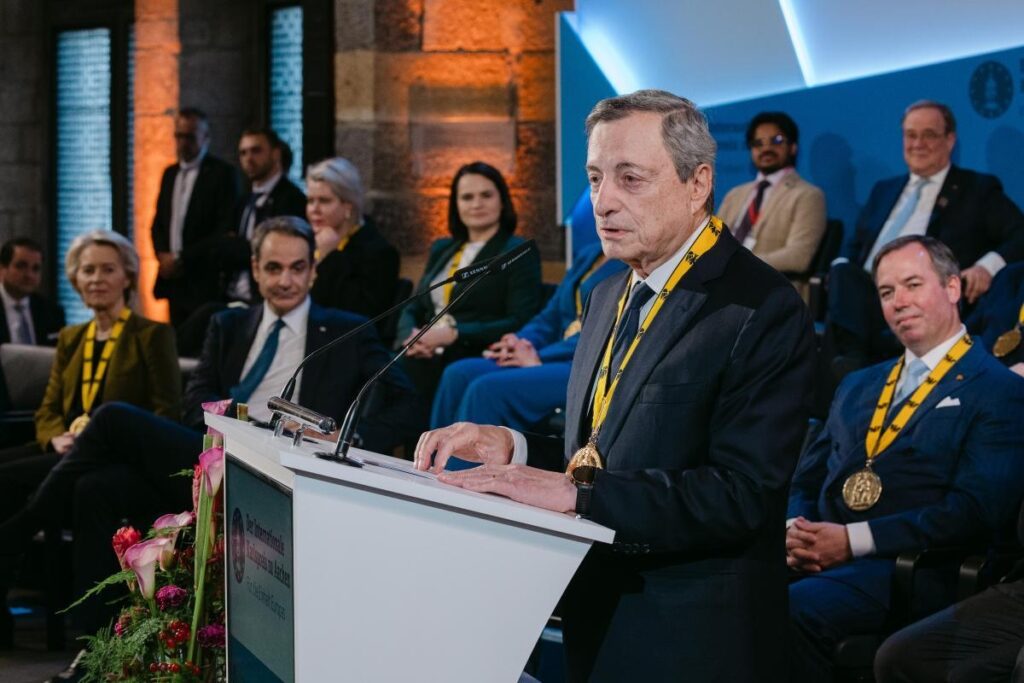
Europe is exposed, outpaced, and running out of time. Accepting the Charlemagne Prize in Aachen, former President of the European Central Bank Mario Draghi delivered his starkest warning yet: the continent is too dependent on foreign demand, too reliant on outside powers for its security, and falling dangerously behind in the technologies that will define the next decade. His answer is a new form of European integration. Willing countries must move ahead, without waiting for all 27.
American tariffs have already cut European exports to the US by around 17 per cent. War in the Middle East has pushed energy prices back up. Defence budgets are climbing, with no clear plan for who pays. Draghi did not come to Aachen just to collect the Charlemagne Prize, awarded each year to figures who have advanced European unity. He came to deliver a verdict.
And it is an uncomfortable one. Europe has spent decades building openness to the world while leaving its internal market unfinished. It has relied on the United States for security while pretending that dependence stopped there. It has watched the technology gap with America widen and assumed it would close on its own. But it didn’t.
The three cracks
Draghi pointed out three challenges.
The first is export dependence. Since 1999, trade as a share of GDP in the euro area has risen from 31 to 55 per cent. In the US and China, it has barely moved. Europe has made itself uniquely vulnerable to decisions taken in Washington and Beijing.
The second is strategic dependence. Europe relies on the US for 60 per cent of its liquefied natural gas imports. Even its green transition depends on Chinese supply chains. These are not just economic exposures. They are political ones, and they show up at every negotiating table.
The third is the technology gap. Since 2019, the productivity gap between Europe and the US has widened by nine percentage points. Artificial intelligence is accelerating that divergence. The US is on track to spend roughly five times more on data centres by 2030. AI gets better the more it is used. The economies that lead now will lead permanently.
Draghi’s competitiveness report from 2024 mapped the same terrain. It is not the first time he has sounded the alarm. Speaking at KU Leuven in February, he warned Europe risks becoming “divided, dependent and deindustrialised”. In Aachen, he drew the conclusion he had stopped short of before. The internal market is unfinished. Capital is fragmented. Energy grids are not connected. And the politics of comfort, he argued, have protected all of it for too long.
Alone, and out of time
“For the first time in living memory, we are truly alone together,” Draghi told his audience. The United States is generating disruption, not underwriting stability. China is not an alternative anchor. It backs Russia and floods global markets with surpluses Europe cannot absorb. Europe must figure this out by itself.
For the first time in living memory, we are truly alone together.
— Mario Draghi, former President of the European Central Bank
That starts with defence. Security dependence on the US bleeds into every other negotiation. As long as Washington can threaten to walk away from Europe’s defence, it holds leverage over trade, energy, and technology too. Building European defence capacity is not about undermining NATO. It is about making the alliance one between equals.
His name for the way forward is “pragmatic federalism”. Countries ready to act should move ahead together in specific areas, without waiting for consensus among all 27. Each step must be democratically approved, so citizens know what has been committed to and can hold governments to account. The euro, Draghi said, is the proof of concept. Those who joined built something they could not afford to leave. If the euro is the proof of concept, the test now is whether Europe has the courage to repeat it.