Europe is tightening controls on foreign money in sensitive sectors, which lawmakers describe as the end of “wilful blindness” towards strategic takeovers. The European Parliament backed the new rules, aiming to close gaps between national screening systems and strengthen oversight of deals in areas such as defence, semiconductors and critical infrastructure.
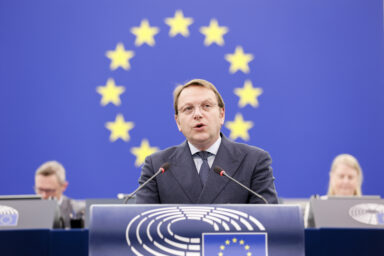
The European Parliament on Tuesday approved new rules requiring all EU member states to screen foreign investments in sensitive sectors for security risks, closing long-standing gaps in the bloc’s economic defences. “With this text, we are closing a chapter of European naivety,” said rapporteur Raphaël Glucksmann (S&D/FRA) after the vote.
MEPs backed the revised Foreign Direct Investment (FDI) Screening Regulation by 508 votes to 64, with 90 abstentions. “We are turning the page on the wilful blindness of member states that allowed foreign actors to seize control of sensitive sectors of our economy,” Mr Glucksmann added.
Europe’s long-open market
FDI in Europe has long been a vehicle for malign influence — China and Russia in particular. “The 2010s were a European garage sale of high-tech firms to China,” wrote James Green and Sander Tordoir in a Centre for European Reform report.
Chinese investors over the past few decades acquired intellectual property, know-how and supply-chain leverage through takeovers of semiconductor companies including Silex, Okmetic, LFoundry and Nexperia. Russian investors also specifically targeted member states without screening mechanisms.
According to the European Commission‘s Fifth Annual Report on FDI screening, published in October 2025, the number of EU member states with active screening tools rose from 14 in 2019 to 24 by 2024. The remaining three — Croatia, Cyprus and Greece — have since all enacted their own mechanisms, with Cyprus the last to do so, its regime entering into force on 2 April 2026.
But the patchwork remained exploitable. Member states collectively reviewed over 3,100 foreign investment transactions in 2024, a 75 per cent increase compared to the 1,800 reported in 2023. The five most screened sectors were manufacturing, ICT, wholesale and retail, financial activities and professional and scientific services.
What changes
Under the new framework, mandatory screening will apply to investments in defence, semiconductors, artificial intelligence, critical raw materials, financial services and electoral infrastructure. All 27 member states will be required to operate national screening mechanisms aligned with a common minimum standard.
The final on decision whether to clear, condition or block a deal, nonetheless, remains with the state where the investment lands. And greenfield investments — where a foreign company builds a new facility from scratch — fall outside the mandatory screening scope. That gap is expected to become the central battleground in negotiations over the proposed Industrial Accelerator Act, as greenfield investment has become China’s favoured approach to entering European markets.
The debate ahead
Chair of Parlieament’s International Trade Committee Bernd Lange (S&D/DEU), who steered the file through negotiations, welcomed the vote but offered a note of caution. He argued that the regulation had struck the right balance — “open for investment, but not in an uncontrolled manner”. But also warned that discipline must carry over into what comes next. “No protectionism under the guise of economic security,” he wrote on X. “Even if this may seem appealing in the short term, it could be very harmful in the long run.”
His remarks were aimed at the Industrial Accelerator Act (IAA), which the Commission tabled in March. It introduces tighter screening for foreign investment in emerging strategic industrial sectors. The IAA is now the next battleground for this underlying debate.
The regulation on FDI now awaits formal Council approval before entering into force. Once published in the Official Journal, member states will have 18 months to align national legislation. The new rules are unlikely to apply before late 2027.