Europe and its allies are orchestrating a three-layered response—political pressure, defensive naval power and economic shock absorbers—to reopen the Strait of Hormuz. Its success will depend on three factors: how quickly the EU can translate resolve into action; whether Iran finds continued closure more costly than compromise; if Donald Trump makes a hash of it yet again.
Iran has effectively closed the strait since US-Israeli strikes against Tehran began in late February 2026. The blockade has removed roughly 20 per cent of global oil supply from the market, sending Brent crude to $80–82 per barrel in early March and lifting European natural-gas prices by more than 60 per cent week-on-week.
A ceasefire has been in place since April, but it has been under severe strain—Gulf countries have recently reported drone strikes—and a lasting peace deal looks uncertain. US President Donald Trump rejected Iran’s latest proposal in his trademark typographic manner, labelling it “TOTALLY UNACCEPTABLE” on social media.
Up and about in Paris and London
The UK and France co-chaired an international summit in May, paving the way for what they defined as an “independent and strictly defensive multinational mission to protect merchant vessels, reassure commercial shipping operators” and to conduct “mine clearance operations as soon as conditions permit following a sustainable ceasefire agreement.”
The Multinational Military Mission, as it is formally known (more specifically, the seaborne bit is called Multinational Maritime Mission, just to make things more complex), will not deploy until a ceasefire holds. But preparations are already well advanced.
The coalition’s military commitments are substantial. Britain has pledged a multi-equipment package that includes autonomous mine-hunting equipment, counter-drone capabilities, Eurofighter Typhoon fourth-generation fighter jets and the Type 45 air-defence destroyer HMS Dragon. The Ministry of Defence said the Eurofighter combat aircraft, which operate in the region in collaboration with Qatar, are “ready to conduct air patrols over the Strait of Hormuz”.
HMS Dragon is deploying to the Middle East in preparation for “any mission to secure” the waterway, the Royal Navy says. It operates six of the destroyers, each equipped with the Sea Viper anti-air missile system, capable of firing eight missiles in less than ten seconds. The service’s modular Beehive system will also “deliver high-speed, autonomous Kraken drone boats allowing the multinational force to sense, track, and identify potential threats and defeat them.” Defence analysts frame the Dragon-Beehive drone package as a watershed in hybrid fleet concepts.
Charles de Gaulle on board
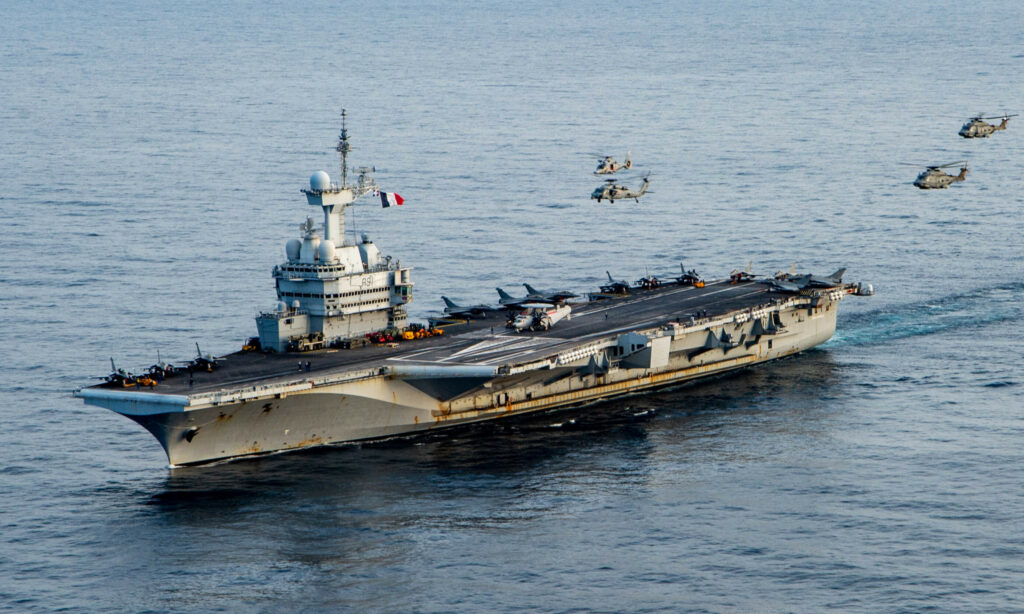
France, the mission’s other co-leader, brings the most powerful single asset in the coalition. “France has a robust naval force in the eastern Mediterranean and the Red Sea, headed by the aircraft carrier Charles de Gaulle and comprising numerous frigates and several amphibious helicopter carriers,” said French President Emmanuel Macron in remarks coinciding with the UK joint statement on the mission.
(The Beehive system) will deliver high-speed, autonomous Kraken drone boats allowing the multinational force to sense, track, and identify potential threats and defeat them. — UK’s Royal Navy statement
“All this equipment will be redirected according to the planning, and part of it will be used in the eastern Mediterranean, part in the Red Sea, but part will be allocated to the multinational effort we’ve just mentioned,” Mr Macron said. In an update on X last week, he spoke of the regional “prepositioning” of the Charles de Gaulle to support the mission. The carrier is the backbone of French naval power.
Mine-clearance is the pacing item. Commercial traffic cannot resume at scale until maritime safety authorities declare the strait mine-free. Several European nations are already moving specialist vessels into position. Belgium’s defence minister Theo Francken announced in an April post on X that the Primula minehunter had gone from the Baltic Sea toward the Mediterranean. “When the coalition with the Brits and the French is ready (…) we will also be ready,” Mr Francken says of the Primula.
Beyond Europe’s shores
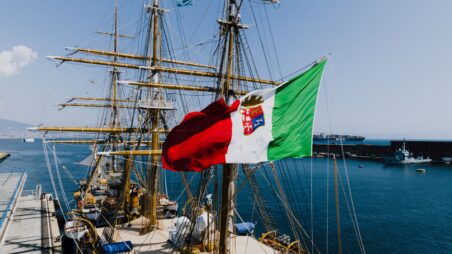
Germany has moved its Fulda minehunter and Mosel replenishment ship to the Mediterranean “to station potential German capabilities for a possible operation” in the strait. “The German government is committed to making a significant and visible contribution within an international coalition to protect freedom of navigation,” noted Berlin’s defence ministry on 4 May. Italy has reportedly committed two minehunters from the Gaeta MLU class—the 5561 Rimini and the 5558 Crotone—alongside the P432 Raimondo Montecuccoli patrol vessel and the A5336 Atlante logistic support vessel.
The coalition extends well beyond Europe. Australian Defence Minister Richard Marles confirmed that Australia would contribute the Boeing E-7A Wedgetail aircraft “to this defensive effort.” Mr Marles added, “While this platform is already doing work in the region, providing this capability would make a valuable contribution to the multinational mission and efforts to secure freedom of navigation in the Strait of Hormuz.”
The E-7A is an Airborne Early Warning and Control aircraft fitted with Northrop Grumman’s Multi-Role Electronically Scanned Array radar, enabling simultaneous tracking of airborne and maritime targets. Paris hosted 51 countries in April to rally support; London followed with a 30-nation planners’ conference, emphasising complementarity with—but independence from—US strategy.
Europe + 21
The EU itself is considering a parallel expansion of Operation Aspides, the naval mission launched in 2024 to protect merchant shipping in the Red Sea, the Indian Ocean and the Gulf, currently involving three naval units and 21 contributing nations. “Operation Aspides already makes a crucial contribution in protecting shipping in the Red Sea, but its activities could also be extended to the Strait” of Hormuz, Kaja Kallas told reporters on Tuesday.
Any such expansion “requires the change of the operational plan”, the EU foreign policy chief noted, adding that such discussions with EU members are ongoing. The Foreign Affairs Council expanded Iran-related sanctions on 11 May for “obstructing freedom of navigation” and discussed strengthening Aspides as a European contribution to the broader coalition.
When the coalition with the Brits and the French is ready, we will also be ready. — Theo Francken, Belgium’s defence minister
The diplomatic architecture underpinning the military effort draws on the European Maritime Awareness in the Strait of Hormuz created in 2020 and still chaired by France. The initiative provides the main European diplomatic channel with Gulf states and the US, and analysts regard it as a template for future EU security roles. The European Council on 19 March demanded “stabilisation of energy shipments” and a moratorium on strikes against critical infrastructure, with some member states signalling they are “exploring ways to ensure freedom of navigation”.
The cost of delay
The economic stakes are stark. Wood Mackenzie, a global consultancy, has modelled three scenarios. A quick peace—reopening by June—would still see global GDP sink to 2.3 per cent in 2026, with Brent easing to roughly $80 by year-end. A summer settlement, involving partial closure until September, would produce prolonged inflation and LNG tightness. An extended disruption through the fourth quarter would push EU-27 GDP down 1.5 per cent year-on-year and trigger a shallow global recession.
The EU has re-activated its joint gas procurement platform, coordinated a strategic oil-reserve release through the International Energy Agency. The bloc is discussing a temporary suspension of maritime insurance sanctions to facilitate neutral carriers once lanes reopen.
Despite sporadic transits, industry risk ratings still classify the strait as a “warlike area,” keeping insurance premia more than 500 per cent above year-earlier levels and charter rates elevated. Iran’s Islamic Revolutionary Guard Corps claimed on 20 May that it had “coordinated” the transit of 26 merchant vessels in 24 hours. The formulation effectively demands prior permission and reinforces Tehran’s blockade narrative rather than signalling any genuine opening.
Project Freedom. Or not
Washington launched—and, apparently, quickly abandoned—its Project Freedom to focus on guiding stranded ships and sustaining a blockade on Iranian ports. European planners, by contrast, stress a defensive, law-of-the-sea narrative—a deliberate effort to avoid mission creep and preserve what Brussels calls strategic autonomy.
The German government is committed to making a significant and visible contribution within an international coalition to protect freedom of navigation. — Bundesministerium der Verteidigung, German Ministry of Defence
If Tehran accepts a face-saving partial reopening and the EU finalises the Aspides mandate amendment by June, a phased convoy system could start in late summer. Any new attack on shipping, however, would likely accelerate the fully fledged multinational escort operation now taking shape. By the same token, any new U-turn by the US could either support or thwart it, however.
Either way, it will test whether Europe’s resolve matches its rhetoric. The effort is the most ambitious European-led naval operation in a generation. Its outcomes will shape both global trade and the future of EU much-vaunted strategic autonomy.