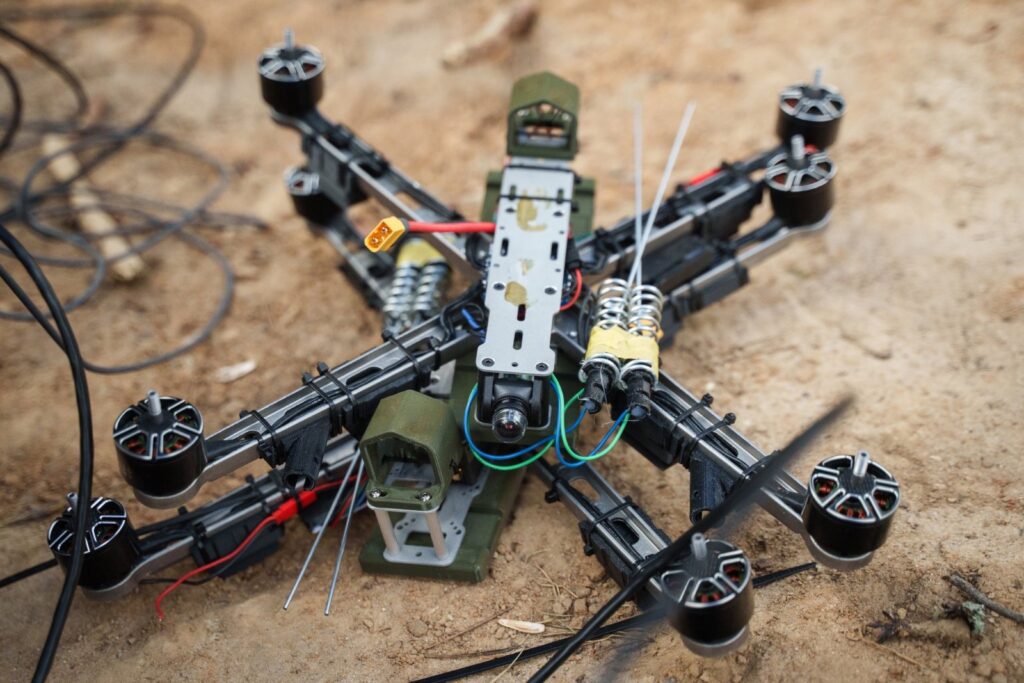
The blood-soaked tragedy of Ukraine has become a test range. Now the European Union wants to turn that grim reality into an innovation engine. On 29 April Brussels produced a €35m contribution agreement that propels its defence-tech programme BraveTech into Phase 2. What does it mean?
It is easy, in the flurry of defence initiatives springing up an all sides, to lose track of what is what. Here goes the lowdown: on 29 April the European Commission and the European Defence Agency (EDA) signed a €35m contribution agreement, opening BraveTech EU Phase 2. “(The programe) addresses one of the central problems in Europe’s defence transformation: how to convert battlefield-derived innovation into scalable, institutionally validated and industrially usable capability,” Defence Finance Monitor writes.
”Ukraine has generated a dense defence-tech ecosystem under wartime pressure, but battlefield relevance does not automatically translate into European certification, procurement eligibility, or investor confidence,” the publication says in its April 30 review. “The significance of BraveTech EU lies in its attempt to close this gap through a structured EU-Ukraine architecture linking Brave1, EUDIS, the European Defence Fund, the European Defence Agency and the emerging EDIP Ukraine Support Instrument.”
Europe’s test range
Brussels sees two prizes. First, faster help for Kyiv. Second—no less important—an upgrade for the European Defence Technological and Industrial Base (EDIP). “The goal is to cut the time between ‘brilliant idea in a lab’ and ‘combat-ready kit’ while strengthening both Ukraine’s war effort and the EU’s industrial base,” says the programme brief. By matching Ukraine’s battlefield ingenuity with EU money and certification, the bloc hopes to mend the notorious gap between bright prototypes and orders that keep factories humming.
The timing matters. Russia’s war has exposed Europe’s slow procurement cycles and thin stocks. Standard calls under the European Defence Fund (EDF) still take three to four years. BraveTech promises to shrink that to under 18 months. If it works, expect the model to infect wider EU defence policy.
None of this should suggests the European Union is doing Ukraine some sort of favour, as it is still viewed in some of the more obtuse European schools of thought. Just the other way around: Ukraine is Europe’s chance not to lose touch with the leaders of the global defence-tech race. Just watch the dates in the following paragraphs.
On 30 March Defence Minister Mykhailo Fedorov unveiled tests of new bomber drones. Eighteen teams accepted a simple trial: fly 20 km through Russian electronic warfare, hit a target and return. Light models carry a few kilograms; heavy ones lug tens. After the sorties Mr Fedorov declared, “The new generation of bombers means greater range, higher payload capacity, secure communications, and the ability to operate from safe positions.” Designs that pass will head straight to frontline units this summer.
Industry in lockstep
Industry adapts well. On 1 April 2026 Powerus, a private drone maker, added Keith Kellogg—the former United States special envoy to Ukraine—to its advisory board precisely in order to be a US-Ukraine liaison.
The firm’s statement read: “His frontline experience on the front lines of one of the most technologically dynamic battlefields today further strengthens Powerus’ mission. General Kellogg will provide the Powerus Advisory Council with top-level strategic leadership on the company’s defence and national security initiatives.” The hire underscores a trend: foreign veterans and investors now treat Ukraine as the cutting edge of modern warfare.
A day later, 2 April 2026 Mezha.net, a well-informed Ukrainian outlet reported the launch of A1, a Defence AI Center A1 inside the ministry. Danylo Tsyvok, its head, set the goal plainly: “Our key task is to develop and implement AI in the defence sector to bring victory closer. This involves several directions: battlefield solutions, AI for internal Ministry of Defence needs, and the defence ecosystem, as well as accelerating innovation cycles in adjacent industries.”
Dead slow
Compare this to Brussels. Last year, it took the freshly formed parliamentary Security and Defence Committee (SEDE) over two months to appoint a rapporteur for a key piece of legislation on EDIP.
The new generation of bombers means greater range, higher payload capacity, secure communications, and the ability to operate from safe positions. — Ukraine’s Defence Minister Mykhailo Fedorov
Not that all members are oblivious. SEDE’s cold feet famously sent MEP Christian Ehler (EPP/DEU) from the research and industry committee into a fit of rage during a common March 2025 session. But it lays bare how poorly the Union’s institutions are suited to wartime decision-making.
That said, Ukrainian practice already informs European doctrine. The army’s ‘drone wall’, dense with surveillance quadcopters and explosive loitering munitions, forced Russia to switch to small three-man infiltration teams. Ukraine countered by pairing artificial-intelligence target recognition with cheap first-person-view drones, making dispersed squads as detectable as armour columns. Lessons like these feed into NATO war games and corporate R&D alike.
Two layers
Russia adapts too. On 28 April, Mykola Bielieskov of the European Policy Institute in Kyiv (EPIK) noted the mass use of glide bombs—40,000 in 2024 and 60,000 in 2025—plus fibre-optic-guided drones immune to standard jamming. The Kremlin has even created Unmanned System Troops and Rubicon units dedicated to hunting Ukrainian drone operators. Every technological leap meets a counter. That arms race forces Kyiv to keep the cycle spinning faster — and should motivate every other European capital to do the same.
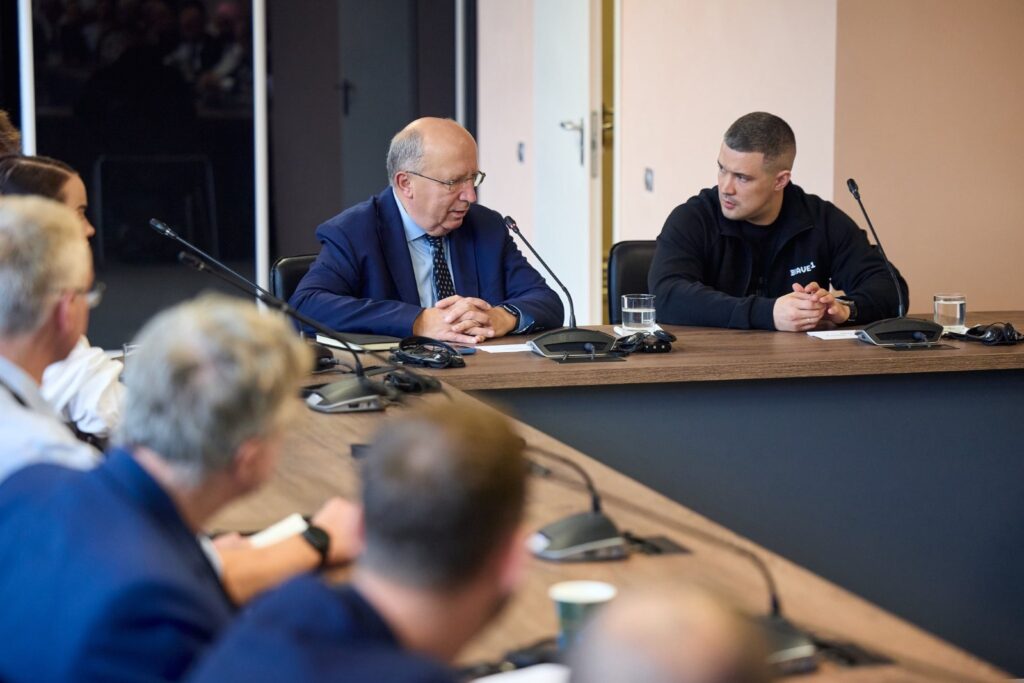
The BraveTech scheme rests on two layers. DefTech Forges, run by a consortium led by Civitta, Starburst Accelerator and Darkstar, scout start-ups and run hackathons. Last year they sifted hundreds of pitches; over 50 prototypes reached technology-readiness level five—meaning tested in relevant environments—and now await frontline trials. The second layer, run by the EDA, will oversee those trials, certify the winners and funnel them into larger EU programmes such as the EDF and the EU Defence Innovation Scheme (EUDIS).
BraveTech EU is also plugged into Brave1, a Kyiv-based accelerator set up in 2023. Brave1 maintains a ‘marketplace’ that lets Ukrainian units order equipment directly using government-issued points. Median concept-to-deployment time for simple electronics is nine days. The EU wants to clone that speed without ditching its safety standards. Shared governance helps. The European Defence Innovation Office in Kyiv acts as a single front door for both sides, ensuring that data about what works—or fails—in combat flows seamlessly into EU testing.
From hackathons to foxholes
Money is balanced. The EU will put up to €50m; Kyiv will match it. So far €45m is committed—€35m via the new EDA agreement and another €10m for hackathon prizes. Ukraine has allocated the same sum through its Innovation Development Fund. Twenty-six EU member states have formally joined.
Seed funding is modest but tangible. Each Forge winner gets €125k to refine a prototype. Typical projects include long-range first-person-view drones, electronic-warfare-resilient radios and sensor kits for artillery. Under a fast-track export waiver agreed in March some of these gadgets are already with select Ukrainian brigades. Brave1’s records show 240,000 unmanned aerial vehicles ordered through the marketplace and over 820,000 verified target hits in 2025 alone. Those numbers make investors listen.
Phase 2 extends the experiment. Starting in June new hackathons in Estonia and France will widen the funnel. By autumn the EDA, together with Ukraine’s defence ministry, will run live trials on both Ukrainian and EU ranges. If the kit survives Russian jamming, mud and cheap counter-drones, it will probably survive anywhere. Successful systems then move into a scale-up track with EU conformity testing, opening the door to bulk orders across the union.
Bridging the certification chasm
For capability planners the lure is clear: combat-proven gear without starting research from scratch. For small firms the prize is bigger still—access to a market of 27 countries that seldom buys from companies with no track record. BraveTech supplies that record, plus immediate feedback from Ukrainian officers who care only whether a gadget gives them an edge.
Europe’s certification rules are strict, and national armies often run parallel processes. That deters start-ups. The EDA-led test-and-evaluation track will act as a one-stop shop, aligning Ukrainian data with EU standards. In principle that means a drone or jammer blessed under BraveTech could be ordered by several member states without fresh red tape. If that proves true, it could set a precedent for future EDF calls.
Ukraine has generated a dense defence-tech ecosystem under wartime pressure, but battlefield relevance does not automatically translate into European certification, procurement eligibility, or investor confidence.
— Defence Finance Monitor
Investors sense the shift. Defence start-up funding in the EU remains tiny, but clarity on exit routes—usually a procurement contract—lowers risk. Again, venture capital may follow if early BraveTech graduates land sizeable orders by 2027. The Commission also pitches the scheme as part of its wider attempt to raise small-and-medium-enterprise participation in defence R&D above 20 per cent.
Tested in trench warfare
The project feeds the EU’s quest for “strategic autonomy”, the notion that Europe should field and make its own weapons. Battlefield data from Ukraine offer a shortcut: design what actually survives Lancet drones and Russian electronic war. That helps the union avoid spending on glossy but ill-suited platforms. It also binds Ukraine closer to the EU’s industrial ecosystem—an important gesture as membership talks inch forward.
Critics will ask why Europe needs Ukrainian mud to validate its kit. Supporters reply that no EU country would volunteer its soldiers as test subjects against a near-peer adversary—and simulations only go so far. The harsh reality of Donbas trenches provides stress tests that no laboratory can mimic.
Testing kit in a warzone is risky. Gadgets may leak to the enemy; failures cost lives. The Commission counters that the EDA’s procedures, combined with Brave1’s frontline vetting, manage those risks. The joint board will decide which units receive prototypes and how data flow back. Ukrainian officers already track each device’s performance, feeding metrics into a central dashboard. The EU will add its own inspectors.
Risk and governance
Political risk looms too. If a BraveTech-backed drone misfires, critics may blame Brussels. Conversely, spectacular success could fuel calls to pour more cash into the scheme—stretching scarce EDF funds. For now €100 m is a pilot sum, small next to national defence budgets but large for an innovation project.
Europe’s defence industry, still dominated by a handful of primes, struggles to absorb fast-moving tech developed by tiny firms. BraveTech offers a matchmaking service. Once a prototype clears combat tests, larger manufacturers can license or co-produce it, using spare capacity in Poland, Slovakia or Spain. Such tie-ups help meet the EU’s pledge to spend at least 50 per cent of defence equipment budgets inside the union by 2030.
The Ukraine Defence Forces have successfully pioneered UAVs as effective air defence (while) Unmanned Ground Vehicles (UGVs) have mitigated the manpower deficit.
— Mykola Bielieskov, European Policy Institute in Kyiv
EU officials also talk up resilience. Supply chains stretched by the pandemic and the war need diversification. A sensor board designed in Kyiv and built in Porto may be hard for Russia or China to disrupt. If BraveTech expands, it could spur new component plants in central Europe, backed by the bloc’s planned defence industrial programme.
A rocky road ahead
Success is not assured. Battlefield need shifts quickly; what dazzles today may be obsolete next year. Some prototypes will flunk certification. Others may prove too pricey for mass production. Yet even partial success could recalibrate EU defence research. Copying Brave1’s nine-day deployment cycle inside a peace-time bureaucracy would be utopian; compressing it to nine months would still beat the status quo.
The next milestone arrives in autumn, when the first EDA-supervised live tests report back. By early 2027 new EDF calls should reference BraveTech-validated tech. If so, winning firms gain a near-automatic path to multi-member-state orders—rocket fuel for Europe’s minnows. September 2026 will bring a summit in Lviv dubbed Defence Tech Valley 2026, where EU and Ukrainian partners aim to showcase export-ready systems.
Brussels claims a modest victory: a concrete bridge between Ukrainian courage and European cash. The war gave the EU a chance to rethink how it buys arms. BraveTech Phase 2 is the first test of that rethink.