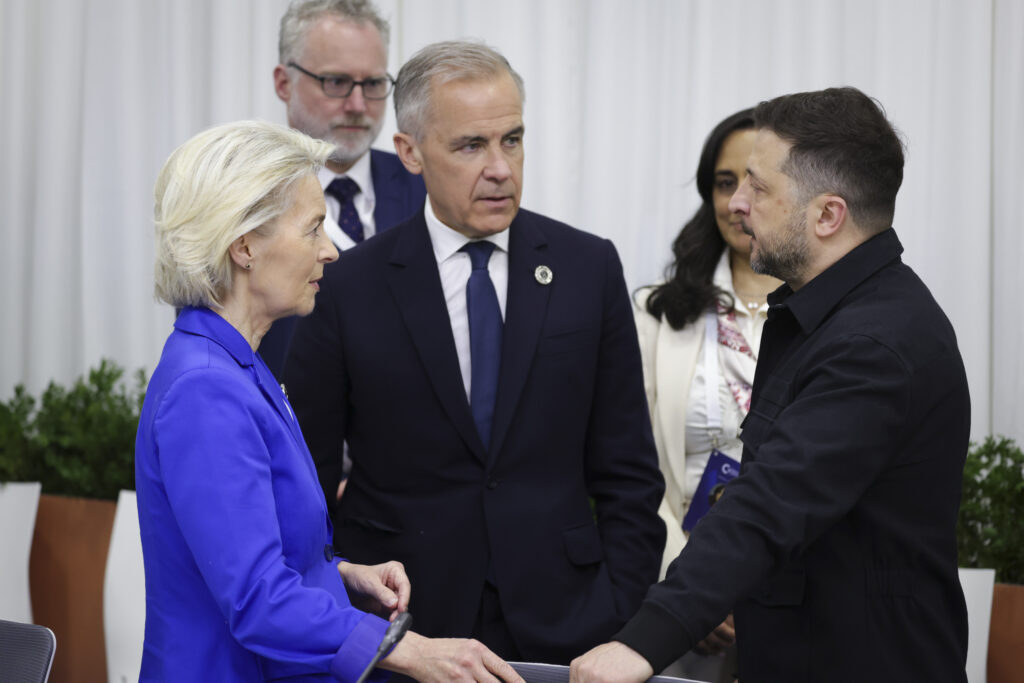
What do you call a Canadian prime minister meeting a Turkish vice-president in Asia? A session of the European Political Community, of course. You can as well call it an anti-Trump-Putin-axis summit, or the Sane-of-Sorts Group.
Europe planted its flag today in an unexpected place. More than forty heads of state and government, plus Canada’s prime minister, assembled in Yerevan, Armenia, for the latest meeting of the European Political Community (EPC).
Holding the gathering in a country that still hosts Russian troops and buys cut-price Russian gas, carried a message of strategic defiance, and of sympathy for a partner edging westward after Moscow failed to shield it during the 2023 Nagorno-Karabakh war. “The fact that we are all here today is a powerful illustration of the country’s courageous geopolitical path,” said European Commission President Ursula von der Leyen, thanking Prime Minister Nikol Pashinyan for his welcome.
Getting the message
“It is also a stark reminder that war in Europe’s neighbourhood has a direct impact on our common security, our energy supply and our economy,” the ranking Eurocrat added. The EPC’s format, launched in 2022, is informal: no treaties, no budget, only talks. Yet symbolism matters.
French President Emmanuel Macron told delegates, “Europeans are taking their destiny into their own hands, increasing their defence and security spending, and building their own common solutions”. Ms von der Leyen echoed him: “We have to step up our military capabilities to be able to defend and protect ourselves.”
A guest from across the Atlantic supplied an extra flourish. “We don’t think that we (have to) submit to a more transactional, insular and brutal world and gatherings such as these point to a better way forward,” declared Canadian Prime Minister Mark Carney whose country is, in a way, in a similar position to the US as Armenia’s is to Russia. Speaking to journalists, he said: “We’re the most European of non-European countries, so there are many ways that we can work together.”
President Donald Trump’s decision to pull thousands of troops out of Germany reverberated through the halls. NATO Secretary General Mark Rutte confronted the issue head-on. “European leaders have gotten the message. They heard the message loud and clear,” he said, while insisting that “Europeans are stepping up, a bigger role for Europe and a stronger NATO”.
US out, UK in?
Italian Prime Minister Giorgia Meloni faced questions about whether some of the 12,000 American troops stationed in her country might also leave. “It is a decision that doesn’t depend on me,” she admitted, but stressed she would not support a withdrawal.
Her British counterpart, Sir Keir Starmer, was still blunter about the strains facing allies. “We cannot deny that some of the alliances that we have come to rely on are not in the place we would want them to be,” the UK Prime Minister told the summit. “There is more tension in the alliances than there should be and it’s very important that we therefore face up to this as a group of countries together,” he said shortly before the 10th anniversary of the Brexit referendum that sent his country to the continent’s political fringes.
Mr Starmer’s frostier relations with Washington stem from London’s refusal to allow British bases to be used for strikes on Iran. He sought warmer links with Brussels, signing a joint statement with Ms von der Leyen and European Council President António Costa. “We underlined our unwavering support for the Ukrainian people and applauded their resilience and courage in recent weeks and months,” the trio declared. They welcomed Britain’s plan to participate in the EU’s €90bn loan for Kyiv and agreed to start negotiations on UK involvement in the European Innovation Council’s scale-up fund.
Peace and power in the Caucasus
Armenia’s security realignment framed many corridor conversations. Russian peacekeepers watched passively while Azerbaijan completed its takeover of Nagorno-Karabakh in 2023. Public confidence in Moscow evaporated, and last year Armenia’s parliament voted to begin the process of joining the European Union.
There is more tension in the alliances than there should be and it’s very important that we therefore face up to this as a group of countries together. — Sir Keir Starmer, Britain’s prime minister
Today’s summit offered more unexpected imagery. Turkish Vice-President Cevdet Yilmaz crossed the long-closed frontier to attend, the first Turkish dignitary of his rank to visit since 2013. It is difficult to overstate the significance of that move.
Azerbaijani President Ilham Aliyev addressed the plenary by video. Ms von der Leyen concluded that “this summit will forever be remembered as a summit of peace in the Caucasus — brought about by brave political choices and patient diplomatic efforts”. Whether the fragile process endures remains uncertain, yet the optics suited Mr Pashinyan, who hosts an EU–Armenia summit tomorrow with Ms von der Leyen and Mr Costa.
Ukraine’s fight continues
Volodymyr Zelenskyy used his time at the podium to demand unity. The Ukrainian president urged partners to “develop one common European voice” on the American-led war with Iran and called for assurances on extra anti-missile defences.
He later announced progress on a drone deal after talks with Ms von der Leyen. Her reply? “The European Union will stand with Ukraine for as long as it takes to achieve a sustainable, just, and lasting peace, in full respect of Ukraine’s territorial integrity.” As a standalone statement, it sounds unambiguous in reality, it is a tired boilerplate response oft-used to obfuscate indecisiveness.
Energy security occupied a separate track. Ms von der Leyen set out the task. “We need to expand energy production capacity in Europe. These include renewable energy and nuclear energy, which allow us to produce energy domestically. They are cheaper and more reliable.” Leaders compared notes on how Gulf tensions threaten gas flows and fertiliser supplies.
A broader family
The EPC prides itself on inclusivity. Sviatlana Tsikhanouskaya, leader of Belarus’s democratic opposition, attended for the fifth time. “Our task is to keep Belarus in the spotlight. And that is precisely why I am here today,” she said on arrival. Her presence reinforced the point that the forum covers both EU and non-EU democracies.
Mr Carney’s invitation pushed the boundary further still. Canada this year became the first non-European participant in the EU’s defence-financing scheme. “We’re the most European of non-European countries,” he repeated, hinting at deeper industrial co-operation. His meeting with European Parliament President Roberta Metsola explored defence, trade and parliamentary links.
Europe’s way of doing things—diplomacy, multilateralism, and respect of international law—yields results, it yields peace. — Ursula von der Leyen, European Commission president
Delegates discussed the Trump Route for International Peace and Prosperity (TRIPP), a proposed transit corridor skirting both Iran and Russia. EU planners argue that such projects bind the South Caucasus into wider supply chains, bolstering sovereignty. Yet the plan also depends on stable relations between Tehran and its neighbours, a point not lost on energy ministers.
Connectivity and caution
Turmoil in transatlantic relations coloured every topic. Kaja Kallas, the EU’s High Representative, labelled America’s troop move a “surprise”, though rumours had circulated for months. Mr Rutte spoke of “disappointment on the US side” at Europe’s hesitance to join the Iran war. Ms Meloni reminded colleagues that Rome restricts the use of its bases to defensive operations.
Armenia also pays a price for its new course. Days before the summit, Russia banned imports of Armenian mineral water, a familiar form of Kremlin pressure. Officials in Yerevan shrugged, arguing that Western markets can offset lost sales if relations deepen.
Ms von der Leyen closed with the thought that “Europe’s way of doing things—diplomacy, multilateralism, and respect of international law—yields results, it yields peace”. Whether today’s show of solidarity endures will depend on money for Ukraine, missiles for Europe’s skies and, perhaps most pressingly, whether America continues to anchor NATO. In the meantime, the EPC provides a stage where Europe—plus like-minded friends—can debate those questions on its own terms, even in the shadow of bigger powers.