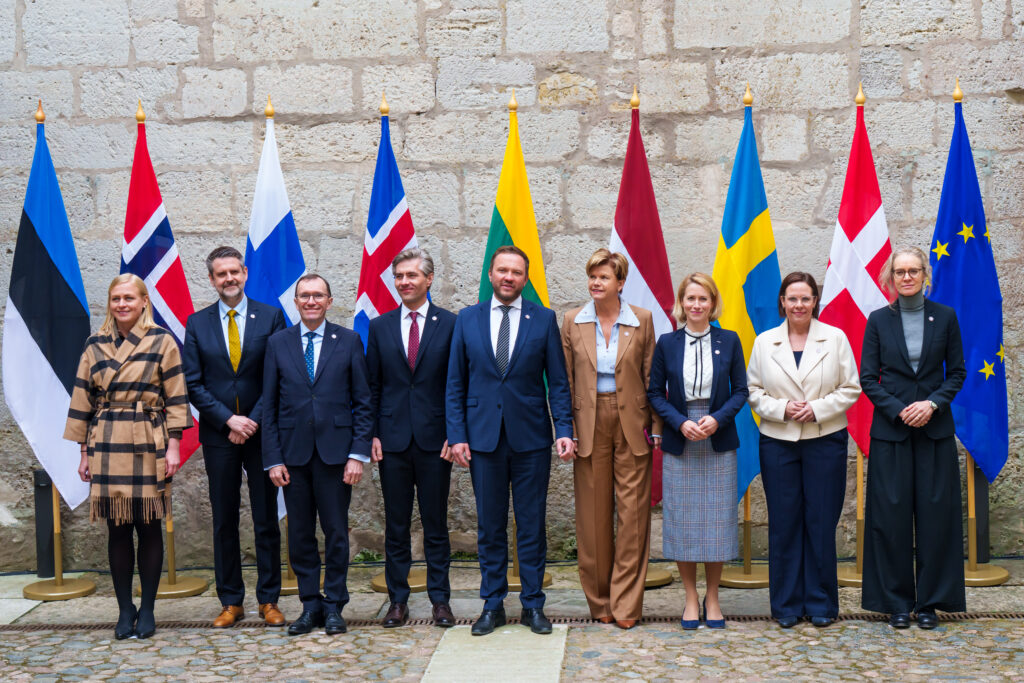
The relationship between the EU and Russia is becoming almost a family feud — shaped by grievances that long predate its collapse. A return to normality now seems impossible. As EU High Representative Kaja Kallas put it after the meeting of the Nordic-Baltic Eight foreign ministers in Kuressaare, Estonia: “There can be no return to business as usual with Russia, even after Moscow ends this war in Ukraine.”
Held on Estonia home turf for EU Foreign Policy Chief Kaja Kallas, the meeting’s agenda covered the bloc’s most pressing security challenges: support for Ukraine, efforts to contain Russian aggression in the region, strengthening European defence, current NATO issues, and developments in the Middle East.
In this close-knit grouping of countries, Estonia’s Foreign Minister Margus Tsahkna described the Nordic-Baltic Eight as “the strongest political framework” — a bloc of “very like-minded countries” that share a common understanding of both the global situation and the threat posed by Russia to Europe.
“For the first time in years, Moscow’s Victory Parade is about to take place without any heavy military equipment. That tells us a lot about how the war is going for Russia.”
— EU Foreign Policy Chief Kaja Kallas
The joint statement adopted at the end of the meeting underlined that Europe must “step up and take greater responsibility for shaping its future” at a time of heightened geopolitical tension, reaffirming that support for Ukraine remains an investment in European security. The ministers also reiterated their backing for Kyiv’s “irreversible path” toward full European and Euro-Atlantic integration, including EU and NATO membership.
Russia is bleeding, but still testing NATO
For European officials, the signs of strain inside Russia’s war machine are increasingly visible. One example, according to Kaja Kallas, is symbolic but telling: “For the first time in years, Moscow’s Victory Parade is about to take place without any heavy military equipment. That tells us a lot about how the war is going for Russia.”
But Russian weakness does not mean reduced danger. The Nordic and Baltic states remain on alert for hybrid threats — from sabotage and disinformation campaigns to cyberattacks targeting critical infrastructure.
“If we want to keep our countries safe, we must continue to strengthen European defence readiness,” she said. “That means increasing defence spending, closing capability gaps and scaling up European defence production.”
For the Nordic-Baltic bloc, the message is clear: Russia’s war does not stop at Ukraine’s borders.
That view was echoed in the ministers’ joint declaration, which pledged deeper defence cooperation with Ukraine and recognised the growing importance of battlefield technology. The NB8 committed to expanding support through cyber cooperation under the Tallinn Mechanism, the IT Coalition, the Drone Coalition and demining initiatives — reflecting a broader view that Ukraine is not only a recipient of security assistance, but a contributor to European security itself.
A new northern maritime front
While the NB8 ministers were meeting in Estonia, another military initiative was taking shape in London: a British-led multinational fleet aimed at strengthening deterrence against Russia in northern European waters.
The initiative was announced by Admiral Gwyn Jenkins, who said a formal declaration on the so-called Northern Fleet Initiative could be reached by the end of the year. The plan would bring Baltic and Scandinavian countries together with the UK to form a joint maritime force, potentially headquartered at Northwood Headquarters, northwest of London.
According to Jenkins, Russia remains “the most serious threat to our security,” with hostile activity by Kremlin-linked ships and submarines rising sharply over the past year. Much of the Royal Navy’s operational focus is now dedicated to protecting the North Atlantic’s critical underwater cable network — the backbone of global telecommunications.
The conversation in Kuressaare will continue next month in Cyprus, where EU foreign ministers are expected to refine their collective approach to Russia and assess how best to strengthen Europe’s security posture in an increasingly confrontational geopolitical environment.