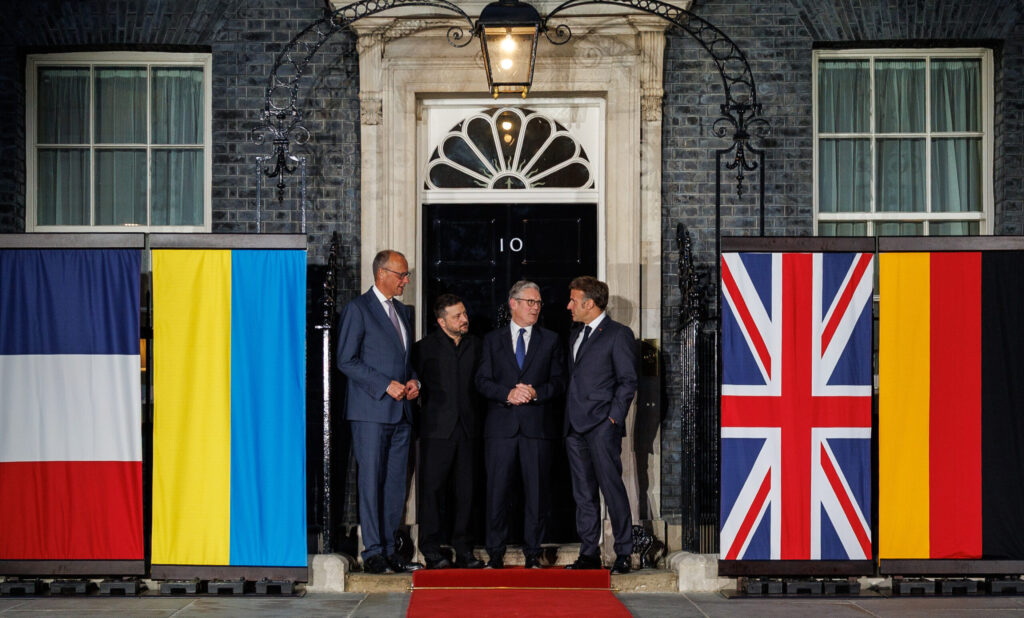
What would a Russo-Ukrainian ceasefire actually mean? Three of Europe’s most influential leaders reaffirmed support for Kyiv in London on Sunday, but left the question unanswered.
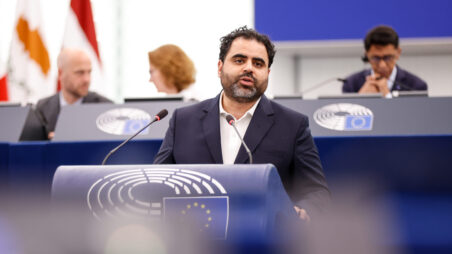
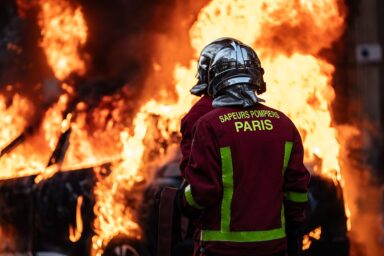
The 7 June meeting at Downing Street came hours after Russia fired Oreshnik hypersonic weapons at Ukraine. In addition, a Russian drone struck a storage facility for spent nuclear fuel nine miles from the Chornobyl nuclear power plant. UK Prime Minister Keir Starmer, French President Emmanuel Macron, and German Chancellor Friedrich Merz met Ukrainian President Volodymyr Zelenskyy to discuss how to counter this.
Zelenskyy called the Chornobyl strike “extremely vile” and stressed that it did not lead to a spike in radiation. “As of now, there are no readings exceeding normal background radiation levels. But there is certainly an increase in Russia’s brazenness, which long ago went off the charts,” he wrote on X.
Five conditions, one absent party
The four leaders issued a joint statement setting out five conditions for a just and lasting peace. First, an immediate and complete ceasefire. Second, the current line of contact as the starting point for negotiations, with international borders unchangeable by force. Third, robust and legally binding security guarantees for Ukraine, building on commitments made in Berlin in December 2025 and Paris in January 2026, including the deployment of the Multinational Force–Ukraine.
Fourth, Russian assets to remain immobilised until Russia ceases its aggression and compensates Ukraine. Fifth, any deal must safeguard European security interests, with EU- and NATO-related elements requiring the consent of member states and allies respectively.
The statement backed Zelenskyy’s open letter to Putin of 4 June 2026, in which he proposed direct talks. The leaders “supported the proposal for a direct dialogue between Ukraine and Russia—with active US and European participation—to bring about a ceasefire and support further negotiations”, the statement said.
Putin, speaking at St Petersburg’s international economic forum on Friday, rejected the offer. He said his war goals had not changed and there was no point in holding peace negotiations. Mr Zelenskyy described the response as “weak”.
The air war intensifies
The London meeting took place against a backdrop of escalating aerial warfare. Russia’s repeated use of Oreshnik missiles prompted the leaders to underline the urgent need to scale up the production of interceptors and co-develop anti-ballistic missile and deep strike capabilities. They also welcomed Ukraine’s ground-breaking use of drone technology and discussed how the alliance could learn from Ukraine’s battlefield expertise.
Ukraine’s own long-range strikes have intensified. Drones hit an oil terminal and a naval port near St Petersburg this week. On Saturday, Ukraine struck again, reportedly targeting an ammunition dump and oil terminal in nearby Kronstadt. Drones also knocked out a bridge connecting Crimea with the Chonhar crossing point, a key supply route, causing severe fuel shortages on the peninsula.
Before the London meeting, Mr Zelenskyy told Sky News: “We will respond. We will be stronger and stronger each day.” He framed air defence as a matter of continental importance, saying that talks would focus on “the security of all of Europe”.
What history warns
The optimism in Kyiv sits uneasily beside a sober analysis published in late May by Chatham House. The paper, written by Simon Smith, Orysia Lutsevych, John Lough, and Keir Giles, argues that a poorly designed ceasefire could make Europe’s security challenges worse, not better. “A ceasefire agreement in Ukraine, far from resolving the continent’s primary security threat, will only make it more challenging and complex,” the authors write.
Russia continually attempts to use peace talks as a tool for manipulation, exploiting Western goodwill to justify new and broader demands. — Chatham House
The paper draws on three historical cases. In Moldova in 1992, a ceasefire froze the conflict on Russian terms and legitimised the 14th Army as a so-called neutral peacekeeping force, with no withdrawal timetable. In Georgia, Russia used ceasefire frameworks in 1993 and again in 2008 to legitimise the separatist entities of Abkhazia and South Ossetia. The Minsk agreements of 2014 and 2015 had no enforcement mechanisms; the OSCE recorded 270,000 ceasefire violations in 2018 alone.
The pattern is consistent. “Russia continually attempts to use peace talks as a tool for manipulation, exploiting Western goodwill to justify new and broader demands,” the authors warn.
A country under strain
The Chatham House paper also documents Ukraine’s internal vulnerabilities. The country’s population has fallen from 40m in 2014 to about 31.1m in Kyiv-controlled territories, and is likely to drop to 29m by 2041. Ukraine needs an additional 4.5m working citizens just to fund its recovery. A 2026 Chatham House survey found that 46 per cent of Ukrainians believe a ceasefire would increase internal political instability.
The economic burden is immense. Recovery costs are about $588bn over ten years, with $200bn in urgent needs. Even under a ceasefire, Ukraine would require $68–105bn annually for defence. There are over 900,000 veterans, 21 per cent of whom self-identify as having a disability, yet only one in six disabled people is employed.
On the military side, the paper says Ukraine needs a force of approximately 1m people: 450,000 active duty, 150,000 conscripts, and 450,000 high-readiness reserves. It also recommends stockpiling 5,500 defensive interceptors annually to protect critical infrastructure, a figure that underscores just how far the London discussion on scaling up production has to go.
Red lines, Russian demands
Russia’s stated demands remain maximalist. Moscow insists Ukraine must never join NATO, that no NATO forces may be deployed on Ukrainian soil, and that elections must be held as soon as possible after any ceasefire. The Chatham House authors note that Moscow has already declared that foreign military units deployed in Ukraine “would be considered legitimate combat targets”, a direct challenge to the Multinational Force–Ukraine that the E3 statement endorses.
The paper is equally firm on what the West must not concede. Ukraine’s sovereignty, any legal recognition of Russian annexations, NATO’s charter, and accountability for war crimes must remain non-negotiable.
We will respond. We will be stronger and stronger each day. — Volodymyr Zelenskyy, Ukraine’s president
On sanctions, the authors are precise: “It would be unwise to give Russia the opportunity to claim that (re)imposing sanctions is a breach of the ceasefire agreement,” they write. Any deal, they argue, must be backed by “credible policies to persuade Russia that it stands to lose more than it will gain by restarting military action.”
Évian, Ankara, and the American question
The London four agreed to use the G7 summit at Évian on 15 June and the NATO summit at Ankara to coordinate further support and press for additional economic sanctions. “They confirmed they would continue to stand firmly with Ukraine,” the joint statement said, somewhat predictably.
The United States looms over all of this. In his letter to Putin, Zelenskyy acknowledged shifting American priorities. “The world has not grown tired of Ukraine, as you long hoped it would. But there is growing fatigue with Russia,” he wrote. The Chatham House paper flags a mooted 2027 deadline for the US to reduce support for European defence, a pressure point for which European nations are currently ill-prepared.
The E3 statement insisted that all efforts should be conducted in closest cooperation with Ukraine, wider European partners, and the US. But the sequence matters. Europe is moving faster than Washington. The question is whether the architecture being built in London, Évian, and Ankara will hold if American attention does not return in time.