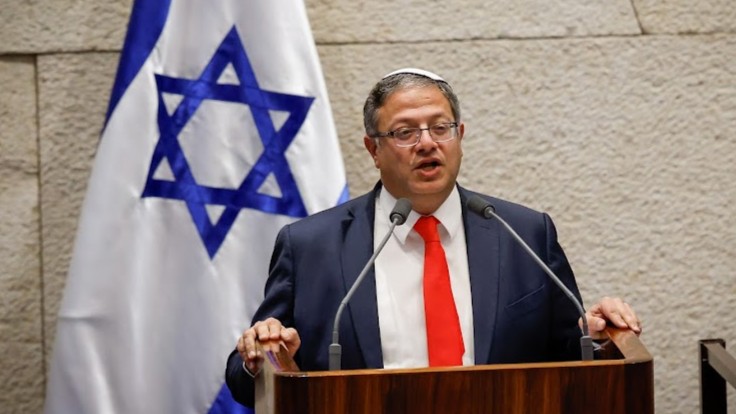
Efforts to impose EU sanctions on Israeli minister Itamar Ben-Gvir have run into familiar limits. Member states are divided over how to respond to his handling of activists attempting to deliver aid to Gaza Strip. For now, the necessary unanimity across the bloc simply not there.
The European Union has so far failed to reach agreement on imposing sanctions against Israel’s National Security Minister Itamar Ben-Gvir. Despite growing pressure from a number of governments calling for a tougher response to the controversial minister, the necessary unanimous backing is still out of reach.
That was the message from EU foreign policy chief Kaja Kallas ahead of Monday’s Foreign Affairs Council meeting in Luxembourg. Under the EU’s common foreign and security policy, sanctions require the agreement of all 27 member states.
Video triggered backlash
The far-right minister posted a video on X showing him walking through the port of Ashdod past dozens of activists kneeling on the ground with their hands bound, while smiling and waving an Israeli flag. “This is how we welcome supporters of terrorism,” he wrote alongside the footage. Prime Minister Benjamin Netanyahu also condemned Ben-Gvir, saying his behaviour was “not in line with Israeli values and laws”.
Ben-Gvir made his presence felt again on Monday with a sharply worded statement in which he declared that Israel, as a sovereign state, is not bound by the recent agreement between the US and Iran. He was referring to a deal under which Tehran is conditioning an end to hostilities and the reopening of the Strait of Hormuz on, among other things, the withdrawal of Israeli forces from Lebanese territory. Israel is engaged there in fighting with the Iranian-backed militant group Hezbollah. “Every time we succumbed to international pressure at the expense of Israel’s security, we paid a blood price with interest,” Ben Gvir wrote on X.
Call for action
The push for action is being driven by countries including Spain, Ireland, and Slovenia. Italian Foreign Minister Antonio Tajani has described the Ben-Gvir’s treatment of activists from a flotilla bound for Gaza as unacceptable. He urged the EU to take a decision on sanctions. France has also taken a notably firm stance, having banned the minister from entering its territory and backing a broader European response.
On the other side of the debate, a group of states is prepared to block any such move. This includes Czechia, Bulgaria, and Hungary. Luxembourg’s Foreign Minister Xavier Bettel has previously criticised the more cautious approach of countries such as Austria and Germany. He argued during May discussions that historical responsibility towards Israel cannot be used to justify present-day actions by its government.
Czechia stands among key opponents
Czechia has emerged as one of the most vocal opponents of sanctions. Foreign Minister Petr Macinka has repeatedly stressed that while Prague does not agree with Ben-Gvir’s conduct, placing him on an EU sanctions list would be counterproductive.
In his view, such a step ahead of Israel’s October elections would only strengthen the far-right minister politically. “Paradoxically, we would end up helping him,” Macinka said, arguing that Ben-Gvir could portray himself as “a victim of some kind of anti-Zionist EU conspiracy”, thereby boosting his support among radical voters.
He has warned EU partners not even to attempt the proposal, threatening to block it if it is formally tabled. At the same time, he emphasised that the Czech government continues to criticise Ben-Gvir’s behaviour and actions. “Our interest is not in helping him, but rather in ignoring him. We also disagree with how he behaves and what he does. On the other hand, placing him on the EU sanctions list is too much for us,” the Czech minister added.
When majority is enough
The sanctions debate forms part of a wider dispute over EU policy towards Israel. Another proposal is also under discussion, focusing on restricting imports of goods from illegal Israeli settlements in the occupied West Bank.
According to legal analyses, such a measure could be approved by qualified majority voting if it is framed as a trade issue, not as a form of sanctions. However, that would also mean the initiative would need to come from the European Commission, which is responsible for EU trade policy, rather than the EU’s diplomatic service. Kallas has already raised the matter with the Commission, but there has so far been no concrete progress.