Foreign powers are interfering in European elections, spreading disinformation, and sabotaging infrastructure. MEPs say the EU’s answer must be legally binding, properly funded, and built to last.
The European Parliament’s special committee on the European Democracy Shield backed a report this Tuesday calling for the EU’s new democratic resilience centre to be turned into a binding structure with a legal mandate, dedicated funding, and operational capacity.
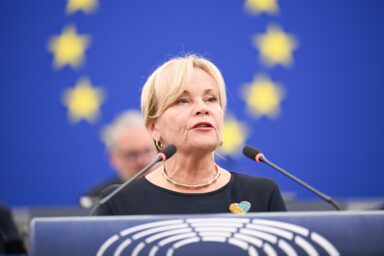
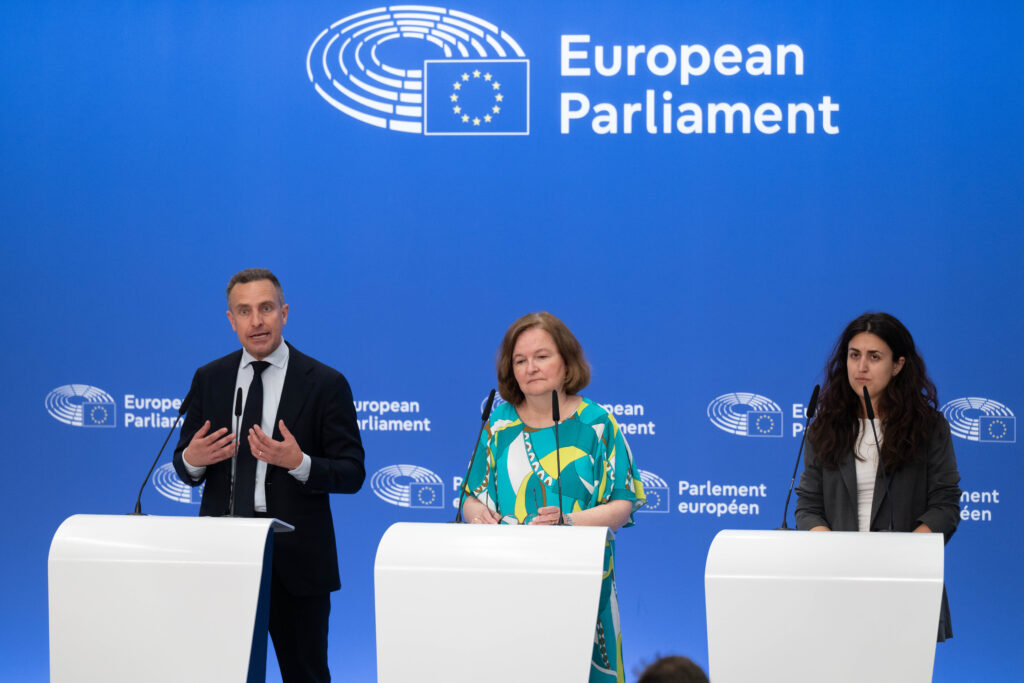
Committee chair Nathalie Loiseau (Renew/FRA) warned after the vote that the centre must not become “symbolic”. According to her, the EU needs a structure to respond to the scale of foreign interference. That concern is also reflected in the report. It states that “the lack of clarity regarding the timeline and concrete milestones for the progressive roll-out of the Centre’s development, as the reference to a ‘gradual’ implementation based on voluntary participation of member states does not provide sufficient predictability, accountability or operational certainty”.
Russia as the main threat
The report identifies Russia as the primary external threat to Europe’s democratic integrity. Next to the country are Belarus, China, Iran, and North Korea. The list of threats includes cyberattacks, sabotage, arson, espionage, GPS jamming, signal spoofing, attacks on critical infrastructure, and covert influence campaigns.
Russia remains the primary threat to Europe’s democratic integrity, and no member state can counter it effectively on its own. — Tomas Tobé, rapporteur (EPP/SWE)
“Russia remains the primary threat to Europe’s democratic integrity, and no member state can counter it effectively on its own,” rapporteur Tomas Tobé (EPP/SWE) said after the vote. “Foreign information manipulation, disinformation, and hybrid interference are becoming increasingly sophisticated and coordinated”.
An annual “European Preparedness Day” on 24 February, the date of Russia’s invasion of Ukraine, and an EU crisis app are some of the other proposals.
Online platforms and AI
Generative AI is accelerating manipulation, and the committee wants faster platform responses. This includes labelling synthetic content and more visibility for independent, verified sources. Education is another response to this problem. MEPs want EU media literacy programmes, especially for minors, including awareness of AI-generated content.
Besides manipulative content, Europe’s dependence on foreign technology, especially from the US and China, can create risks for democracy. To face this, lawmakers call for “digital autonomy stress tests” to map dependence on foreign technology. The report also advocates a “buy European” approach for critical infrastructure.
Next steps
The report was adopted with 20 votes in favour, 9 against and 2 abstentions. Opposition came from ECR, Patriots for Europe, Europe of Sovereign Nations, The Left, and one non-attached MEP. It will now go to plenary, with a vote expected during the September plenary session.
The Centre was announced in November 2025 as a flagship initiative of the European Democracy Shield. On paper, it is to serve as a hub for pooling expertise on foreign information manipulation and disinformation. In practice, it has yet to become operational, which is precisely what MEPs are pushing to change.