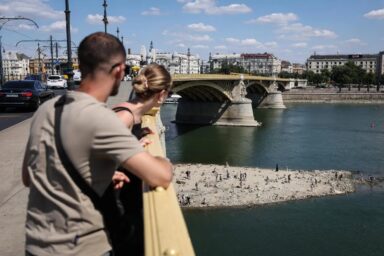
As summer approaches, eleven Schengen countries are calling for tighter rules on Russian tourists’ entry into Europe. They find it unacceptable to see Russians enjoying their holidays in Rome, Paris or Amsterdam while forces of Kremlin continue to shell Ukrainian cities.
In a letter addressed to the European Commission, nine EU member states—Sweden, the Czech Republic, Denmark, Estonia, Finland, Latvia, Lithuania, the Netherlands, and Poland—as well as Norway and Iceland, urge for “new restrictive and binding measures” to curb travel by Russian citizens.
“It is deeply troubling to see a growing number of Russian tourists enjoying leisure travel on European beaches and in holiday resorts,” the signatories wrote. According to the letter, sponsored by Sweden, 477,878 visas were granted to Russian citizens last year. Most of them allowed multiple entries into the Schengen area.
Beyond the political symbolism, the countries also warn of a potential security threat. The access to border-free European territory could make it easier for Russian fighters who served in Ukraine to move across the continent. They are calling on the Commission to better identify both active-duty and former combatants in order to ban their entry into the EU.
The Commission shares those concerns. The Commission shares these concerns. “We are assessing possible ways to restrict their access to the Schengen area,” Commission spokesperson Markus Lammert said.
New measures are under way
Brussels is already working on a new round of visa restrictions. The measures are intended to address security risks arising from hostile actions by third countries. “This is part of the revision of the Visa Code that will come early next year,” Mr Lammert added.
The EU has already strengthened its measures following the invasion of Ukraine. In 2022, Brussels suspended the agreement facilitating visas for Russian citizens. In November 2025, it also banned the issuing of multiple-entry visas to Russian citizens following a series of hybrid attacks attributed to Moscow.
According to the Commission, the number of visas granted to Russians has dropped dramatically, from over four million before February 2022 to approximately 500,000 in 2023. Since then, however, they have slowly begun to grow again.
Who’s not signed it?
However, several countries with strong tourist ties, including France, Spain, and Italy, remain among the top visa-issuing states to Russians. These countries have not signed the letter. In their view, existing sanctions already target hundreds of Russian officials and public figures who are barred from entering the EU. Extending restrictions to ordinary citizens is therefore unnecessary, they argue.
Yulia Navalnaya, widow of Russian opposition leader Alexei Navalny, who died in prison in 2024, also backs this view. Last year, she warned that such restrictions could reinforce the Kremlin’s narrative of Western hostility toward the Russian people.
Renew on the frontline
The Renew Europe group in the European Parliament supports the EU member states’ initiative to limit access to Schengen visas for Russian travelers before the summer holidays. EU justice and home affairs ministers also discussed the proposal informally during a meeting in Luxembourg.
Parliament proposed additional safeguards, including requiring visa applicants to provide documentation of military service, while maintaining humanitarian exemptions for dissidents, human rights defenders, and people fleeing persecution.
MEP Petras Auštrevičius (Renew/LTU) argued that normalising travel from Russia was increasingly difficult to justify. “It would be unjustifiable, both politically and humanitarianly, to continue with tourism as if nothing had happened,” he said.
EU should send a strong message to Russian people, urging them to “take action to prevent their government from killing innocent people in Ukraine”. “Those responsible for the aggression and crimes must know that we are aware of their actions, that they are not welcome in the EU, and that justice will be served,” he added.
Closing visa gaps
The group is also calling for a more unified European approach to visa policy, pointing to data showing continued pressure on the system. According to the Schengen Barometer, visa applications from Russia rose by eight per cent in 2025, with 623,451 visas issued.
“At a time when Russia continues its aggression against Ukraine and intensifies hybrid threats against Europe, destabilising our democracies, we cannot afford a fragmented approach to Schengen visas,” said MEP Malik Azmani (Renew/NLD).
According to him, a common European framework is needed to strengthen the security, fill existing gaps, and ensure that the Russians cannot “exploit our openness, while Europe remains united in defending its values”. “European security must come first,” he concluded.