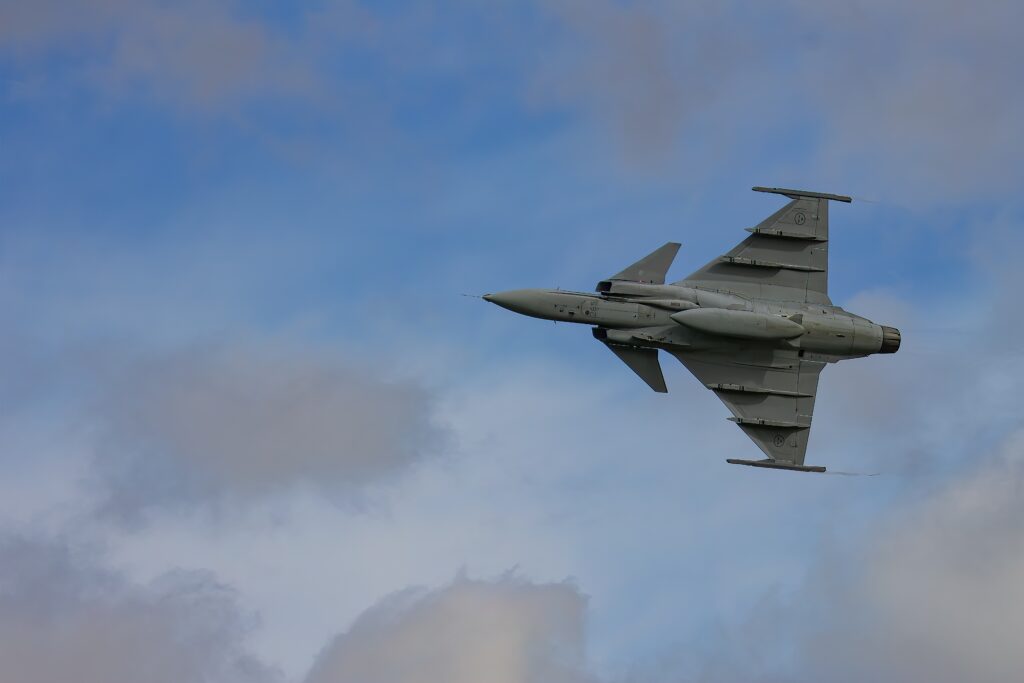
The Sweden-made Gripens equipped with Meteor missiles could deny Russia the safe distance it needs to pound Ukraine from the air.
Stockholm will donate 16 Gripen C/D fighter jets to Ukraine free of charge. Kyiv expects the first aircraft within ten months, roughly in spring 2027. Separately, Ukraine will purchase up to 20 of the newer Gripen E/F variant at a cost of around $2.9bn by 2030.
Last week, Ukrainian President Volodymyr Zelenskyy and Swedish Prime Minister Ulf Kristersson met in Stockholm and formalised the defence deal that had been in the works since October 2025. What does it actually mean for the course of the war?
A potential game changer
The announcement drew immediate attention, not so much for the aircraft themselves, but for what they might carry. Mr Zelenskyy specifically mentioned the Meteor long-range air-to-air missile as “very important,” in order to push out Russian jets dropping aerial bombs. The Swedish government said the donation “may consist of” an advanced ammunition package including the Meteor, alongside Diehl’s IRIS-T and Raytheon’s AIM-120.
Whether the Meteor will definitely accompany the jets remains, for now, unconfirmed by Stockholm. The ambiguity matters enormously. Without Meteor, the Gripen is a capable but not transformative addition to Ukraine’s air force. With it, analysts say, Ukraine gains something it has lacked throughout the war: a realistic means of threatening the Russian bombers that have been systematically destroying its cities and front lines from a safe distance.
To understand why the Gripen-Meteor combination matters, it is necessary to understand what Russia’s glide bombs have done to Ukraine. A glide bomb is a conventional aerial munition fitted with pop-out wings and a GPS/inertial guidance kit. Instead of falling ballistically, it glides for dozens of kilometres, giving the launching aircraft stand-off range.
Its radar cross-section is tiny. The time from detection to impact is short. Ground-based air-defence systems struggle to intercept it. The most reliable counter-measure is to destroy the carrier aircraft before it releases the weapon.
A campaign of attrition
Russia has exploited this logic ruthlessly. Its Su-34 fighter-bombers drop FAB-500, FAB-1500 and FAB-3000 munitions fitted with UMPK (Russian abbreviation for Unified Planning and Correction Module) or newer UMPB (Universal Interspecific/Multi-purpose Gliding Munition) wing-and-guidance kits, from altitudes of 10 to 12 kilometres, 60 to 80 kilometres behind the front line.
Newer kits have demonstrated ranges of roughly 190 kilometres. The bombers stay well outside the reach of most Ukrainian surface-to-air missile batteries and far beyond the effective range of Ukraine’s F-16s and Mirage 2000s, which carry shorter-range missiles.
The scale of the campaign is staggering. Russia dropped a record 7,987 guided aerial bombs in March 2026, followed by nearly 7,000 in April, according to Ukraine’s Ministry of Defence. The attacks have flattened fortified positions, terrorised cities including Kharkiv, Sumy and Zaporizhzhia, and ground down Ukrainian defences in a way that artillery alone could not.
The no-escape zone
The Meteor is a beyond-visual-range air-to-air missile developed by pan-European maker MBDA in a consortium of six countries, including France and the United Kingdom. Sweden was the first country to deploy it on its Gripen fleet, in 2016. It also equips the Eurofighter Typhoon and the Dassault Rafale. MBDA says its ramjet propulsion gives Meteor the largest no-escape zone of any air-to-air missile in Western service.
Gripen C with Meteor offers a (good) chance to successfully engage Su-34s dropping glide bombs 60-70km behind Russian front lines. — Justin Bronk, Royal United Services Institute
The no-escape zone is the critical concept. Conventional rocket-propelled missiles burn out quickly and lose energy; a fast, manoeuvring target at long range can simply outrun them. The Meteor’s throttleable ramjet sustains Mach 4-plus across most of its flight path. It arrives at the target with enough energy to chase a manoeuvring aircraft.
Saab’s operations adviser for the air domain, retired Gripen pilot Jussi Halmetoja, has said the missile can fly 200 kilometres at high speed. Ukraine’s Air Force puts the stated engagement range at more than 120 kilometres, with some estimates closer to 200.
Built for exactly this problem
That range is the key. Russian Su-34s currently release their glide bombs from 60 to 80 kilometres behind the front line, a distance that keeps them safe from Ukraine’s existing air-to-air arsenal. Missiles in Ukraine’s current inventory do not have the range to target Russian bombers without venturing into dangerous layers of long-range Russian air defence around the front lines. Meteor changes the arithmetic.
“Gripen C with Meteor offers a significantly better chance to successfully engage Su-34s dropping glide bombs 60-70km behind Russian front lines than F-16 with AIM-120 or Mirage 2000 with MICA,” said Justin Bronk, senior research fellow for air power at the British Royal United Services Institute.
The Meteor alone does not explain the combination’s appeal. The Gripen brings its own distinct advantages, ones that suit Ukraine’s circumstances unusually well. The aircraft was designed during the Cold War for dispersed operations throughout Sweden, on the assumption that major air bases would be targeted at the outset of any conflict.
The Gripen’s particular suitability
Saab built the Gripen to be concealed at road bases, launched from sections of highway, and rapidly refuelled and rearmed by small maintenance teams. It can take off and land from runways as short as 400 metres. A crew of five can refuel and rearm a returning Gripen within 10 to 15 minutes. Operating costs are the lowest among comparable Western fighters.
These are not abstract virtues in Ukraine. Russian missile and drone strikes have repeatedly targeted fixed airfields. A fleet that disperses along pre-surveyed highway stretches, turns around in ten minutes and moves before Russian intelligence can act is far harder to destroy on the ground.
Gripen C/D with Meteor (are) the best capability to counter Russian glide bombs before they are launched that Ukraine realistically has access to. — Fabian Hoffmann, Norwegian Institute for Defence Studies
Former Estonian Air Force commander Brigadier General Jaak Tarien, speaking to ERR News, placed the Gripen in that context. “They are not particularly demanding when it comes to maintenance or runway requirements,” he said. “They can operate from caves and highways, which is how the Swedes use them”.
General Tarien also noted a technical constraint that shapes how the jets will actually operate. The radars on the older Gripen C/D can detect targets at distances of only about 100 to 120 kilometres, potentially less than the Meteor’s maximum range. The jets will therefore need to work in conjunction with the Saab 340 airborne early-warning aircraft that Sweden is also donating.
How the kill chain works
The operational concept is straightforward in outline, demanding in execution. Gripens disperse to highway road bases 50 to 100 kilometres west of the front. Ground-control intercept stations and the Saab 340 airborne radar track Su-34s as they approach their release points. The Gripen climbs to around 12 kilometres, accelerates to Mach 1.5 to 1.7, and fires the Meteor at the bomber before it reaches glide-bomb release range.
The missile sustains Mach 4-plus and retains energy for end-game manoeuvre, giving the bomber less than ten seconds to react once inside the no-escape zone. The Gripen then breaks, descends and recovers to another road site for a ten-minute hot turnaround. Link-16 data-link feeds the missile mid-course updates until its own radar locks onto the target.
Patriot and IRIS-T surface-to-air batteries share the air picture, providing a layered defence: SAMs for any leakers, Gripens for the bombers. When Ukrainian HARM-equipped F-16s suppress frontline Russian air-defence sites, Gripens can push further east, shrinking the window in which Russian bombers can safely operate.
Caution from Kyiv
Yurii Ihnat, head of communications for Ukraine’s Air Force, was careful not to oversell the prospect. Speaking on the national telethon on 1 June, he urged caution with the term “game changer,” noting that any weapon must first be tested in real combat conditions and that Ukraine had received older versions of the F-16 rather than the most capable variants. He said a similar situation applies to the Gripen C/D.
“And the main thing is the Meteor missile, which could be that ‘game changer’ if everything works out tactically,” Mr Ihnat said. “This missile can push back Russian aviation, which attacks us with guided aerial bombs, away from our borders.”
(The Gripens) are not particularly demanding when it comes to maintenance or runway requirements. They can operate from caves and highways. — Estonian Brigadier General Jaak Tarien
The combination is not without constraints. Sixteen aircraft cover only the sectors with the highest glide-bomb activity. Nationwide coverage would require 40 to 60 jets, a number Ukraine may eventually approach through the planned purchase of 20 Gripen E/Fs and its separate agreements for 100 French Rafales and 150 additional Gripens, but not before 2030 at the earliest.
Limits and uncertainties
Russia will adapt. Increased combat air patrols by Su-35s carrying the long-range R-37M missile could threaten Gripen patrols. More S-400 batteries pushed forward would compress the safe operating envelope. Ukrainian tactics will depend on staying west of those envelopes and using Meteor’s reach to compensate.
The Meteor stockpile question is also unresolved. Germany ordered additional Meteor missiles in January 2026, after Sweden and France both placed further orders in 2025. France and the United Kingdom earlier this year agreed to conduct a joint 12-month study on a successor missile. Supply will need to keep pace with expenditure in combat.
General Tarien was measured about the strategic ceiling. “I do not see either side achieving air superiority in the traditional sense of the term, meaning complete freedom of action in the air,” he told ERR News. “However, the situation will improve for Ukraine once the Gripens begin operating because they will be able to push Russian aircraft even farther away from the front line.”
A meaningful shift
Fabian Hoffmann, a senior research fellow at the Norwegian Institute for Defence Studies, called Gripen C/D with Meteor “the best capability to counter Russian glide bombs before they are launched that Ukraine realistically has access to,” while noting that Ukraine had become “really good” at countering glide bombs with electronic warfare, making the combination useful—if perhaps less urgent—than it would have been earlier in the war.
The main thing is the Meteor missile, which could be that game changer if everything works out tactically. — Yurii Ihnat, head of communications for Ukraine’s Air Force
Ukrainian pilot and Hero of Ukraine Vadym Voroshylov (call sign Karaya), flew the Gripen and called it “the future of our combat aviation,” praising its adaptability to Ukrainian conditions and ease of integration with Western weapons systems. Saab has said it is ready to open a final assembly plant in Ukraine; full domestic production is expected to begin in 2033.
Russia launched its glide-bomb campaign because it found a safe distance, one from which it could pound Ukraine without meaningful risk to its aircraft. The Gripen-Meteor combination, if delivered with the promised munitions and integrated effectively, shrinks that distance.
It does not end the threat. But it forces Russian planners to choose between flying closer to the front and accepting higher losses, or dropping their bombs from so far away that accuracy suffers. For a country that has absorbed over 15,000 guided aerial bombs in two months, even that partial shift would matter.