A 12.1 per cent plunge in Irish GDP tipped the whole eurozone into contraction. Yet most of that drop never touched the real economy. It was simply the bookkeeping of a handful of American multinationals.
So what does it mean for Europe when one country’s accounting can rewrite the economic story for the whole eurozone? In real terms, the Irish economy itself is fine. “On the surface, to somebody that doesn’t know Ireland, it looks like Ireland is in a very severe recession. But actually, things are pretty robust,” said Irish economist Shaun McDonnell.
The eurozone had been projected to grow by 0.1 per cent in the first quarter of 2026. Instead, revised Eurostat data showed a contraction of 0.2 per cent, the bloc’s first quarterly decline in over a year. The principal cause was Ireland, whose 12.1% contraction was itself a dramatic downgrade from an initial −2% estimate, knocking as much as 0.4 percentage points off eurozone output, according to Goodbody chief economist Dermot O’Leary.
But the domestic economy looks healthy. “If you look at Central Bank credit and debit card spending and adjust for inflation, real spending growth on a rolling three-month basis was around 7.5 per cent year on year. We’re still seeing robust domestic activity,” McDonnell said.
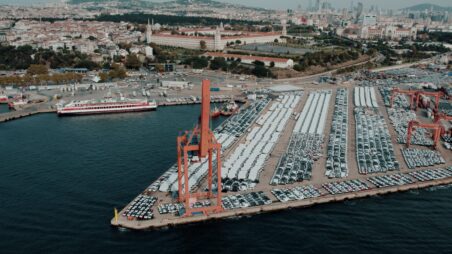
The distortion traces back to multinationals—Apple, Google, Microsoft, and others—that use Ireland’s favourable tax regime as a gateway to the European Union. “A lot of American businesses set up here. And with it, their profits go through Ireland, so the product goes into Irish GDP, but this product is actually produced in, say, Taiwan,” McDonnell said. “Those products at no stage impact the Irish economy. It’s just a flow of international capital that comes in and out, neither for good nor for bad.”
McDonnell describes it as a parallel economy—one that exists in the books, less connected to conditions on the ground in Ireland than to the geostrategic environment, including the instability around the US–EU trade relationship. The official data show the contraction was concentrated in the multinational-dominated sector, which fell 27.1 per cent in the quarter, with the globalised industry component down roughly 35 per cent. The collapse was led by pharmaceuticals—the very sector that had inflated Irish output a year earlier.
“When Trump initially made announcements about tariffs, Ireland started to frontload exports in anticipation of higher tariffs on goods. So some of what you’ve seen in the latest figures is a base effect—we’re comparing against a period where there was substantial growth,” McDonnell said.
This is why economists in Ireland have learned to move away from GDP as the base indicator. “Irish economic growth figures as measured by GDP are quite misrepresentative of what goes on in the Irish economy,” McDonnell said. “Economists here, including myself, prefer to look at modified domestic demand (MDD), which removes multinational volatility and looks at how economic conditions are for domestic consumers and firms.”
By that measure, Ireland grew. According to Ireland’s Central Statistics Office (CSO), MDD rose 0.6% in the quarter and 4.3% over the year, lifted by personal spending.
What the eurozone must learn
For the bloc, “on the surface it rings alarm bells”, McDonnell said. But the alarm is largely misplaced. Forecasters had already pencilled in slower growth for both Ireland and Europe. Stripping out Ireland, eurozone output stayed in positive territory, with Germany, Italy, and Spain all expanding. The bloc-wide contraction was an Irish artefact, not a continental one.
The real lesson is about how Europe reads its own economy. A single small member state can swing the entire bloc’s growth print by several tenths of a point. It does so through the accounting of a few foreign firms. That makes aggregate eurozone data a noisier signal for those who rely on it.
Ireland’s quarterly numbers are now so volatile that analysts openly concede they are close to impossible to forecast. That volatility feeds straight into the figures the European Central Bank (ECB) watches.
Headline inflation hit 3.2% in May, driven by an energy shock tied to the US–Israeli war on Iran and disruption around the Strait of Hormuz. In response, the ECB raised rates on 11 June, its first hike since 2023, lifting the deposit rate to 2.25%. Markets are already weighing a second move later in the year. A growth picture distorted by Irish pharma flows unwinding after last year’s pre-tariff surge does nothing to clarify that judgement, but further muddles it.
The deeper warning runs to the competitiveness debate now occupying Brussels. Ireland’s phantom contraction is the mirror image of a growth model few other member states can copy. That model means an extreme reliance on a handful of foreign multinationals. Their decisions—shaped by US tax and tariff policy rather than Irish conditions—can dominate the national accounts in either direction.