Belgium’s deadliest heatwave on record killed nearly 1,750 people in a fortnight, most of them elderly and poor. As politicians turn air conditioning into a culture war, Europe’s market has already made its choice, leaving Brussels to catch up.
Beneath the rhetoric lies a genuine opportunity: heat pumps can cool and heat buildings all year round, and where they cannot, cheaper environmental solutions already exist.
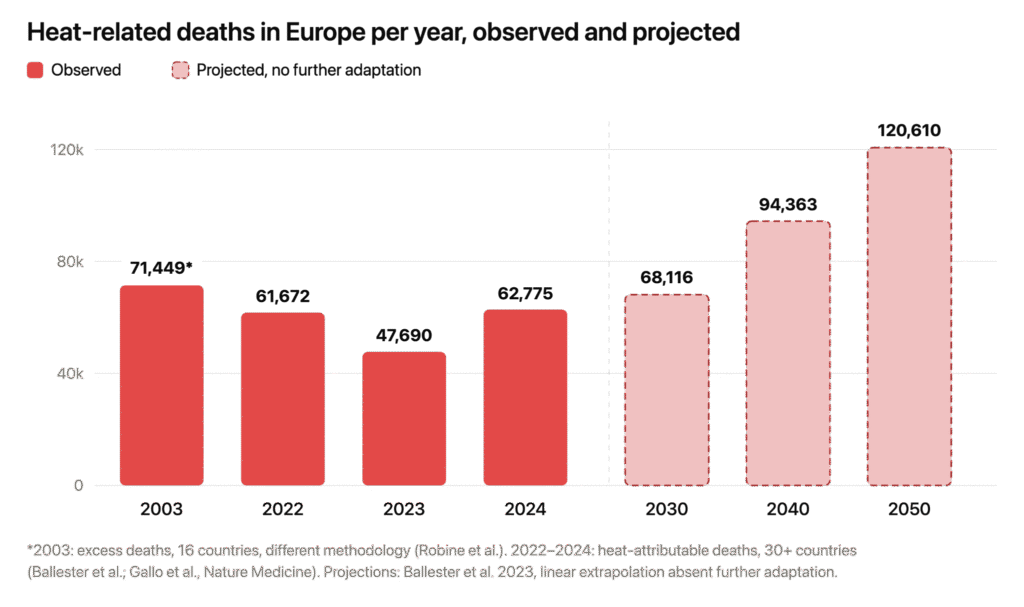
Mortality in Belgium rose 48 per cent during the two-week spell. On the worst single day alone, 641 people died. France fared little better, recording more than 2,000 excess deaths in a single week.
Much of the reaction to the crisis has been dismissive, swept up in the culture war. “It’s been hot for two days and we’re all going to die again,” joked Belgium’s defence minister Theo Francken on social media, promising followers photos of his pool, a cold Stella and a barbecue.
“Right now what we’re seeing is this weird culture war, where people on one side are saying air conditioning should just be everywhere and the evil climate zealots want us all to die of the heat,” said Jan Rosenow, Professor of Energy and Climate Policy at the University of Oxford. “It’s a bit strange that the same people who always pretended that there wasn’t climate change, and that summers would not be hotter than in the past, are now screaming that we should all get air conditioning,” he continued.
By the time the heat broke, portable air conditioners had vanished from Brussels shop shelves. Belgian wholesale electricity had hit a record of over €1 per kilowatt-hour at sunset on 24 June, as air conditioning demand collided with weak wind output and reduced nuclear capacity.
In France, presidential contender Marine Le Pen was demanding a €20bn loan scheme. It would put air conditioning in tens of millions of French homes. In Flanders, Energy Minister Melissa Depraetere declared she was taking air conditioning “out of the doghouse”.
Europe’s new heatwave normal
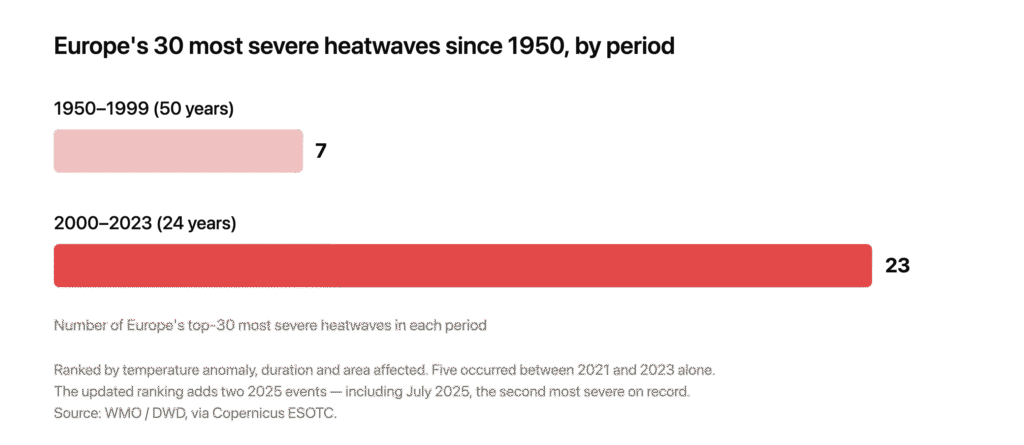
Europe is the fastest-warming continent, heating at roughly twice the global average. Summer temperatures across the continent rose at 0.028°C a year between 1991 and 2012. That rate then jumped five-fold, to 0.142°C a year, in the decade that followed. Of the 30 most severe heatwaves Europe has recorded since 1950, 23 have struck since 2000.
Europe has long been the world’s holdout on air conditioning. In the US and Canada, the figure is three-quarters. In Japan and South Korea, it is roughly nine in ten. Across Asia-Pacific, it is nearly half, according to the IEA. Europe has the lowest AC penetration of any advanced economy, and is the least prepared for the heatwaves ahead.
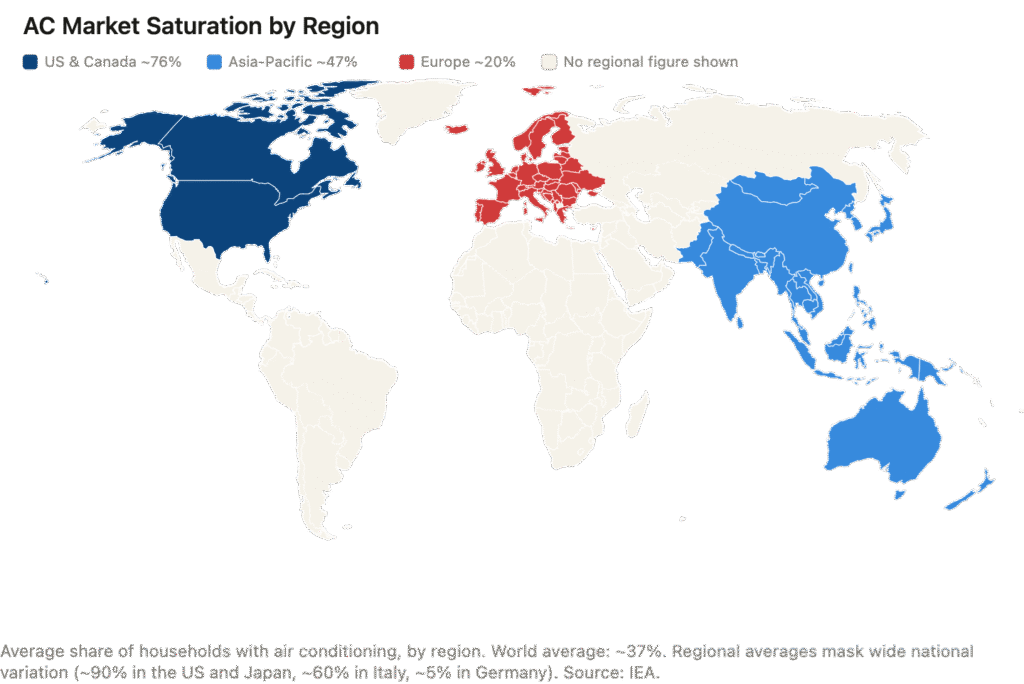
But Europe’s rush to cool down is already under way. Italy now accounts for a third of all EU electricity spent on cooling. France has climbed to roughly one in four homes.
The heat pump pivot
The clearest rise is in the heat pump sector. Europe sold 7.3 million heat-pump units in 2025. The industry’s association counts only 2.7 million of those as heating purchases. The rest, mostly reversible air-to-air units, went largely towards cooling.
“Air conditioning systems are effectively heat pumps. They’re just pumping the heat out of the building rather than into the building. If you install a reversible air-to-air heat pump, you can do both: you can also heat the building with the same device in the winter and displace fossil fuel used for heating,” said Rosenow.
“If someone is convinced they need cooling in summer, and at the same time you convince them to decarbonize their heating, it’s a major win,” says Melanie Auvray of the European Heat Pump Association.
Rosenow believes there is a policy opportunity there: “If you subsidise a reversible heat pump, that can also reduce the emissions that cause the heatwaves in the first place.” The Commission has already targeted 4m heat pump sales a year by 2030. The cooling crisis may speed that up.
The IEA expects the global stock of cooling equipment to more than double by 2050, rising from around 3.4 billion units to over 8 billion. More than half of that growth will come from China, India and Indonesia. The markets have chosen air conditioning as a necessary means of surviving global warming. Europe is just the last to wake up to it.
The most vulnerable
“Some people have air conditioning who can afford it, but some people might not. This is an equity issue: who can afford air conditioning, who will install it first, who will install it last,” said Rosenow.
In France’s June heatwave, 85 per cent of the excess deaths were people over 65. Deaths of those in their home jumped 91 per cent. Grandmothers and grandfathers passed away alone in their homes due to heat. In Belgium, even among those under 65, mortality rose more than 60 per cent. The common thread is access and ability. The people dying in Europe’s heatwaves are overwhelmingly those without: the widow in an un-shuttered flat, the tenant on the top floor, the household that simply cannot afford another electricity bill.
“Protective infrastructure and nature-based solutions, such as urban greening, cool surfaces and overheating standards in social housing, can reach the vulnerable and require no direct action from households,” says Clara Camarasa of the UNEP Copenhagen Climate Centre.
Panic buying
As these heatwaves hit, portable units and fans get snapped up, even when a better option is on the table. This applies both to those who choose convenience and to tenants who have no other option. “When it’s a heatwave like this, people rush to the shops for fans and portable units, which are far less effective and efficient than a properly installed heat pump system,” says Auvray.
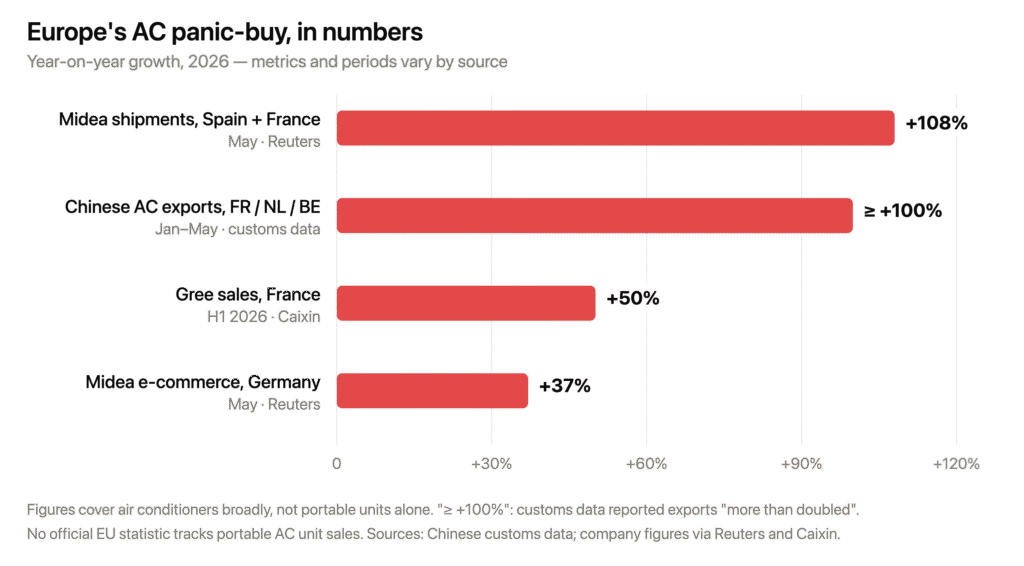
“Panic-buying can lead to the least efficient equipment going into the least efficient buildings at the moment of maximum grid stress,” Camarasa said. China is meeting much of that rush. Chinese air conditioner exports to France, the Netherlands and Belgium more than doubled in the first five months of this year, according to Chinese customs data.
This approach limits the cooling people need. It also harms the climate further. “People go out and buy room air conditioners on Amazon, open the window and feed the exhaust through, but it’s not properly sealed, and it draws hot air back in,” says Rosenow.
There is also a knock-on effect: air conditioning pushes hot air back outside. Modelling of Paris by Météo-France researchers found air conditioning raises outdoor temperatures by up to 1°C today. In high-adoption scenarios, that rises to as much as 2°C. The effect is strongest at night, when hot cities kill.
Europe’s buildings compound the problem. Designed to keep heat in, not out, they waste energy on cooling. Research led by Francesco Colelli found that relieving one degree-day of heat exposure in Europe takes roughly five times more electricity than in India.
The bigger picture
Heat pumps are a necessary part of the solution, but only part of it. Asked whether they solve the deeper problems, the overheating cities, the straining grids, Rosenow is blunt. “No, not really,” he said.
“When a city relies on air conditioning alone, part of the cooling gained indoors is offset by heat released outdoors,” Camarasa added. The grid problem persists too: “Most electricity systems in Europe are winter-peaking,” Rosenow notes, “but with cooling, that could reverse.”
What is needed first and foremost is a broader infrastructural change. “Reduce the need for cooling first through shading, insulation, ventilation and more urban trees, then add efficient active cooling where it is still needed,” Rosenow wrote in a widely shared post this month.
What already works
“Southern Europe’s vernacular architecture solved much of this problem centuries ago — white buildings, thick walls, extensive shading, natural ventilation,” says Camarasa. “The knowledge already exists; the problem is that we moved away from it.”
“Europe can learn from countries like Japan that near-universal ownership of efficient equipment, combined with sensible behaviour such as moderate temperature setpoints, can keep consumption manageable,” Camarasa said.
Insulation and external shading alone can cut a building’s cooling demand by up to 80 per cent. They cost a fraction of mechanical cooling to install. They also protect everyone on the street, including those who cannot afford AC.
For dense cities, all three experts pointed to district cooling as a solution. Paris already runs one of the world’s largest networks, pumping Seine-chilled water beneath the city. It plans to triple it by 2042, reaching more than 3,000 buildings including hospitals, schools and retirement homes.
Europe’s missing plan
“I doubt we have a particular view or position on air conditioning,” European Commission spokeswoman Anna-Kaisa Itkonen said when asked about AC this June. The culture war has left the Commission unsteady on its future approach, but the economics are fairly straightforward. The public is pushing for cooling. India already has a national cooling action plan. Europe could have one too.
Policy has to get ahead of the adoption curve rather than react to it.
— Clara Camarasa, UNEP Copenhagen Climate Centre
“Policy has to get ahead of the adoption curve rather than react to it,” says Camarasa. This is already visible in the Commission’s Electrification Action Plan, due next month, which will unveil new measures for the bloc’s heating and cooling systems.
In the meantime, the market has already decided: air conditioning is here to stay. The question is what Europe does with that. It can leave cooling to yearly panic demand dominated by Chinese imports. Or it can build a plan that cools its cities, protects the most vulnerable and delivers the climate transition at the same time.