Companies doing business across Europe still face a maze of 27 national tax systems that can hold them back. European lawmakers are calling on Brussels to go further with plans for a new tax framework that would make it easier for businesses to expand and compete.
In Thursday’s vote, MEPs backed proposals for an optional EU-wide tax framework that would complement the Commission’s planned EU Inc. legal status, setting out Parliament’s vision as negotiations on the broader reform continue.
The proposals are part of the Commission’s flagship “28th regime” initiative, which aims to give businesses a single set of rules for operating across the EU instead of navigating 27 different legal systems.
Our single market remains one of the most underused assets at our disposal. Fragmentation makes us punch below our weight. — Ľudovít Ódor (Renew/SVK)
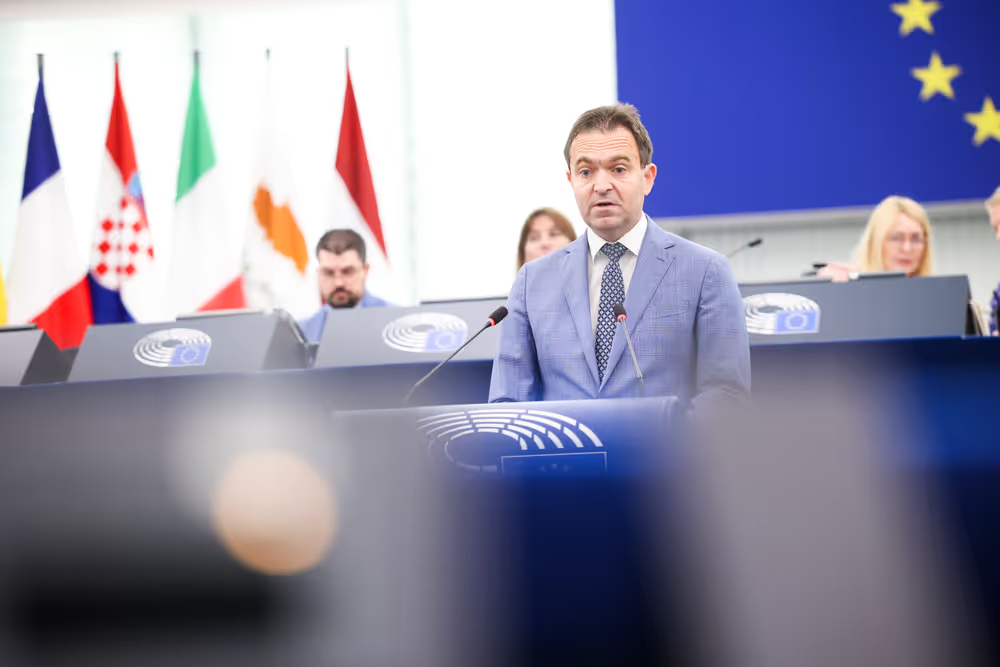
“While focusing specifically on taxation, this report supports the ultimate goal of the overall EU. Inc endeavour: to create an ambitious, yet still caring space for European talent in business, and future growth and prosperity,” rapporteur Ľudovít Ódor (Renew/SVK) said.
One company, 27 tax systems
Supporters argue that while the single market allows companies to sell goods across borders, expanding a business remains unnecessarily complicated because firms still have to deal with different tax administrations, reporting systems and procedures in every member state.
“Our single market remains one of the most underused assets at our disposal,” Mr Ódor told MEPs. “Fragmentation makes us punch below our weight.” He said businesses consistently identify taxation, alongside legal and administrative complexity, as one of the biggest barriers to expanding across Europe.
To tackle that, Parliament wants the Commission to develop an optional EU tax framework alongside the new legal status. Companies choosing it could file standardised tax returns, use simpler VAT procedures through a single EU VAT number, and benefit from more coordinated corporate tax rules across participating countries.
The report also suggests common rules for employee share schemes, simpler transfer pricing rules and better coordination of tax incentives for research and innovation, all aimed at making Europe more attractive for start-ups and fast-growing companies.
Growth versus national control
Supporters presented the proposals as a way of keeping innovative companies in Europe. “Unfortunately, many scale-up companies are leaving our market,” said Luděk Niedermayer (EPP/CZE), arguing that simpler tax rules would make it easier for businesses to grow without relocating abroad.
This is an erosion of national competence. — Enikő Győri (PfE/HUN)
Enikő Győri (PfE/HUN), however, argued that taxation should remain firmly in the hands of national governments. “This is an erosion of national competence,” she said, insisting that member states can simplify their own tax systems without Brussels becoming involved.
S&D supported the overall direction but stressed that any new framework should not become a vehicle for tax avoidance. Bruno Gonçalves (PRT) argued that companies should only qualify if they carry out genuine economic activity in the EU and continue contributing fairly to national tax systems.
A first step
The vote gives Parliament’s negotiators a political mandate as discussions continue on the Commission’s broader EU Inc. proposal.
“There is still much work to do so that European companies may function, grow and flourish within the single market,” Mr Ódor said. “But I am convinced that this report is a positive statement to companies and those who wish to invest in their growth because it helps simplify life for companies.”