The European Commission has specified a price tag on its two flagship eastern defence projects: up to €100bn for border security, €5bn for drones.
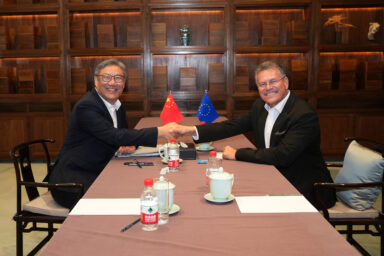
The European Commission has put figures to two of its most ambitious defence initiatives. Balázs Újváry, Commission spokesperson, confirmed on Tuesday that the EU is backing its European Defence Projects of Common Interest from this past July with an investment of €325m. Two projects dominate the package: Eastern Flank Watch and DECODER.
The two initiatives share a common logic but differ sharply in scope. Eastern Flank Watch is the broader umbrella, covering the full threat picture along the Union’s eastern border. DECODER is the focused drone-and-counter-drone effort nested within it.
Watching the flank
Both projects are open to EU member states, Norway, and Ukraine. That reflects a deliberate choice to anchor the initiatives in the wider European security architecture, not just the Union’s internal structures.
Eastern Flank Watch goes well beyond drones. Mr Újváry was explicit: “It covers a range of capabilities, be it counter mobility, military mobility, air and missile defence systems.” Thirteen EU member states, Norway, and Ukraine participate.
The indicative investment runs between €60bn and €100bn, with a completion timeline of 2036. The Commission’s roadmap ties the project to Defence Readiness 2030 and envisions faster authorisation and greater access to EU funding for projects of this kind.
The scope is deliberately wide. Eastern Flank Watch covers multi-domain surveillance, electronic warfare, precision strike systems, and coordination with NATO structures such as Baltic Air Policing. It targets hybrid, cyber, maritime, and conventional threats from Russia and Belarus alike.
Drones at scale
DECODER—Drone and Counter Drone European Resolve—is the more specific of the two. All 26 EU member states participate, alongside Norway and Ukraine. Mr Újváry put the indicative budget window at between €3.5bn and €5bn, with completion by 2033.
The project aims to enable coordinated development, scaling, and deployment of European unmanned and counter-unmanned systems. It is to fill capability gaps that no single member state can address alone. The design is to ensure the delivery of interoperable systems across all domains.
These collaborative industrial projects are designed to turn shared priorities into jointly developed capabilities. — Balász Újváry, European Commission spokesman
DECODER also carries an industrial policy dimension. It should support joint procurement, expand production capacity, and create a European Network of Drone Technology Hubs to accelerate testing and innovation.
The bigger picture
The two projects reflect a shift from scattered national efforts to coordinated, industrially backed border defence. Eastern Flank Watch provides the geographic and architectural frame. DECODER provides the unmanned systems capability within it.
Implementation of both was due to begin in 2026. Eastern Flank Watch was expected to reach full operational capability by the end of 2028. DECODER’s longer runway, stretching to 2033, reflects the industrial ambition behind it.
Mr Újváry framed the broader package in clear terms: “These collaborative industrial projects are designed to turn shared priorities into jointly developed capabilities.” The Commission is betting that shared money, timelines, and hardware can do what decades of fragmented procurement could not.