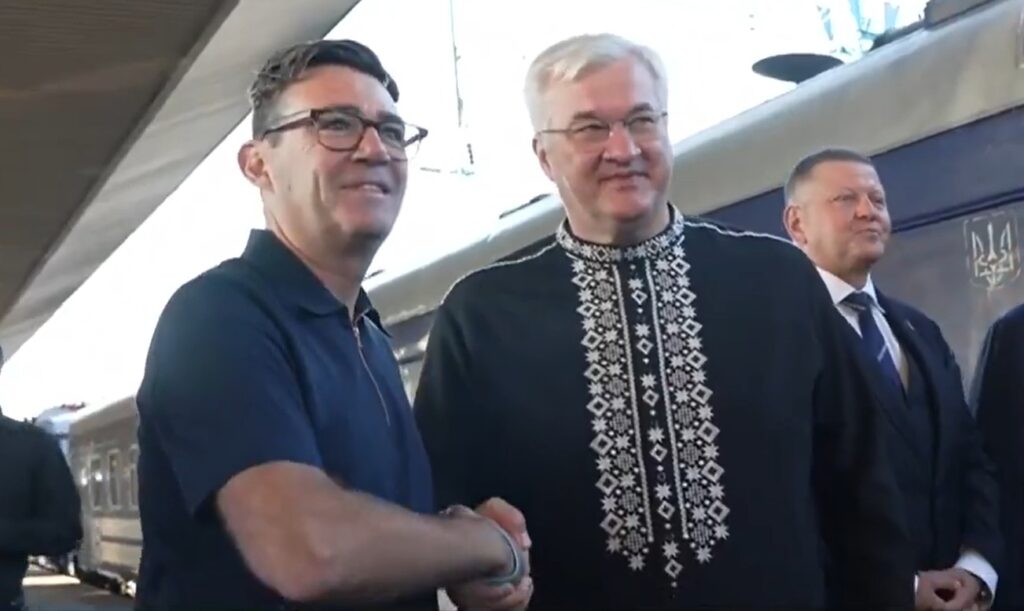
Britain’s Storm Shadow blueprints for Ukraine reveal how deep (if quiet) a renaissance EU–UK defence ties have enjoyed since Brexit.
When the British Prime Minister Andy Burnham touched down in Kyiv on Monday, he carried more than words of solidarity — cruise missile blueprints. The decision to hand Ukraine classified technical information on British components means a lot of things.
For Kyiv, the gesture is a bilateral act of wartime generosity. Looked at from Brussels, it is something considerably more significant. It reveals how far EU–UK defence cooperation has quietly, and sometimes awkwardly, been rebuilt since Brexit. In London, it’s yet more complex.
A European missile, a British decision
Storm Shadow (or Scalp-EG in its French export variant) is a joint product of European industrial history. Built by MBDA, a consortium with British, French, Italian and German shareholders, the missile is a physical embodiment of the kind of cross-border defence collaboration the EU has spent years trying to institutionalise.
France moved first, handing Kyiv the Scalp-EG blueprints as part of a wider defence deal struck in July. But Ukraine’s ability to actually manufacture the weapon domestically depended entirely on a British decision: MBDA could not release sensitive information on UK-made components without London’s sign-off. Mr Burnham gave it.
The sequencing matters. It was not the EU that unlocked Ukrainian missile production. It was a bilateral Franco-British decision, coordinated outside EU structures, that made it possible. And yet the implications land squarely inside EU policy space.
Ukraine’s ability to produce its own long-range strike weapons reduces its dependence on drip-fed Western stockpiles, accelerates its path toward the kind of defence industrial self-sufficiency the EU has been trying to foster through its own instruments (including the European Defence Projects of Common Interest and the AGILE programme) and changes the calculus of what EU financial support to Kyiv actually buys.
The EU’s stake
The Union’s financial stake is self-evident. The EU approved a €90bn Ukraine support loan package in February 2026, of which €60bn goes to defence capabilities and military procurement. A further €30bn in macro-financial assistance is partly contingent on legislative reforms in Kyiv.
It is a condition Ukrainian President Volodymyr Zelensky acknowledged publicly on the eve of the independence day summit. He noted he was working with France and Germany to release the frozen funds. The Storm Shadow decision does not directly unlock that money, but it shifts the political atmosphere. A Ukraine that can manufacture Western weapons domestically is a stronger argument for continued EU financial commitment.
Germany and the UK are now the two largest European backers of Ukraine by publicly reported figures, and they co-lead the Ukraine Defence Contact Group attached to NATO. The Storm Shadow decision fits a pattern: Britain acting as a full participant in European security, even while remaining outside EU institutions.
Participation without membership
That gap between participation and membership is where the tension lives. The EU’s own defence industrial ambitions (EDPCI, AGILE, the Defence Procurement Directive simplification) are designed to build a distinctly European capability base. The UK is not part of that legislative architecture.
MBDA, the missile’s manufacturer, straddles both worlds, but the legal and procurement frameworks do not. As the EU pushes to create binding rules for joint defence procurement and shared industrial projects, the question of how a deeply integrated but formally external partner like the UK fits into that system remains unresolved.
What Mr Burnham’s visit clarifies is that in practice, the EU–UK defence relationship is already functioning at a level of depth that the formal institutional framework has not caught up with. France and Britain made a joint industrial decision affecting Ukraine’s war-fighting capacity. Germany and Britain are co-leading Ukraine’s international support structure. The EU is providing the financial architecture. None of these actors are operating in isolation; but neither are they operating through a single coherent system.
Burnham’s pro-European gamble
This finally brings up the London angle. Mr Burnham is the most pro-EU top-league British politician since Sir Tony Blair and his New Labour suite in the late 1990s. This, however, is a hard sell in the current British political climate. Any mention of reversing Brexit would pretty much leave Mr Burnham at the mercy of Nigel Farage and his avowedly anti-Brussels Reform pack.
Russia has accelerated its destabilisation campaigns against allies through cyber attacks, assassination attempts and acts of sabotage. — Unnamed NATO official
This is how Mr Burnham may be trying to tip the balance in favour of his pro-European views by stealth. Defence (including participation in Ukraine’s war efforts) is one of the areas where most Britons agree. Vladimir Putin’s broadsides against Whitehall because of Storm Shadows—something that is almost inevitable—will drive the point home with extra urgency.
It also makes common sense. As a NATO official told The Telegraph: “In recent years, Russia has accelerated its destabilisation campaigns against allies through cyber attacks, assassination attempts and acts of sabotage.”
The bigger picture
There is also a structural point about where Britain now sits in European security architecture. The 2024 Trinity House Agreement between London and Berlin, and the 2025 Kensington friendship treaty that followed, have embedded the UK into a web of bilateral and minilateral defence arrangements with EU member states that did not exist five years ago. Any move like Mr Burnham’s on Monday will only cement the spirit, if not the letter, of such arrangements.
For Brussels, the lesson may be that the most consequential European defence decisions of this war are being made in bilateral and minilateral rooms, not in Council working parties. That is not necessarily a problem. But it is a reminder that building a genuine European defence capability will require not just new legislation, but a clearer answer to the question the Storm Shadow blueprints quietly pose: where does European defence end, and British defence begin?