
Meta wanted to build its largest Dutch data centre on farmland. The town said no, and forced Brussels to rethink. The EU still wants to triple Europe’s data centre capacity, and support outweighs opposition, but one town has shown how fast that can change.
The offer came in 2021: a 166-hectare hyperscale campus on farmland. The then Rutte government promised the community 400 permanent jobs, courting the investment. The town however, had other thoughts.
A local party running against the project swept the 2022 municipal elections, and within days the Dutch Senate urged the government to halt the centre’s creation. Brussels’ Cloud and AI Development Act (CADA) is the EU’s response, a push to expand data centre capacity across Europe.
Two goals, one law
The Commission’s plan is to at least triple the EU’s data centre capacity within five to seven years via CADA. Around 40 per cent of people in Britain, Germany and France back building more data centres, a Public First survey found, more than twice as many as oppose it, though a large share remain undecided.
CADA is the centrepiece of the Commission’s Technological Sovereignty Package, its bid to loosen Europe’s dependence on non-EU technology. The regulation bolts two ambitions into one law: build cloud and computing capacity fast, and control who owns it. Those two goals, however, do not always pull in the same direction.
The build-out runs through Data Centre Acceleration Zones and a green corridor capping permits at 12 months. The Commission estimates the expansion needs around €200bn, mostly private.
That private demand has yet to appear. At present, European firms already buy cheap, competitive multi-cloud from the incumbents CADA wants to fence off.
Not how much, but whose
The grid strain will also be a factor. The data centre electricity demand is expected to more than triple by 2030, to roughly 35GW.
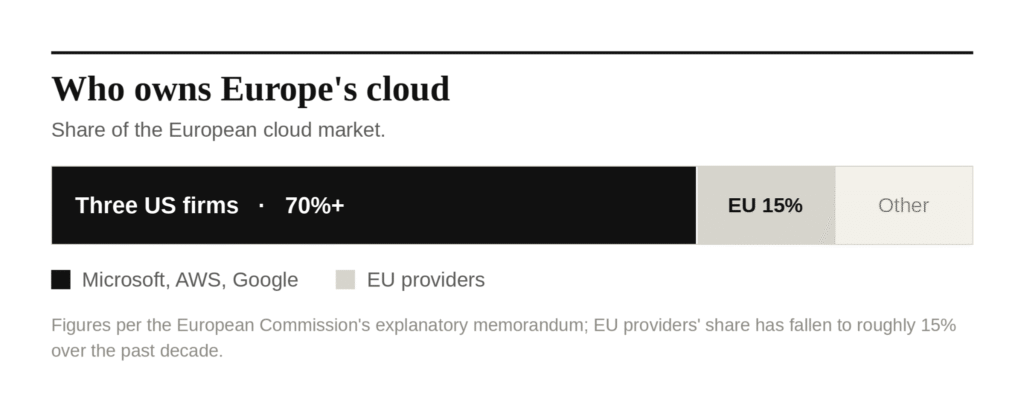
Behind CADA’s build-out sits a sharper anxiety: not how much cloud Europe has, but whose it is. Three American firms — Microsoft, Amazon and Google — control most of the European market, and their practices are now under EU antitrust investigation. That creates two risks. Under the US CLOUD Act, Washington can potentially compel American providers to hand over data held in Europe. And US sanctions can force them to cut a customer off.
After the Trump administration sanctioned ICC prosecutor Karim Khan in February 2025, his Microsoft email went dark and he moved to a Swiss provider. Microsoft disputed that it had cut services to the court, but the episode hardened European conviction that a foreign “kill switch” was real.
A ladder full of loopholes
To claw back control, CADA sorts public-sector cloud contracts into four sovereignty tiers. The lowest requires only that data sits on EU soil; the highest demands full EU ownership and control, with no third-country interference. The more sensitive the data, the higher the bar a provider must clear.
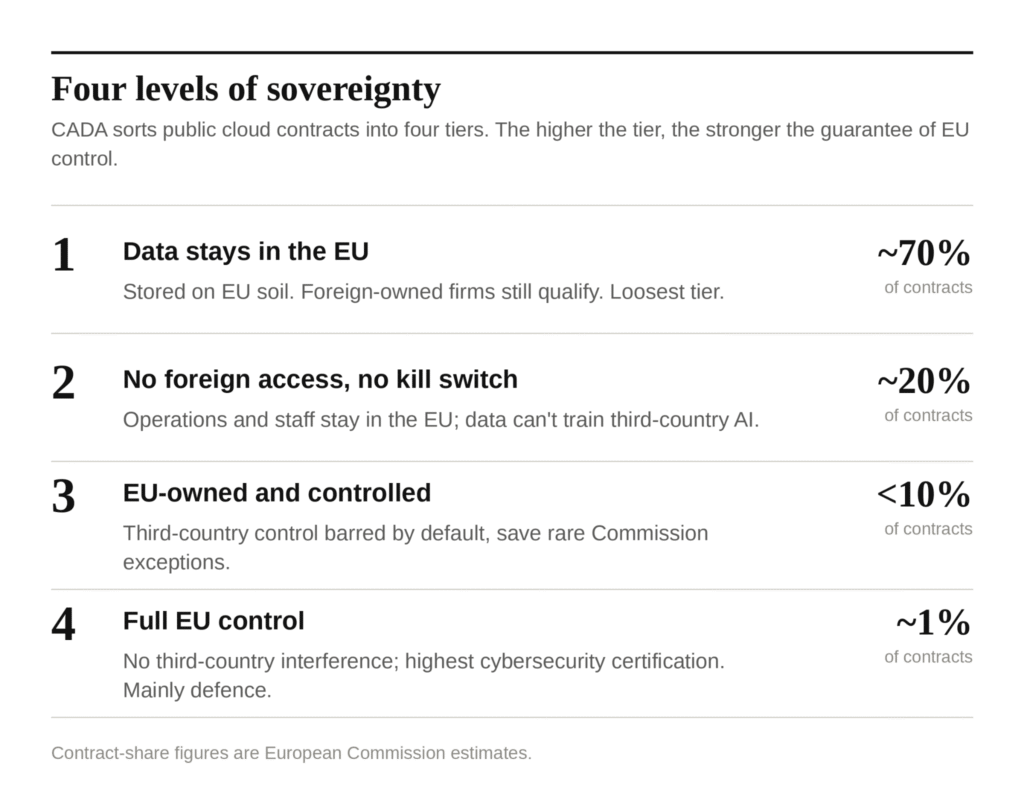
The catch is that the two ambitions pull against each other. Building capacity fast means leaning on the same hyperscalers CADA wants to fence out, and by the Commission’s own reckoning, roughly 70 per cent of public contracts sit in the lowest tier, still open to them. Critics at German think-tank cep argue nationality is a blunt instrument for sovereignty, and warn that procurement rules built around it risk higher costs and protectionism, not resilience.
Europe wants to build fast, build big, and build its own: three demands that do not sit easily together.
Whether CADA delivers sovereignty or simply a more expensive dependence is unresolved. What is clear is that Europe wants to build fast, build big, and build its own: three demands that do not sit easily together, in Zeewolde or anywhere else.
CADA now enters negotiations between Parliament and the Council, where the sovereignty tiers and the exemptions that could keep US providers in the game will be decided, a process unlikely to conclude before 2027.