Washington says it is using trade policy to fight modern slavery. At the same time, its own immigration detention system is facing court battles over allegations of coercive labour.
The tariff took effect on 24 July, as part of a Section 301 action against 60 trading partners, with rates of 10 per cent for economies that have banned or pledged to ban forced-labour imports and 12.5 per cent for the rest. While underneath the 15-per-cent ceiling in the US–EU Turnberry deal, the development came with little shock from Brussels.
The number is not what is shocking, it is the strategy behind the policy.
In its own words, the Office of the United States Trade Representative (USTR) calls the US “the only country in the world to adopt, and effectively enforce, a ban on imports made with forced labor”, and casts President Donald Trump as “tackling modern-day slavery at its source”.
Yet the “only country that enforces” claim runs into a domestic record its own courts are still adjudicating: five months before the tariffs, the Supreme Court unanimously cleared a forced-labour suit against an ICE contractor to proceed.
Work for $1 a day
In ICE detention centres run by GEO Group and CoreCivic, detainees held on civil immigration violations, not criminal convictions, work for $1 a day. The acting director of ICE David Venturella is a former GEO Group executive; former GEO employees routinely move between the company and the agency.
In the ongoing case of Novoa v. GEO Group, plaintiffs allege the “Voluntary Work Program” was anything but: that GEO withheld food, water and hygiene supplies so detainees had to work to buy them. Those who refused were threatened with solitary confinement, use of force and legal repercussions.
This development corresponds to the Trump administration’s own definition of coerced labour almost exactly. And this growing phenomenon has developed side by side with Trump’s forced labour tariff campaign abroad.
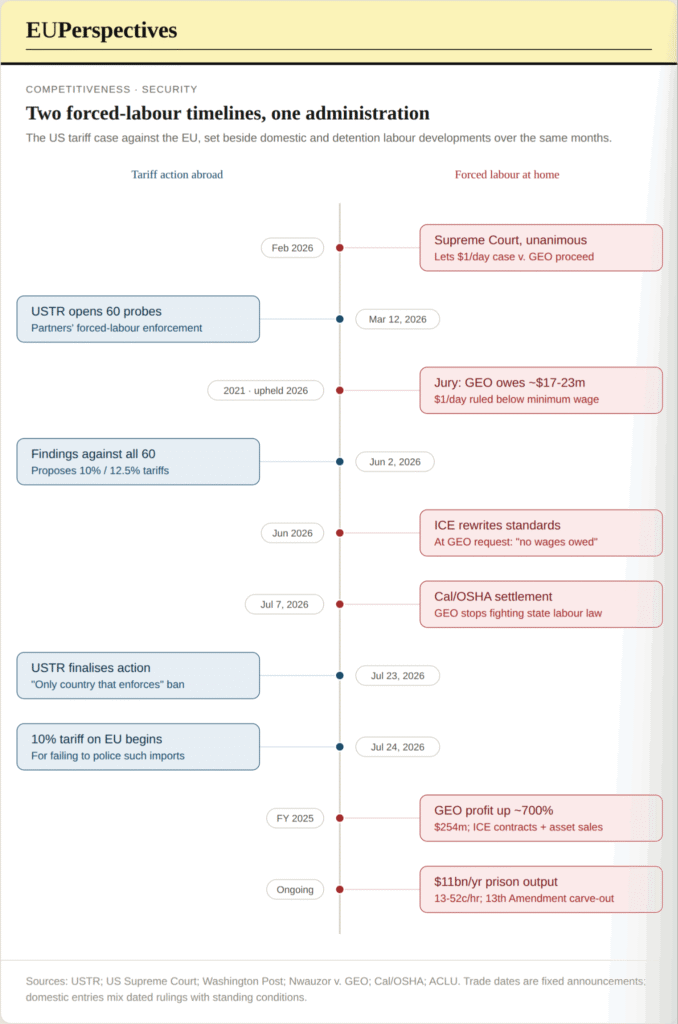
In 2021, a federal jury found GEO’s dollar-a-day scheme illegal, ordering it to pay detainees $17.3 million in back wages for violating Washington’s minimum-wage law — a verdict the Ninth Circuit upheld in January 2025. In February 2026, five months before the tariffs, the US Supreme Court unanimously rejected GEO’s bid to dismiss the class action over $1-a-day pay at its Aurora, Colorado facility.
Yet in June 2026, at GEO’s request, ICE issued detention standards stating explicitly that detainees “are not entitled to wages or benefits under applicable wage laws or labor regulations”.
The credibility gap
GEO and CoreCivic each also gave $500,000 to Trump’s 2025 inaugural committee. As Trump assumed office, GEO has now booked more than $250 million in profit in 2025, a nearly 700-per-cent jump on the prior year, driven by new ICE contracts and asset sales.
Incarcerated workers in the US produce roughly $11 billion in goods and services a year. That is $2.09 billion in prison-industry output plus an estimated $9 billion in maintenance labour. They do so while earning, on average, 13 to 52 cents per hour, with no minimum wage, no right to refuse, and no standard workplace protections.
The constitutional basis is the 13th Amendment’s punishment clause, which preserves slavery and involuntary servitude as acceptable punishment for those convicted of crimes. Legal experts call it in effect “administrative enslavement.”
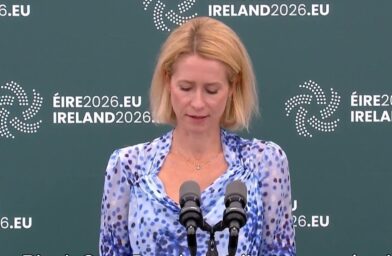
Commission Vice-President Kaja Kallas called the tariffs “a negative surprise” and a breach of the Turnberry agreement, adding: “If you compare our labour laws to the ones of the United States (…) we have paid vacations, we have very good labour conditions for our employees, so it’s not really grounded.”
Kallas only touches the surface of the divergence. This US administration is reaching for the dormant tools it has to carve out a global competitive edge while undermining the legitimacy of those very tools at home.