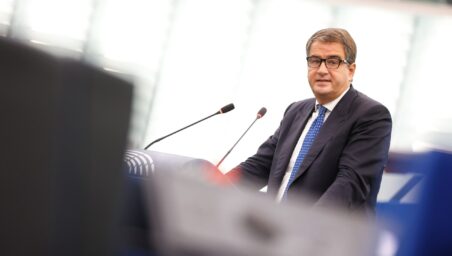
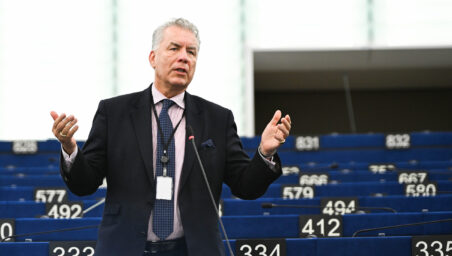
EU enlargement would make Europe safer, Croatian lawmaker Željana Zovko has argued. It could counter hybrid threats and instability at the bloc’s borders. Her message is simple: Europe cannot secure itself while leaving its neighbours in a permanent waiting room.
“Enlargement is the only tool for peace and security of the European Union,” Croatian member of the European Parliament Željana Zovko (EPP/HR) told EU Perspectives. “Without a stable neighbourhood, we cannot claim that we have stable and secure borders.”
She pointed to migration routes through the Western Balkans and hybrid threats affecting Poland, Lithuania and Latvia. Closer integration with neighbouring countries could also allow Europe to move production nearer to home and reduce its reliance on distant suppliers, she argued.
Her comments accompanied the launch of Hic sunt leones: Strategic risks and security threats for Europe, an edition of the EPP-associated Martens Centre’s European View. Its contributors examined threats accross regions ranging from the Arctic and Black Sea to the Mediterranean, Middle East and East Asia.
Bosnia must move from Dayton to Brussels
Ms Zovko’s contribution focused on Bosnia and Herzegovina three decades after the Dayton peace agreement ended the war. The settlement stopped the fighting but left behind a political system still marked by face separatism, disputes over representation and institutional paralysis.
Ms Zovko warned that tensions dating back to the Bosnian war had never fully disappeared. She cited the state-style honours given in Serbia to convicted war criminal Ratko Mladić as evidence that nationalist narratives of the conflict remained influential.
“Bosnia and Herzegovina is no less important than Ukraine,” Ms Zovko said. Although “there is no fighting today”, she warned that unresolved tensions continued to threaten lasting peace. Her paper calls for the country to move from its post-war “Dayton phase” towards a “Brussels phase” centred on functioning institutions and eventual EU membership.
For Ms Zovko, enlargement should continue alongside a reform of the Union itself. “The whole debate nowadays, whether we have to reform the European Union or continue the enlargement, does not make any sense,” she told EU Perspectives. “Enlargement is the answer, and it should never be debated.”
Security argument gives enlargement new momentum
Russia’s invasion of Ukraine has strengthened the argument that enlargement can protect Europe from instability and hostile influence. European Council President António Costa has described expansion as a means of securing peace, stability and security. Furthermore, German Chancellor Friedrich Merz said the EU must demonstrate its ability and willingness to admit Western Balkan countries, arguing that the region belongs in Europe’s future.
Without a stable neighbourhood, we cannot claim that we have stable and secure borders.
— Željana Zovko, Member of European Parliament
The process has recently accelerated. In July, Albania, Moldova, Montenegro and Ukraine all advanced their membership negotiations on the same day. Enlargement Commissioner Marta Kos called it a “Super Tuesday”, saying that the EU had not seen comparable movement in more than two decades. Montenegro remains the most advanced candidate and aims to become the bloc’s 28th member in 2028.
However, the security case for enlargement does not remove the conditions for joining the EU. Candidate countries must still align their laws with EU rules and demonstrate progress on judicial independence, corruption and democratic standards. Concerns in these areas continue to complicate Montenegro’s bid, while the accession processes of Serbia, Bosnia and Herzegovina and Georgia have slowed or stalled. The EU must also prepare for enlargement by adapting its budget, institutions and decision-making to accommodate new members.