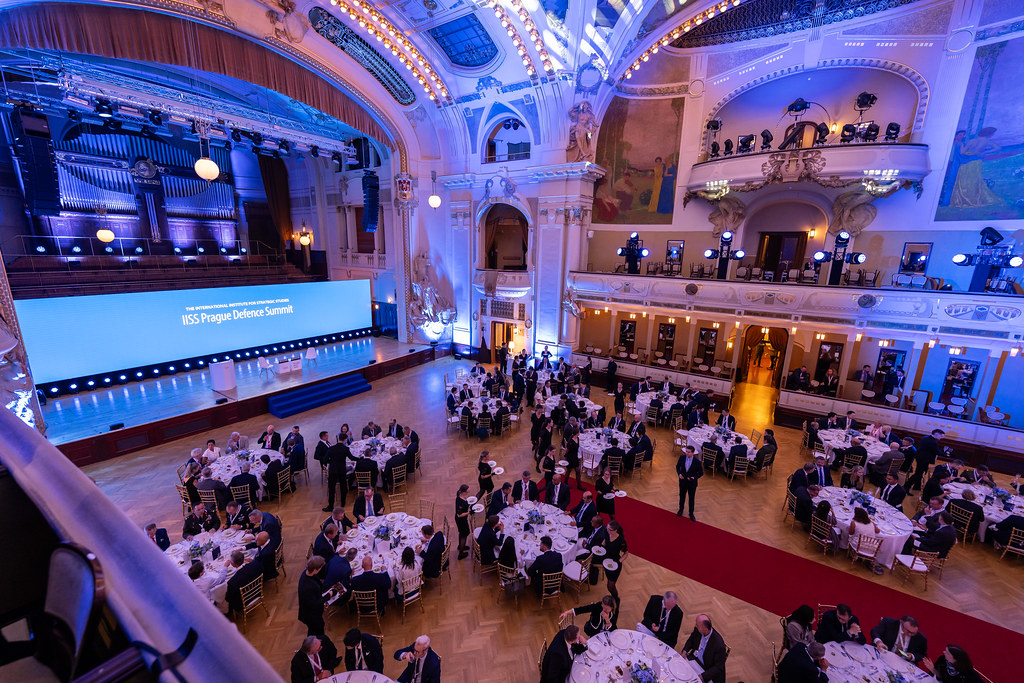
Europe’s defence thinkers gathered in the Czech capital sharing both a sense of urgency and an unease about whether urgency alone would be enough.
Europe’s progress is real, and the gaps in it are larger. That is the conclusion of the IISS Prague Defence Summit, held on 16–18 September 2026. The event brought together senior military commanders, government officials, and defence analysts to examine what a continent rearming at speed still risks getting wrong. The International Institute for Strategic Studies published its annual strategic dossier to coincide with the summit. Its findings were sobering.
In the celebrated concert hall of Prague’s Municipal House, the keynote address fell to General Carsten Breuer, chief of defence of Germany’s federal defence ministry. He opened with a tongue-in-cheek quote. “Wars are not won with speculations,” he said. “Wars are won with soldiers.” The line, he noted with dry humour, came not from Clausewitz and Moltke but from Captain America: The First Avenger. The point was serious nonetheless.
General Breuer’s central argument was about time. Technology, he said, has always shaped warfare, but the pace of change has now broken the old relationship between strategy, technology, and planning cycles. “In my view, a strategy already starts to be outdated once it is signed,” he said. “You could label strategy a living document. I would additionally suggest it is a continuously dying document.”
Technology must not dictate strategy
He urged the audience to resist a familiar temptation. “We must resist the temptation to let technology become strategy,” he said. “Technology must not determine what we do. Instead we must determine what to do with technology.” The first question, he argued, must always be: what strategic problems are we trying to solve?
Ukraine, he said, was both a lesson and a warning. “We must learn from Ukraine.” But Russia was learning too. “They are imitating and adapting. They innovate against and around our strengths.” Technological superiority, he cautioned, is not permanent. “The leader today can become the underdog tomorrow.”
European leaders are doing nothing to resolve the conflict.
— Andrej Babiš, Czech prime minister
His conclusion was direct. Speed of adaptation now matters more than the quality of any single technology. “It is no longer just about learning faster: it is about putting what you have learned into practice faster than your opponent.” And no military, he stressed, could do this alone. “How should we mitigate hybrid threats, if not as a society, as a whole?”
The dossier provided the numerical backbone for what General Breuer described in strategic terms. Between 2022 and 2025, NATO European states signed production contracts worth more than $358bn. It is a 171 per cent increase over the $132bn signed between 2018 and 2021. Of that total, approximately 63 per cent, or more than $227bn, went to European manufacturers. The share going to US systems was 25 per cent. South Korean companies saw the sharpest relative rise, from $2.5bn to over $40bn.
Spending more, buying smarter
Total European NATO spending reached around $638bn in 2026 — over 90 per cent higher in nominal terms than before Russia’s full-scale invasion in 2022. European NATO members allocated 36.2 per cent of defence budgets to investment in 2026, compared to 24.8 per cent in 2020. The structural shift is real.
The production surge has been most dramatic in artillery and ammunition. NATO Europe’s combined 155mm shell production capacity has grown by at least a factor of five since February 2022, from an estimated 300,000–400,000 rounds per year to more than 1.6 million. It could reach 3.5 million by 2030.
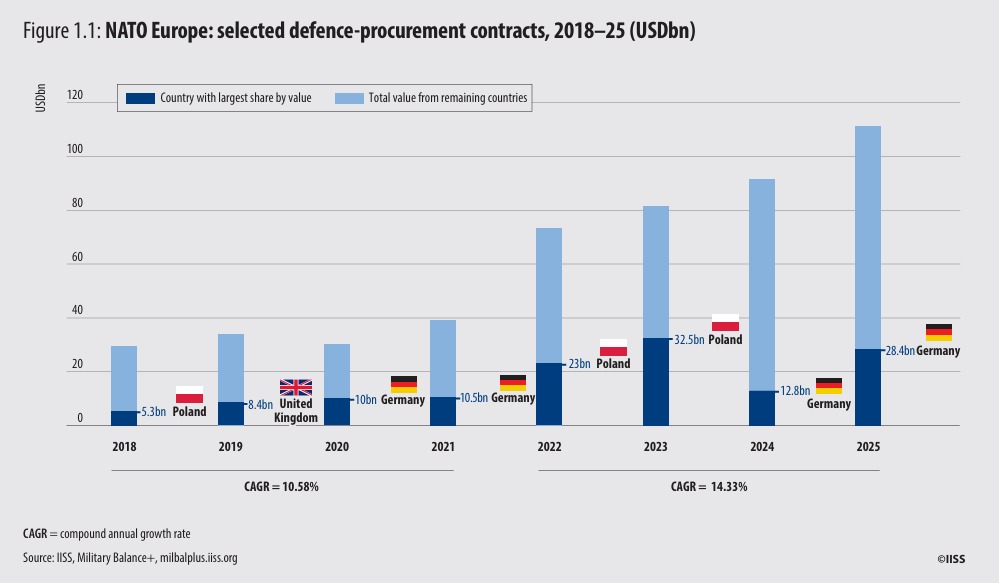
The total value of artillery production contracts rose by 867 per cent, from $3bn in 2018–21 to $29bn in 2022–25. Rheinmetall alone holds a framework contract with Germany worth up to €8.5bn for 155mm rounds, under which Denmark, Estonia, and the Netherlands can also place orders.
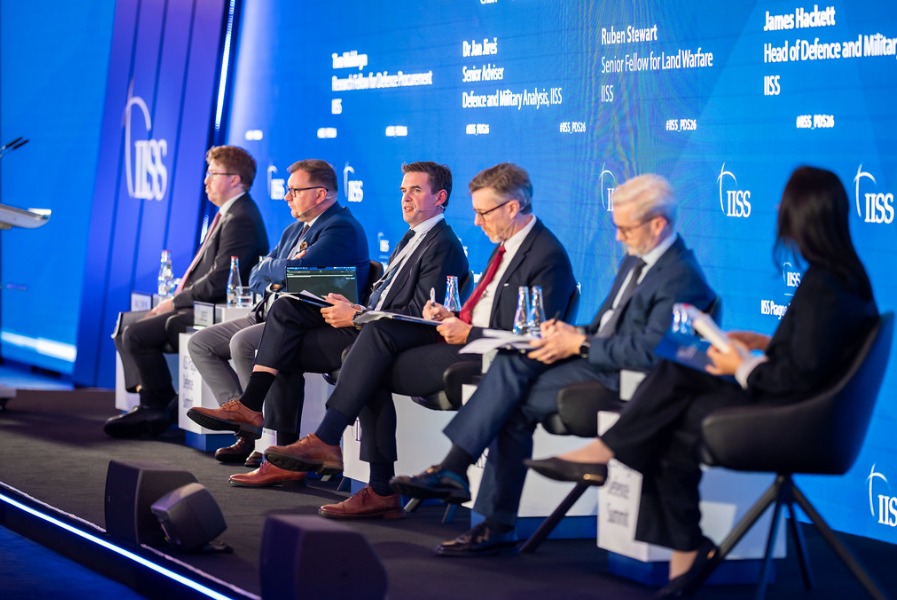
The summit’s session on NATO logistics — chaired by Lieutenant General (Retd) Sir Thomas Beckett, Senior Adviser and Corresponding Director of IISS-Americas — addressed what the dossier calls the most politically neglected of Europe’s defence shortfalls.
The logistics warning
Leigh Method, US deputy assistant secretary of war for sustainment set out the core problem with unusual directness. “Our alliance logistics have had the assumption for the last several decades of peacetime efficiency, open sea lines and a very permissive uncontested rear area,” she said. “And that is definitely not the case today or going forward.”
Her central message was strategic, not administrative. “Logistics is no longer an enabler,” she said. “It is our strategy in motion.” The credibility of deterrence, she argued, now rests on three things: the resilience of the industrial base, the protection of supply lines, and the ability to sustain forces through protracted high-intensity, multi-domain environments.
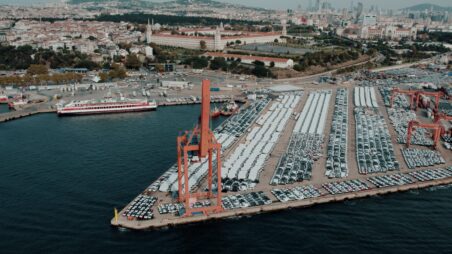
The threat, she said, would not begin at the front. “The first decisive battle is not going to be among the front lines,” she said. “It’s going to begin in our commercial seaports; with the software that runs our civilian rail systems. It’s going to begin with our municipal power grids.” The conclusion was blunt. “The most direct path to neutralizing NATO’s frontline combat power is to sever its logistics at the rear.”
The dossier confirmed the scale of the problem. NATO currently lacks sufficient fuel distribution to the eastern flank, medical evacuation capacity for high-intensity war, strategic and tactical lift, heavy-armour rail-transport capacity, and mobile bridging. Customs delays, weak bridges, unsuitable roads, rail-gauge breaks, and incomplete signalling systems all constrain movement. The Allied Joint Support and Enabling Command in Ulm, Germany—led by Lieutenant General Kai Rohrschneider—represents progress. It is not yet sufficient.
Gaps that spending alone cannot close
The dossier’s assessment of emerging technologies offered a similarly mixed picture. In artificial intelligence, Europe has built competitive applications for targeting and decision support. France’s AMIAD agency coordinates defence AI with a €300m budget. The UK’s ASGARD programme awarded contracts worth £180m to 26 suppliers (including Helsing, Anduril UK, QinetiQ, and Tekever) to compress targeting decision cycles from hours to seconds or minutes.
Wars are not won with speculations. Wars are won with soldiers.
— General Carsten Breuer, German defence ministry’s defence chief
Yet Europe remains heavily dependent on US hyperscale cloud infrastructure. Amazon Web Services, Microsoft Azure, and Google Cloud together hold approximately 63 per cent of the global cloud market. That dependency remains a strategic vulnerability, with European lawmakers increasingly looking for ways to reduce it.
In quantum sensing, Europe’s position is stronger. France’s Exail leads the global commercial quantum gravimetry market. A UK flight trial in May 2024, led by Infleqtion with BAE Systems and QinetiQ, demonstrated cold-atom inertial navigation at near-state-of-the-art performance. Germany’s Bosch Quantum Sensing and Q.ANT are developing NV-diamond magnetometers and quantum gyroscopes.
Scary vulnerabilities
But China is closing the gap. A drone-mounted atomic magnetometer demonstrated offshore Weihai in April 2025 achieved 0.849-nanotesla accuracy. It is a sensitivity relevant to detecting submarines. US private investment in quantum technology represented approximately 44 per cent of the global total in 2024, against roughly 12 per cent for the EU.
Critical supply-chain vulnerabilities (dilution refrigerators, isotopically purified silicon-28, and helium-3) sit outside current EU critical-materials frameworks. The policy instruments that would address them do not yet exist.
In military robotics, Europe lags furthest. Ukraine’s Ministry of Defence planned to procure 25,000 uninhabited ground vehicles in the first half of 2026 alone. European armed forces have tested quadruped systems, but mostly US-made ones. Germany’s Helsing launched its RX-1 quadruped robot in June 2026 and may prove an outlier. The constraint is not technical. It is the absence of a strong enough demand signal from European armed forces themselves.
Growing, yet falling further behind
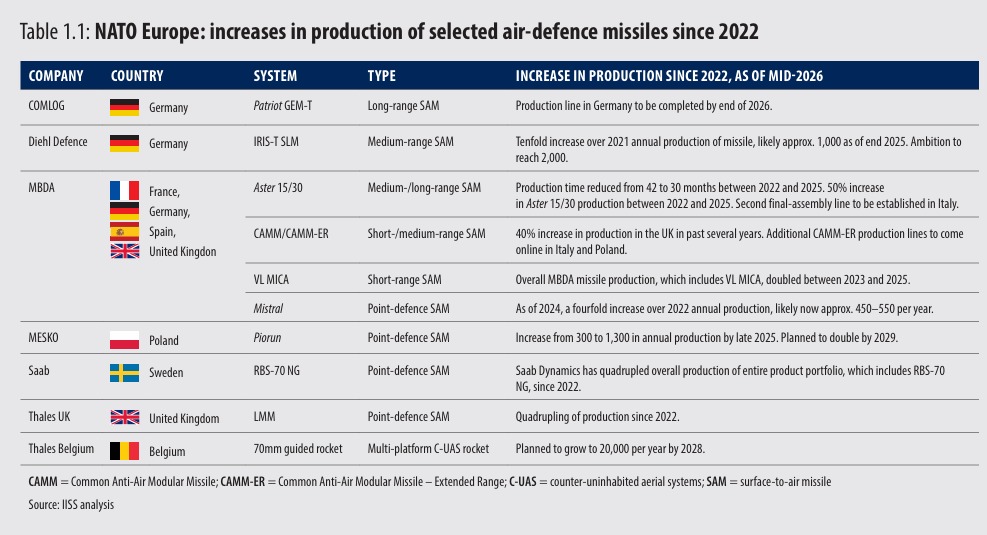
The dossier’s account of ground-based air and missile defence illustrated how far production has come. Between 2022 and 2025, NATO European states placed contracts worth $51bn in this area. It is a 629 per cent increase over the $7bn signed in 2018–21.
Diehl Defence increased IRIS-T SLM missile production tenfold. Poland’s MESKO raised annual Piorun MANPAD output from 300 to 1,300 units, with plans to double that by 2029. Germany’s European Sky Shield Initiative now comprises 24 countries. For armoured fighting vehicles, the increase was 353 per cent, from $17bn to $77bn. KNDS’s order backlog now stands at €33.1bn, up from €23.5bn at end-2024.
Our alliance logistics have had the assumption for the last several decades of peacetime efficiency, open sea lines and a very permissive uncontested rear area. That is definitely not the case today.
— Leigh Method, US deputy assistant secretary of war for sustainment
Latvia, Lithuania, and Estonia have each launched domestic ammunition production initiatives, with Rheinmetall and ARCA Defense among the partners. Central and Eastern European manufacturers have become Tier 1 and Tier 2 partners in key weapons programmes. Yet their aggregate share of NATO Europe’s total defence expenditure fell slightly, from 13.23 per cent in 2023 to 12.64 per cent in 2026. Most investment still flows elsewhere.
Whatever ‘together’ means
General Breuer returned, in his closing remarks, to the question of what binds all of this together. Technology integration, he said, would not be the hardest part. The hardest part was collective. “We need to crack this nut together as a team effort of our society.” He invoked the nuclear submarine as an analogy: the military came last. Industry built it. Scientists developed the theory. Workers sourced the materials. “So, we are all in this together, not only when we build submarines, but everywhere.”
What exactly “together” means is not obvious. The lack of togetherness rang loud and clear at the summit’s opening — from the hosts, no less. Czech Prime Minister Andrej Babiš, often viewed in Europe’s west as Orbán lite, spoke of the need for peace. “Europe should finally be trying to end this war,” Mr Babiš said, adding that “European leaders are doing nothing to resolve the conflict”, he was quoted as saying by TASS. “’Trump, by contrast, spoke with [Russian President Vladimir] Putin on the phone for an hour and 15 minutes,’ the Czech prime minister noted,” the Kremlin propaganda machine wrote.
The IISS dossier’s final judgement, however, echoed the tone of the defence strategists, not that of Putin’s collaborators. The foundation for a more capable European pillar of NATO is now in place. Whether it will be enough (and whether it will be built fast enough) the institute declined to say with confidence. That, perhaps, was the most honest conclusion Prague could offer.
As EU Commissioner for Defence and Space Andrius Kubilius has repeatedly noted, the absence of a single European defence market continues to impose major structural costs on everything that follows. The spending is real, and so are the gaps. The race between the two, and Europe’s fate, are hanging in the balance.