Short-term needs risk obscuring Europe’s strategic vision. Surging defence budgets are filling depots with hardware, while the soldiers, engineers, and industrial capacity are lagging dangerously behind, an Ideas conference heard.
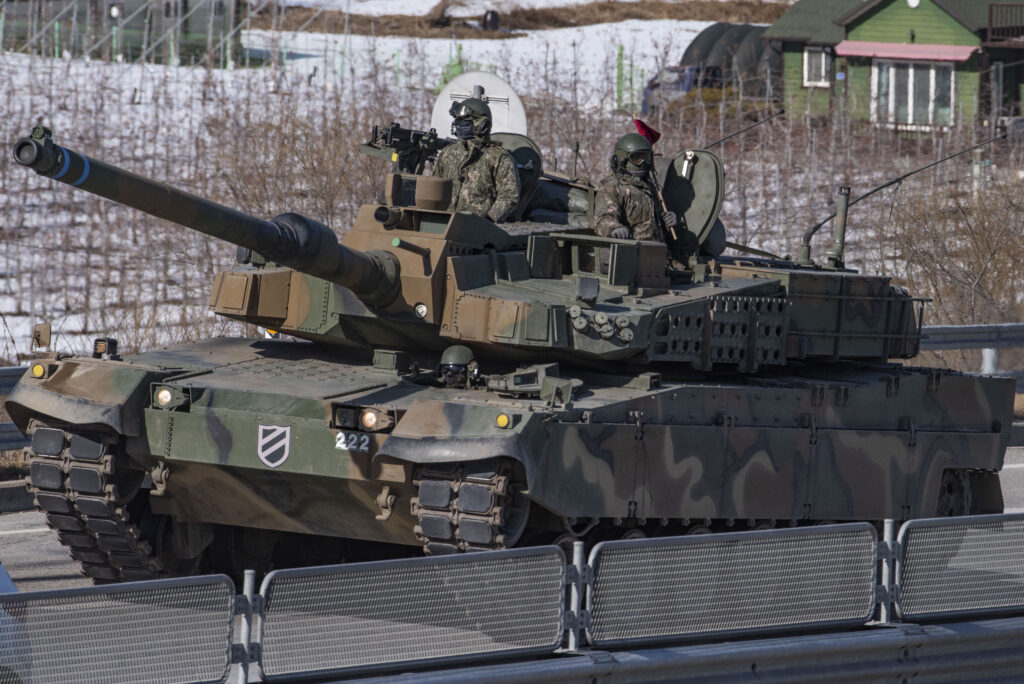
Poland intends to field a ground force that no other EU member can match by 2030. To get there fast, it went shopping in Seoul. Between 2021 and 2025, 47 per cent of Poland’s major arms imports came from South Korea and 44 per cent from the United States. The first K2 Black Panther tank contract covered 180 vehicles for around $3.37bn — all delivered by November 2025. A second batch arrived on 28 August 2026, bringing the total to 208 tanks. No European manufacturer could have offered anything close to that schedule.
The numbers are, in their way, impressive. EU member states plan to invest €135bn in ground combat capabilities, €63bn in land-based precision engagement, and €13bn in future soldier systems between 2023 and 2029. Land forces’ share of overall planned defence investment has risen from 24 to 28 per cent.
There is a difference between political agreements, strategic agreements, and industrial realities. — Romain Le Quiniou, IronBridge
Collaborative procurement is up, and so is spending; the direction, on paper, is right. It is the execution that is not keeping pace. And the gap between what Europe is buying and what Europe can actually field is becoming the central problem of the continent’s rearmament. It was also the centrepiece of the online conference From Survivability to Industrial Scale: Europe and South Korea Building Future Armour by the defence platform Ideas on 22 September.
The personnel paradox
Giuseppe Dello Stritto, head of the land and logistics unit at the European Defence Agency (EDA), was precise about the nature of the failure. Between 2023 and 2025, defence investment across EU member states grew by 76 per cent in real terms. Over the same period, personnel grew by 3.8 per cent. The arithmetic is damning.
“Higher spending already recorded throughout all member states in Europe is not producing yet proportionate operational output,” Mr Dello Stritto said, “because personnel, training, maintenance, infrastructure, and sustainment are not keeping the same pace of acquisition programmes.” The problem, in other words, is not the hardware. It is everything around it.
The point is not abstract. A tank sitting in a depot without a trained crew, a logistician, or a maintenance team is not a military capability. It is a procurement statistic. “A platform is not operational just to have it in the parking if we don’t have trained crew commanders, logisticians, maintenance, industry supplies and whatever,” Mr Dello Stritto said. Europe has been funding the former while neglecting the latter.
The same imbalance runs through the industrial workforce. Employment in EU aerospace and defence industries grew by nine per cent between 2021 and 2024, a fraction of the pace at which investment expanded. Engineers, software specialists, and systems integrators cannot be conjured from a budget line. The workforce constraint is, in Mr Dello Stritto’s framing, a binding one.
Hardware without doctrine
The gaps Mr Dello Stritto identified go beyond personnel. Heavy armour and mechanised formations remain underfunded relative to stated ambitions. Artillery—particularly deep-strike precision fire—is short. Ammunition stocks are inadequate. Ground-based air defence and counter-drone capabilities lag. Combat support and combat service support, the unglamorous logistics backbone of any sustained operation, remain, in his words, “unevenly prioritised despite their decisive role in manoeuvre survivability and regeneration of force”.
That last phrase matters. The central challenge for European land forces is not replacing old platforms. “The real challenge,” Mr Dello Stritto said, “is generating, deploying, sustaining, and regenerating credible combat power at scale and over time.” Recent conflicts have made clear that tanks remain essential, but also that they operate under fundamentally changed conditions. Loitering munitions, persistent surveillance, and electronic warfare mean that protection can no longer rest on armour alone. Active protection systems, counter-drone capabilities, and resilient digital architecture are now baseline requirements, not enhancements.
South Korea was pretty amenable to the need and wishes of European countries, was willing to transfer technology, willing to localise production, willing to train labourers, etc. — Lami Kim, International Institute for Strategic Studies
Collaborative procurement, which might help aggregate demand and reduce unit costs, represented only 24 per cent of member states’ declared plans and programmes in 2025. The room for improvement is large. The political will to exploit it has been uneven.
Why Seoul, not Brussels
It is against this backdrop that Poland’s turn to South Korea makes sense. The urgency was genuine. Russia’s full-scale invasion of Ukraine in 2022 created immediate capability gaps. Poland had donated Soviet-era equipment to Kyiv and needed replacements. A domestic election campaign in autumn 2023 added political pressure: visible, large-scale procurement was a signal to voters as much as to adversaries. The strategic ambition was real; Poland’s goal of leading EU land forces by 2030 required hardware, and it required it now.
South Korea could deliver. Its production lines were active. The offer was comprehensive, covering training, financing, progressive localisation of production, and technology transfer. Its financial package was attractive for a country carrying significant national debt. As Romain Le Quiniou, founding partner of the defence consultancy IronBridge, put it: “South Korea was probably the one country that could do it. So that was a convenient wedding.”
The initial deliveries were branded K2GF-Gap Fillers. The name was candid. The programme has since evolved towards K2PL, a version tailored to Polish specifications, with assembly undertaken in partnership with Poland’s Pegasus entity and Polish command-and-control systems integrated into the K9 howitzers. South Korea’s approach, Mr Le Quiniou noted, was “designed on customers’ needs and not just on the sellers’ objectives”. That is a degree of flexibility that European primes had been slower to demonstrate.
Agreement versus reality
The localisation story is, however, uneven. The K2 tank programme is progressing, if slowly. The K9 howitzer cooperation has fallen well short of early ambitions. “We talked about things in 2022 with big objectives and now we are just downgrading because we are not able to do it,” Mr Le Quiniou said. “There is a difference between political agreements, strategic agreements, and industrial realities.”
The K239 Chunmoo rocket artillery system offers a third model: a hybrid, with South Korean components mounted on a chassis built within Poland’s Polish Armaments Group (PGZ) defence conglomerate, with export cooperation already under discussion. Estonia purchased K9 systems with a South Korean commitment to reinvest roughly 20 per cent of the contract value into the Estonian defence industry. Romania is developing plans for a broader production hub involving 25 to 30 entities.
Each arrangement differs. The common thread is South Korea’s apparent long-term strategic vision for a durable European presence. It is a quality Mr Le Quiniou suggested Europe itself lacks. “We are very short-term,” he said. “They look very long term.”
Seoul was flexible
Lami Kim, Korea Chair at the International Institute for Strategic Studies (IISS), identified both the promise and the limits of the model from Seoul’s perspective. South Korean firms would prefer to sell complete systems off the shelf.
Localisation raises production costs. But it is the price of access, and it creates lasting interdependence. “South Korea was pretty amenable to the need and wishes of European countries, was willing to transfer technology, willing to localise production, willing to train labourers, etc.,” Ms Kim said.
Higher spending already recorded throughout all member states in Europe is not producing yet proportionate operational output. — Giuseppe Dello Stritto, European Defence Agency
“I think that this is a win-win arrangement, especially over the long term,” the IISS Korea chair said. She also noted that as Poland rebuilds its own defence industrial base, South Korea’s role may narrow. Yet maintenance, repair, and overhaul services, alongside integrated components, will sustain engagement.
Readiness today, sovereignty tomorrow
The EDA’s framework for navigating this tension is a dual-track approach: acquire available systems to fill immediate gaps, while using those acquisitions to expand European production, integration, and lifecycle support. The ambition is interoperability, not just in communications and ammunition, but in spare parts, software access, and long-term obsolescence management. These are the details that do not appear in signing ceremonies but determine whether a fleet remains operational a decade after delivery.
Mr Dello Stritto condensed the logic into a single formulation. “The readiness today includes the sovereignty tomorrow,” he said, “because they should reinforce each other.” Every urgent acquisition from outside Europe should, in his view, leave the continent’s industrial capacity stronger than before, not merely its vehicle inventory larger.
That standard has not consistently been met. And the deeper problem, as Mr Le Quiniou framed it, is political rather than industrial. “The problem of our rearmament at the moment is that we cannot reconcile short-term interest and long-term strategic vision,” he said.
No good solutions
The tension between buying what is available now and building what is needed permanently has no comfortable resolution. Choices involve trade-offs. Industrial interests, national preferences, and alliance obligations pull in different directions.
What the Polish case demonstrates (with its mix of delivered tanks, stalled howitzer localisation, and hybrid rocket artillery arrangements) is that the tension is manageable. But it requires much political will, realistic industrial expectations, and agreements that extend well beyond the initial contract. Whether these are available is a looming question.
Europe is spending its way towards a larger force. It has not yet resolved how to crew it, sustain it, or ensure that the money spent outside the continent comes back to strengthen the base it is trying to build.