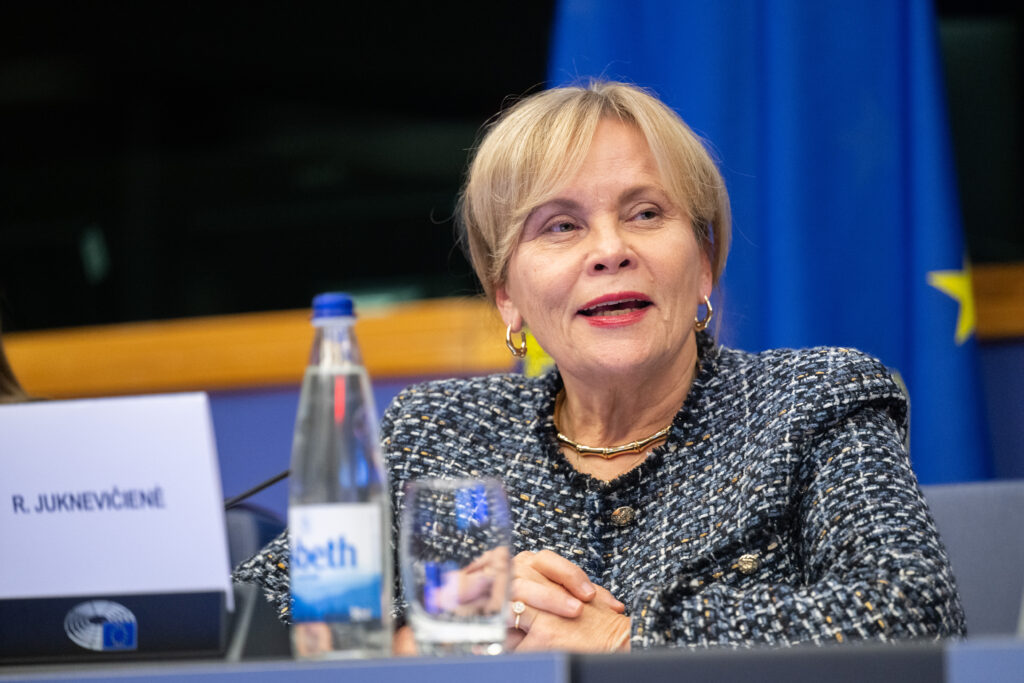
Russian spy centres still operate in the open across a dozen EU countries. Elections have turned into frontlines. And the woman co-writing the EU’s hybrid-warfare rulebook says Brussels is losing the race against the clock. Rasa Juknevičienė (EPP/LTU) tells EU Perspectives why deterrence, not just resilience, has to become Europe’s default setting.
During the debate on her file on hybrid warfare, Ms Juknevičienė argued that the EU must move beyond resilience towards a more comprehensive approach to hybrid defence and deterrence. “We are too slow in Europe now,” she told EU Perspectives.
During your speech, you said the EU needs to move from resilience to deterrence. How?
We need different kinds of instruments. I think we have to change our thinking and start talking about hybrid defence, which can cover all the instruments we already have: cyber, asymmetric resilience and, of course, deterrence.
Let me give you one example: when I see that Russian Houses are still operating in so many countries—similar Russian Houses to the one that operated in Berlin before it was shut down following the Leipzig event—I ask myself how serious we can be about fighting hybrid threats. These centres are still operating in Austria, Belgium, Bulgaria, France, Greece, Hungary, Italy, Luxembourg, Malta and Cyprus, among others. It means that Russian spies and intelligence services are operating openly in European countries, organising disinformation and other operations, and possibly also activities linked to direct sabotage.
I cannot imagine how countries can be serious about fighting hybrid threats while having such centres such as Russian spy centres operating inside their borders. We have to start from small things and not be afraid to do so. Now I see that the fear of escalation is actually helping Putin to escalate. Putin and the Kremlin understand that we are weak, that we are afraid and that we don’t want to escalate. Of course, nobody wants escalation. But the Kremlin is escalating.
Look at what has happened in recent days. There has been the Danish incident, jamming in the north, explosives in Leipzig a little earlier, a drone in Lithuania, railway incidents near the Polish border, all of this happening together. And what is happening with every single election on European Union soil is that it is becoming a frontline.
When we talk about hybrid attacks, are we talking primarily about Russia as the actor, or are there also others?
Russia is the main actor and the main threat to us. But we also mentioned its proxies. We mentioned Belarus, Iran and North Korea, and of course China, which is an ally of the Russian Federation. They are supportive and they have their own interests on our continent. So yes, it is not only Russia. Some actors in some countries may also be trying to use the same instruments that Russia is using.
Cables, pipelines, ports, airports and satellites “should be treated as strategically equivalent to military installations”, you said. Does that also mean they should receive the same level of protection?
They should receive the level of protection they need. Look at what is happening in Ukraine. Airports, pipelines, cables, satellites: all this strategically important infrastructure is under attack, and attacks against it cause huge consequences. This is the experience we have, so we have to protect it. We must protect it, including through the responsibility of those who own this infrastructure. If it is private infrastructure but strategically important, the owners have to care about its protection. States, of course, must do much more.
For example, in Lithuania we have LNG terminals. They were immediately placed under the protection of our security forces, including the armed forces. They are securing this strategically important infrastructure. Of course, it is difficult. It is not easy because we have a lot of infrastructure that is strategically important. But we don’t have any choice. We have suddenly realised that our airspace is open to malign influence and attacks.
Regarding the operationalisation of Article 42.7, the mutual defense clause in EU treaties, how could Europe use this article? And in what kind of context?
This is what we mentioned in the debate, and this is what I read yesterday from Ursula von der Leyen’s speech in the SOTEU. She mentioned exactly this point, and she went further, saying that Europe needs something similar to Article 4 of NATO (Editor’s note: Article 4 allows any member state to call for formal consultations whenever they feel their territorial integrity, political independence, or security is threatened).
I mean an arrangement whereby, when one country feels that it is under attack, the other countries must be informed and act together to assess the situation, discuss possible support and coordinate their response. One way or another, countries need to be able to say that they feel they need this kind of support. Article 42.7 is still more theoretical. We have it in our treaties, but it is only theoretical.
We need more exercises to practise how it works and to develop all the necessary procedures and mechanisms. Hybrid threats are a very complicated issue. You cannot say, as with NATO’s Article 5 (Editor’s note: Article 5 states that states that an armed attack against one NATO member is treated as an attack against all), that only an armed or military attack means that the mechanism will be activated. With hybrid threats, our enemies can use almost everything, all kinds of instruments, to cause harm or damage. So we need some kind of coordination centre that can assess the situation and coordinate the response. Of course, member states that are under attack will also have information from the ground.
This is what we have to start doing, and life will show us how it develops. You can never put everything into one law or one algorithm. Life is life. Life is different now from what it was two years ago. Nobody knows what will happen in two years. But today we have something to do, and we must do it. This is our starting point. Then we can develop concrete measures and concrete instruments to achieve our intention. We have to activate these mechanisms because we are too slow in Europe now. We are too slow. We are always waiting for something, but we have to speed up our actions.
What do you make of European Commission President Ursula von der Leyen’s announcement on the so-called European Security Council? Do you think it could strengthen the EU’s response to hybrid attacks?
I support it very much, despite the criticism that it could create some kind of new bureaucracy. No, I don’t think that is the case. The European Union is moving towards a defence union, or something similar, because of the situation we are facing. Without coordination, and without having people responsible for this very important new competence which was not previously a competence of the European Union, we will just talk and talk and talk and do nothing.
I ask myself how serious we can be about fighting hybrid threats.
— Rasa Juknevičienė, MEP and rapporteur on hybrid warfare
But there is a second reason why it is so important. We have to think beyond the European Union itself. We need to think about how to include Great Britain, Norway and, most importantly, Ukraine in this common defence framework.
Ukraine today, I would say very openly, from my understanding, is no less important for European defence than the United States. They are both important, but the United States provides us with enablers and other capabilities, while Ukraine is defending us in a very direct way. So we must have this Security Council in a format larger than the European Union alone.
What role could hybrid attacks play in the EU elections taking place in 2027?
Every single election, given the circumstances and the situation we are in, when we are being attacked by Russia especially, is like our frontline. Every single election in every single country is like a frontline. So we have to pay attention to Moldova and Armenia because they are the best examples of how to manage such situations.