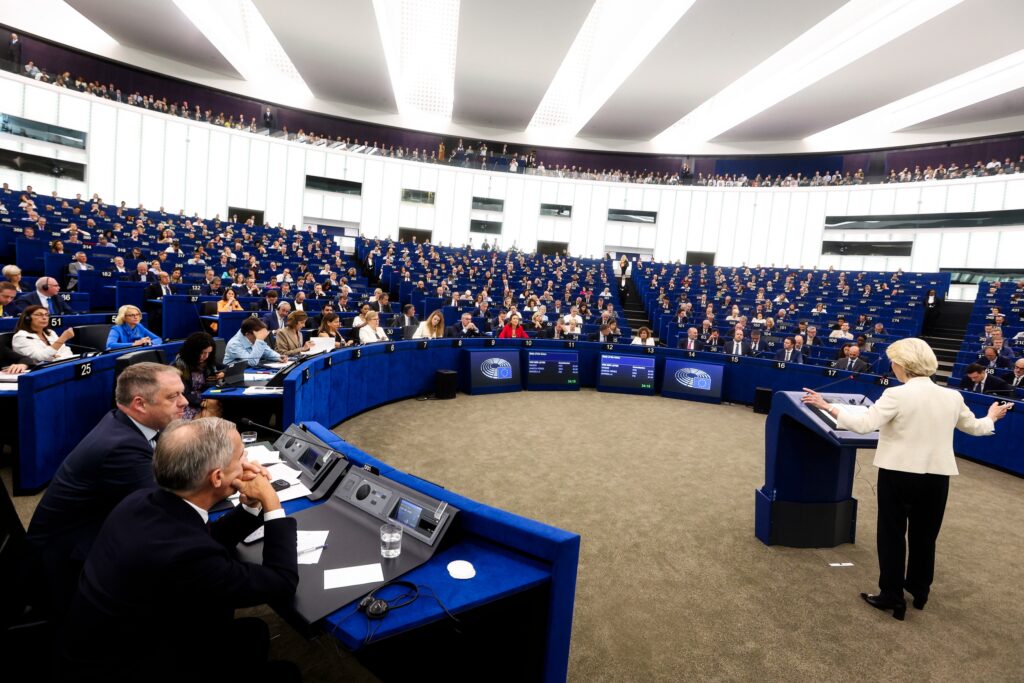
In her most operationally specific defence address yet, the Commission president unveiled three new instruments to turn years of rearmament promises into fighting capability.
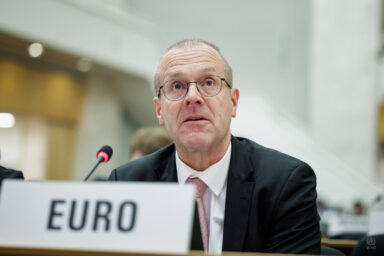
Europe has spent the past two years promising to rearm. On Wednesday morning, European Commission President Ursula von der Leyen told the European Parliament it was time to deliver. Her State of the European Union speech shifted the EU’s defence debate from how much money to spend to how fast that money can become fighting capability. It was the most hawkish defence address a Commission president has ever delivered.
The backdrop justified it. A drone attack in Leipzig, carried out with military-grade material by Russian operatives, had taken place days earlier. Lithuania reported a new airspace violation the same morning. “We should be under no illusions about what is happening here,” Ms von der Leyen told the chamber. “Hybrid threats facing Europe are less and less hybrid and less and less threats.”
When (as yet hypothetical Article 4 is) triggered by one member state, all member states would convene. To coordinate a European response, to deter further escalation and to mitigate the impact. — Ursula von der Leyen, European Commission president
The hall largely agreed. Where previous SOTEU addresses—including her own 2025 speech, which launched the €150bn SAFE loan facility and the Readiness 2030 framework—focused on financial pledges, this one announced institutional and legal machinery to turn those pledges into capability.
From money to mechanism
The centrepiece on defence was the European Instrument for Strategic Enablers (EISE), a new €20bn guarantee facility running from 2027 to 2030. It targets the so-called orphan gaps: satellites, secure communications, strategic airlift, air-to-air refuelling, and cyber defence.
These are assets that individual member states cannot afford alone but that any credible joint force requires. A 30 per cent grant component applies to projects involving at least three member states plus Ukraine, managed jointly by the Commission’s defence directorate and the European Defence Agency.
The EISE directly addresses a gap the European Parliament had repeatedly flagged. It mirrors the logic of the US National Defense Enablers Act and is designed to make European forces more interoperable with NATO without duplicating its structures. “Only together does Europe have the scale to deliver them,” Ms von der Leyen said of these critical assets.
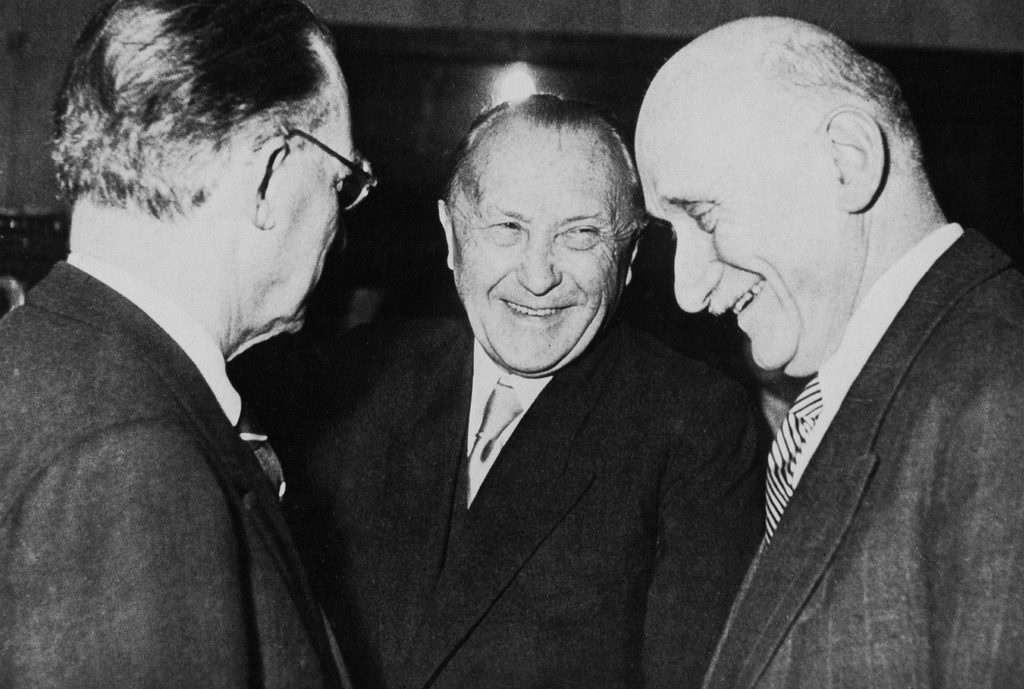
Adenauer, De Gasperi and Schuman understood the political and historic dimension of unifying Europe. (…) Let’s make this old treaty now a new reality. — MEP Manfred Weber (EPP/DEU)
Alongside the EISE, she announced the first comprehensive European Security Strategy (ESS) since 2003. The new strategy will replace the outdated 2003 document and align the 2022 Strategic Compass with a single classified threat assessment. It makes the five-yearly European Defence Semester binding rather than voluntary, tying national budget cycles to common capability targets that feed directly into NATO’s own defence planning process.
An Article 4 for Europe
The most structurally novel proposal was the Emergency Security Protocol (ESP) — described by Ms von der Leyen as Europe’s own version of NATO’s Article 4. Under the ESP, a single member state could trigger a convening of all member states to coordinate a collective response to incidents that fall below the threshold of armed aggression but clearly threaten national security. “When triggered by one member state, all member states would convene,” she said. “To coordinate a European response, to deter further escalation and to mitigate the impact.”
Our systems were made for a different world. (…) We need to consider if they are still fit for the purpose. — Ursula von der Leyen
In practice, the ESP would activate an EU-level logistics command, unlock access to strategic stocks of fuel, ammunition, and medical supplies, and allow temporary waivers on state-aid rules and VAT to accelerate industrial surge capacity. The Commission plans to table the ESP regulation in the fourth quarter of 2026, with a live stress-test pencilled in for mid-2027 in the shape of the exercise EU-Shield 27.
The sticking points are significant. The legal base remains contested: Article 122 of the Treaty on the Functioning of the European Union would allow qualified majority voting, but Article 352 requires unanimity. Some Nordic and Baltic states, which face the most acute threat, paradoxically worry that qualified majority voting is still too slow for scenarios approaching Article 5 timelines.
The protocol’s ambition also collides with the EU’s foundational consensus culture. Ms von der Leyen acknowledged this directly. “Our systems were made for a different world,” she said. “They are driven by well-intentioned attempts at consensus and compromise. But we need to consider if they are still fit for purpose.”
She also announced plans for a European Security Council—a leaders’ format including Ukraine, the United Kingdom, Norway, and Canada—to give the continent’s security architecture a political apex it currently lacks.
Freyja and the Ukraine Dimension
On Ukraine, the speech moved beyond solidarity rhetoric into industrial integration. Ms von der Leyen announced Freyja, a joint EU–Ukraine programme to develop an affordable, modular missile defence system. The project combines Ukrainian combat experience with European production capacity, and is designed explicitly to reduce dependence on a single supplier. This is a reference to the American Patriot missiles whose purchase the EU agreed to for the first time in recent weeks.
“North Korean missiles and Russian drones cannot break the Ukrainian spirit of resistance,” she said, before outlining three concrete commitments: humanitarian and energy support through the coming winter, accelerated Patriot deliveries, and tighter enforcement of existing sanctions against Russia.
A new programme using remaining SAFE funds will finance joint projects with Ukrainian companies, with a 10 per cent bonus grant available when purchases involve Ukrainian-built equipment. This is an upgrade from the 2025 promise of a bonus that had not yet been specified.
The Defence Industry Programme (EDIP), already running at €1.7bn including €347m for Ukraine, receives a €600m top-up under the EISE for joint ammunition production. Macro-financial assistance, previously covering 2024 to 2026, extends to 2030, with conditionality now tied to anti-corruption milestones. Ukrainian industry can participate in EU consortia, a step that accelerates standardisation and opens post-war export markets. Commission estimates suggest EU risk-sharing could lower Kyiv’s borrowing costs by around 200 basis points.
The Parliament responds
The reception in the chamber was broadly supportive on defence, though the fault lines between groups were sharp. MEP Manfred Weber (EPP/DEU), leader of the assembly’s largest group, welcomed the direction but pushed further. He called for a genuine European defence pillar (not merely coordination) drawing an analogy with the euro.
“Adenauer, De Gasperi, and Schuman understood this political and historic dimension of unifying Europe,” he said of the European greats. “The treaty for a real defence pillar has been sitting in the drawer since 1952. Let’s make this old treaty now a new reality.” He warned that without deep integration, Europe risked ending up with “27 bonsai armies” spending €6.4tn over ten years to little collective effect.
MEP Valérie Hayer (Renew/FRA) was equally direct on Russia. “We need to change our doctrine,” she said. “We need to make it clear to Putin that if he attacks us, it’ll cost him.” She welcomed the European Security Council proposal explicitly. “Thank you for this idea of the European Security Council. We fully support you.”
We need to change our doctrine. We need to make it clear to Putin that if he attacks us, it’ll cost him. — MEP Valérie Hayer (Renew/FRA)
MEP Iratxe García Pérez (S&D/ESP) backed Ukraine support but pressed for a harder financial line on Russia. “Let’s put the confiscation of frozen Russian assets back on the table,” she said. “Let’s let Putin pay, not European taxpayers.” She also called for own resources to fund defence without crowding out the green and digital transitions.
MEP Terry Reintke (Greens-EFA/DEU) focused less on the defence proposals themselves and more on the climate emergency, though she endorsed the broader logic of European unity against authoritarian pressure. “Believing and acting as if we are powerless will mean surrendering to the bullies of the world,” she said. “And we will not surrender.”
A qualitative shift
From the right, MEP Jordan Bardella (PfE/FRA) made no substantive engagement with the defence proposals, focusing instead on energy costs and migration. MEP Patryk Jaki (ECR/POL) challenged Ms von der Leyen’s overall record, questioning whether past promises had delivered results, though he did not address the new defence instruments directly.
The SOTEU 2026 defence chapter is the most concrete the EU has produced. The shift from the 2025 Readiness 2030 funding headline to the 2026 ‘independence moment’ (with the ESP, EISE, ESS, Freyja, and the European Security Council all announced in a single address) represents a qualitative change in ambition.
Let’s put the confiscation of frozen Russian assets back on the table. Let’s let Putin pay, not European taxpayers. — MEP Iratxe García Pérez (S&D/ESP)
Whether it translates into capability depends on three unresolved political knots: the legal base of the ESP, the geographic distribution of EISE funds between northern and southern member states, and the durability of Ukraine financing against Hungarian obstruction. The Commission’s own timeline (ESP and EISE regulations tabled by year-end, first EISE call in early 2027, SAFE and EISE merged under the next multi-annual financial framework) is tight. And the crucial test, as always, will come in the capitals.