Europeans who want America to stay should spend more on defence. Those who expect it to leave should spend even more, Tore Sandvik, Norway’s minister of defence, told the Warsaw Security Forum.
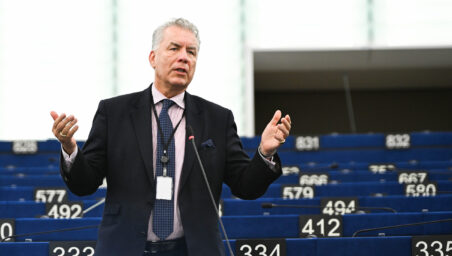
“Europe has to step up. We have to take our responsibility,” said Mr Sandvik to his fellow panellists during Monday’s Warsaw Security Forum discussion titled “Can Europe defend itself?”
Andrius Kubilius, European commissioner for defence and space, agreed. Europe’s need to build defences is its own responsibility, he said, not a sign that Americans no longer love Europeans. China is rising, and America will shift more resources to that region. Europeans should not complain too much. They should take primary responsibility for conventional defence under NATO 3.0.
Mr Kubilius said that task needs new institutions, too. The Commission president has proposed a European Security Council, including member states, Norway, Ukraine, Britain, and Canada. Peacetime institutions, doctrines, and decision-making no longer fit, he said. “In my understanding, in order to become strong in defence, we need to become more united, not less united in Europe,” he said.
One market, not many
Mr Kubilius blamed a divided industry for Europe’s weakness. Europe has no integrated defence market, he said, which leaves its firms weaker than he would like to see. “Our defence industry is very much fragmented,” he said. Overcoming it requires political unity among member states, especially the leading ones, on defence.
Norway already practises that, said Mr Sandvik. It buys frigates from Britain, and the two countries will have 13 identical ships. They will share stockpiles and spare parts, and maintain and train together. Norway also buys six submarines from Germany but builds maintenance facilities for nine in Bergen. Canada joins the submarine purchase, with 12 of the same boats.
It’s a logistics war as much as it’s a war in traditional sense. — Tore Sandvik, Norway’s defence minister
Protectionism is the obstacle, Mr Sandvik said. Donations reached Ukraine from across Europe, but the systems do not fit together. He wants Europe to integrate, standardise, and scale up industrial capacity. He calls this an industrial war. “It’s a logistics war as much as it’s a war in traditional sense,” he said.
Mr Kubilius gave the arithmetic. Ukraine faced 1,000 Russian ballistic missiles last year, he said, and may face around 2,000 this year. Defence against them relies on Patriot PAC-3 missiles, and the war with Iran in the Gulf draws on the same missiles. “The whole production of PAC-3 missiles annually is 700,” he said.
Lessons from Ukraine
Two anti-ballistic projects, Freya and Blixem, aim to close the gap. Ukrainian companies lead them, and European firms take part. Mr Kubilius wants Europe to learn from Ukraine. Industry, he said, still favours expensive, advanced production that is hard to scale up. He wants a move towards good-enough production, without abandoning the advanced kind.
Dilan Yeşilgöz-Zegerius, deputy prime minister and minister of defence of the Netherlands, said her country learns from Ukraine. Ukraine shares battlefield data, and Dutch forces train with it. The two countries produce drones together, which helps Ukraine and Dutch industry. The Netherlands, she said, defunded its military for years, until the large-scale invasion showed that relying on peace was naive.
“We’re done with being naive. We’re done with relying on our big brother or sister in America, regardless of whomever is living at the White House at that moment,” said Ms Yeşilgöz-Zegerius. The Dutch parliament and most people back defence spending and extra help for Ukraine. The Netherlands supplies 14 per cent of military help.
Her worry is the story Europeans tell. A Dutch debate began last week over whether to call Vladimir Putin an enemy. She said it distracted from the question of what Europe must do. Some populist parties, she added, give Russian propaganda a fruitful hearing, and Europe’s own narrative needs to grow stronger.
Winning the argument at home
Ms Yeşilgöz-Zegerius said distance from Russia dulls awareness of disinformation. Countries near Russia know it well, she said, but the further away, the less Europeans realise the danger. She asked colleagues in other parts of Europe for help. She said tanks, drones, and counter-drones alone will not settle the struggle. “This will start and end with communication,” she said.
Romulusz Ruszin-Szendi, Hungary’s minister of defence, said his government took office in April and wants to bring Hungary back to Europe. As chief of defence in 2022, he visited the front line in Ukraine. “The ceasefire is more than essential because every day people are dying there,” he said. He saw no early end to the war.
We’re done with being naive, with relying on our big brother or sister in America, regardless of whomever is living at the White House at that moment. — Dilan Yeşilgöz-Zegerius, Dutch deputy prime minister and minister of defence
Mr Ruszin-Szendi said the army wins public trust through work at home. When the Danube ran low, it built an obstacle in under two weeks, and the nuclear plant kept running. Helicopters helped fight wildfires, and soldiers carried water to communities. “So the Hungarian society realised, hey, there is a military,” he said.
Hungary will meet the target of two per cent of GDP on defence this year, he said, and has a clear path to five per cent. Hungarian industry cannot deliver fast, though. Hungary ordered 44 tanks, which take eight years to arrive. So it orders from Germany, France, Turkey, and Poland to feed European industry and rebuild its own through joint ventures.
Late, but building
Europe starts late and slow, Mr Kubilius said — but it builds advanced systems. Galileo beats America’s GPS, he said, and Copernicus is the best observation system in the world. Europe now builds a secure satellite communication system, IRIS², with quantum encryption. It should be ready in 2029. Ukraine uses Starlink, which he called good technology.
Mr Sandvik ended on cost. Norway will spend five per cent of GDP—a challenge, he said—while Ukraine spends 30 per cent of GDP. Norway will give about $8.5bn to Ukraine next year, the same as this year. “War is much more expensive than deterring and building defence when we have time,” he said.