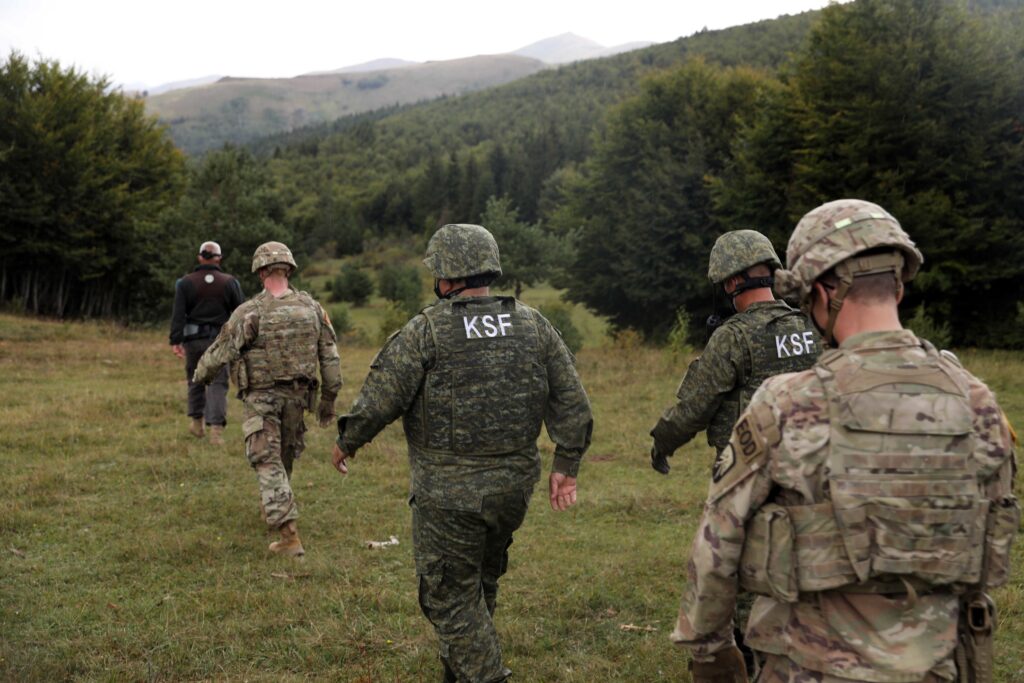
Kosovo has spent 27 years clearing mines from its fields, roads, and villages, and the job is still not done. Yet five EU countries bordering Russia have now left the global ban on anti-personnel mines, and Finland alone plans to buy a million. Critics warn the weapons could outlive the very threat they are meant to deter.
Estonia, Latvia, Lithuania, Poland, and Finland left the Ottawa Convention, also known as the Mine Ban Treaty, between December 2025 and February 2026. The treaty, signed in 1997, bans the use, production, stockpiling, and transfer of anti-personnel mines. The five governments acted in the name of national defence. Their move lays bare Europe’s landmine dilemma. What governments see as a tool of deterrence can become a danger to civilians for decades.
Those governments point to the deteriorating security situation on NATO’s eastern flank and the need to strengthen defence capabilities in response to the Russian threat. They also fear that existing restrictions could limit their military options in a potential conflict.
Campaigners see it differently. The International Campaign to Ban Landmines (ICBL), which won the Nobel Peace Prize in 1997, argues that EU member states and institutions “should also join our call on Finland to halt its plans, commit not to use or transfer antipersonnel mines, and rejoin the Mine Ban Treaty without delay”.
EU defence money under scrutiny
The withdrawals raise a broader question. How do member states’ new military needs square with their commitments to humanitarian disarmament? The issue has also reached the European Parliament. Lawmakers there are asking what the withdrawals mean for EU defence funding and whether that money respects international conventions.
The Security Action for Europe (SAFE) regulation, adopted in May 2025, offers member states up to €150bn in low-cost loans for defence. It does not change their obligations under international law. Treaties banning certain weapons, including the Ottawa Convention, still bind every state that has ratified them. The Commission has also stressed that the EU will keep pursuing the Convention’s goals. States that have withdrawn, it adds, remain bound by international humanitarian law.
The ICBL, a global network of civil society organisations that runs jointly with the Cluster Munition Coalition, sees a gap. It notes that SAFE contains “no explicit exclusion of antipersonnel mines, and its broad equipment categories include ammunition and counter-mobility”. Counter-mobility covers obstacles meant to slow enemy forces, a category that can include mines. That matters, the campaign adds, because “several member states are now actively restarting production and procurement”.
Million mines for Finland
Finland shows what is at stake. Its Army Command has just confirmed that the country is seeking one million anti-personnel mines, worth some €100m. It wants contracts signed by the end of 2027 and production running by 2028. The ICBL told EU Perspectives that the news came only a week after it appealed to senior UN officials, heads of humanitarian organisations, and foreign ministers. It urged them to act fast to stop new mine production in Finland and Poland.
Other countries raise questions too, the ICBL says. Latvia has announced a €28.3m mine purchase linked to SAFE, but has not said which types of mines it wants to buy. Public descriptions of Poland’s SAFE contracts name Belma, a company that is also expanding its mine production. “When the same manufacturers produce both antivehicle and antipersonnel mines, financing for one can strengthen capacity for the other,” the campaign explained.
Commitments to legality mean little without a way to verify them. — International Campaign to Ban Landmines
The Commission insists that these investments must comply with international law. Yet it also says compliance is a matter for member states, and that it cannot disclose what national plans contain. For the ICBL, that is not enough. “Commitments to legality mean little without a way to verify them.”
The campaign also sees a contradiction. “The EU is one of the world’s largest funders of mine action. It should not finance the clearance of mines with one hand while its defence instruments risk financing their production with the other.”
Kosovo’s long clean-up
Kosovo shows how long mine clearance can take. The country is a potential candidate for EU membership, though not yet an official candidate. In September, the HALO Trust, a British charity that has cleared landmines in conflict zones around the world since 1988, announced it had wrapped up its demining work there. Its teams arrived in 1999 and stayed for 27 years. “Mines do not distinguish between a soldier and a farmer, a child or a deminer, and they remain active long after the conflict that justified them is forgotten,” the ICBL warns.
HALO is now handing responsibility for any residual contamination back to the national authorities. Its work has reopened farmland, roads, tourist trails, and areas near homes and public buildings. Families have returned to places that were once too dangerous. Communities have rebuilt homes and businesses, and farmers can use machinery and repair irrigation again. Pristina airport, which handles almost five million passengers a year, could only be redeveloped once a nearby minefield was cleared.
The cost of a mine is not its purchase price but the decades of clearance, victim assistance and lost land use that follow. — International Campaign to Ban Landmines
For the ICBL, Kosovo holds three lessons for policymakers. “First, the cost of a mine is not its purchase price but the decades of clearance, victim assistance and lost land use that follow. Second, mines laid ‘temporarily’ for defence routinely outlast the threat they were meant to counter, and records, marking and fencing break down in real conflict. Third, the land the five states would mine is their own: their own forests, farmland and border communities would bear the consequences. Any honest assessment must count those costs, not just the hoped-for military effect.”
Yet HALO’s exit does not mean Kosovo is free of mines. The 2026 Mine Action Review report shows that the country is still contaminated with anti-personnel mines and cluster munition remnants. Cluster munition remnants alone still affect more than six square kilometres. Kosovo’s national strategy for 2025–2030 aims to finish clearance by 2030. But funding cuts, above all the suspension of US funding in 2025, have reduced the capacity to get there.
Closing one organisation’s programme is not the same as making a whole territory safe. The first marks the end of an operational phase. The second means finding every contaminated area and then clearing it or confirming through checks that it is safe.
Lives and land on hold
Landmines and other explosives do not only kill and maim. They also keep farmland out of use, stall the rebuilding of homes, and cut off roads and infrastructure. In Kosovo, landmines killed or injured 585 people between 1999 and 2024, according to HALO. Three in four of those casualties came in 1999 and 2000, before systematic survey and clearance began.
Kosovo’s national strategy for 2025–2030 describes how contamination has held back the return of communities, the restart of economic activity, and post-war reconstruction. Since 1999, teams have cleared more than 64 square kilometres of contaminated land. Yet the strategy admits that some contamination remains.
Access is a problem for the clearance work too. Deminers must be able to reach an area, assess the risks, and run the necessary checks. Every area they clear does more than remove weapons. It gives people back places to live, farm, and travel through safely.
Security at what cost
The clash between the defence needs of eastern European countries and the goals of the Ottawa Convention remains unresolved. The five governments argue that the military situation on their borders demands more freedom in choosing their defence tools. Humanitarian organisations point to the risks mines pose to people long after the fighting ends.
Brussels insists that stronger defence and the treaty’s goals can go together. Kosovo is a reminder of the price if they do not. It takes decades to make mined land safe again, and communities cannot rebuild until it is.
“We understand the security fears behind these decisions. But it is hard to understand why border protection should rely on weapons that have long been proven to harm far more innocent civilians than military targets,” the ICBL says. It goes further. “Countries that were once champions of humanitarian disarmament and international law are now among the first to dismantle that progress, in the name of a false sense of security.”
What campaigners want from Brussels
The campaign wants the EU to adopt four safeguards. First, SAFE, the European Defence Industry Programme (EDIP), the European Peace Facility, and any future defence instruments should explicitly exclude anti-personnel mines, their components, and the capacity to produce them. Second, member states should disclose the types, quantities, and end use of any mines bought or produced with EU-backed money.
Third, the Commission should check national plans specifically for anti-personnel mines and report publicly on how it does so. Fourth, the EU should remind the 22 member states still party to the Mine Ban Treaty that they may not assist, encourage, or induce banned activities. That includes approving joint financing that supports them.
For Brussels, the debate on European defence therefore reaches beyond military strategy. The question is how to keep Europe secure without weakening the very treaties that protect civilians from the consequences of war.