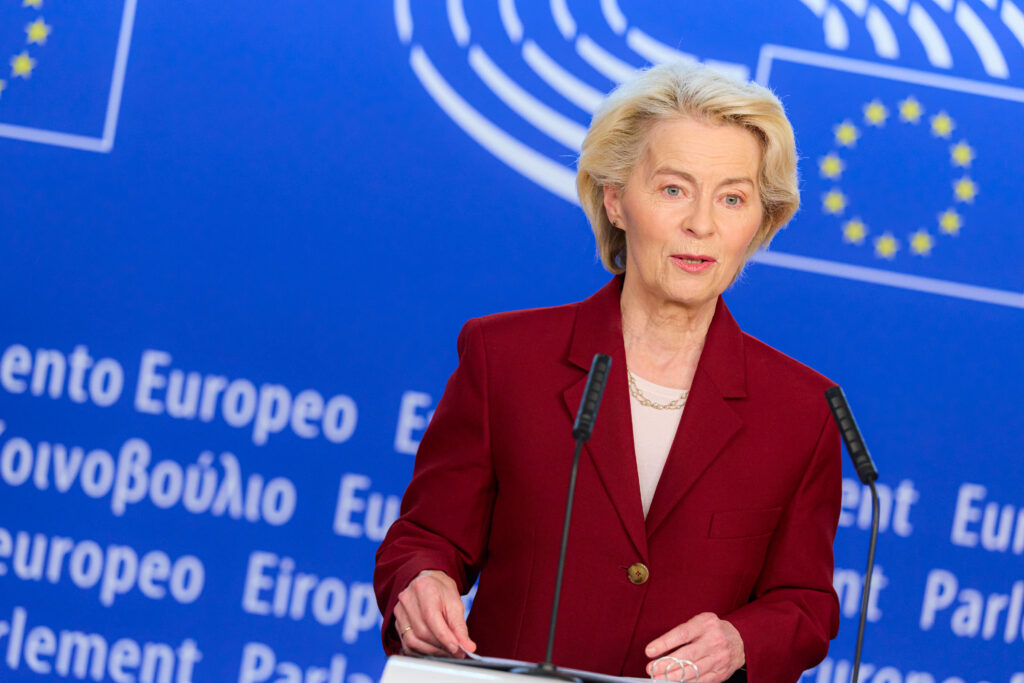
The EU will propose new powers to restrict access to its market when its economic interests are threatened, Ursula von der Leyen told Parliament on Wednesday. António Costa also set out the next step in budget negotiations: a detailed compromise proposal for leaders to discuss in November.
The announcements came during Parliament’s debate on last week’s European Council. The Commission president outlined plans to help businesses find alternative suppliers and support countries facing economic pressure. Mr Costa confirmed that he would seek a budget agreement in December, following an extraordinary summit on 26–27 November.
Faster action against economic pressure
Ms von der Leyen said the Commission would propose an instrument allowing Europe to respond more quickly when its interests were threatened. “Deterrence works when others know we are ready to respond,” she said. She did not spell out the proposed powers or the conditions for using them.
A “Diversify EU” package, due in December, would help European companies broaden their supply chains. It would not target a particular country. “There should be no critical dependence on one single supplier,” she said. A further solidarity package would support countries facing economic pressure, preventing individual governments from being left to respond alone.
Europe must be ready to act when dialogue does not produce results. — Ursula von der Leyen, President of the European Commission
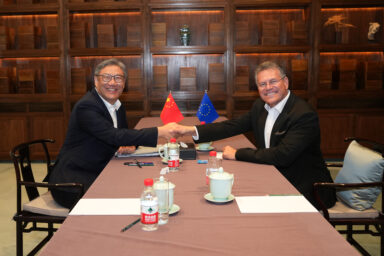
China was central to her argument. Ms von der Leyen praised Trade Commissioner Maroš Šefčovič’s recent negotiations in Beijing, citing the previously announced agreement limiting Chinese hybrid-vehicle shipments to 350,000 annually, reducing exports by around 45 per cent.
She warned that the deal could not resolve the broader trade imbalance. “Europe must be ready to act when dialogue does not produce results,” she said, identifying chemicals and machinery as sectors facing growing concerns.
Mr Šefčovič said the Commission was working to deliver most of its promised measures before December’s European Council. He highlighted completing the single market, diversifying supply chains and developing trade partnerships.
Costa prepares a new budget compromise
Mr Costa announced that he would present a detailed negotiating proposal for the extraordinary European Council on 26–27 November. Its purpose would be to bring governments closer to an agreement on the 2028–34 budget, “probably only in December”.
He said work would begin immediately with the Commission and national governments, alongside close contact with Parliament. Reaching agreement this year would leave 2027 for the legislation needed to start the new programmes in January 2028.
We must keep national contributions at a reasonable level. — António Costa, President of the European Council
Mr Costa said the EU needed new sources of income so governments would not have to cover all the extra spending through higher payments. “We must keep national contributions at a reasonable level,” he said. EPP leader Manfred Weber urged governments to consider what they gain from EU spending, not just how much they pay in.
Energy plan faces demands for relief
Ms von der Leyen also announced that the Commission would develop a plan for a stronger European Energy Union. She pointed to electricity grids, cross-border connections and coordinated purchasing as opportunities Europe was failing to use fully. “We are also squandering opportunities by not having a true European Energy Union,” she said.
For Mr Costa, temporary relief could not remove the vulnerability created by imported fossil fuels. He called for investment in European renewables, nuclear power and electricity networks. Ms von der Leyen ruled out lifting Russian energy sanctions before Moscow ended its war.
Lawmakers pressed the institutional leaders to address the immediate pressure on households. Renew Europe leader Valérie Hayer condemned violence surrounding the weekend’s demonstrations but identified the concerns behind them: living costs, purchasing power and fear of losing jobs. The Left’s co-chair Martin Schirdewan demanded an extraordinary summit on social cutbacks.
Mr Costa’s closing response put housing and energy costs alongside competitiveness. The next concrete tests are now approaching: the Commission’s December economic-security proposals and his November attempt to narrow governments’ budget differences.