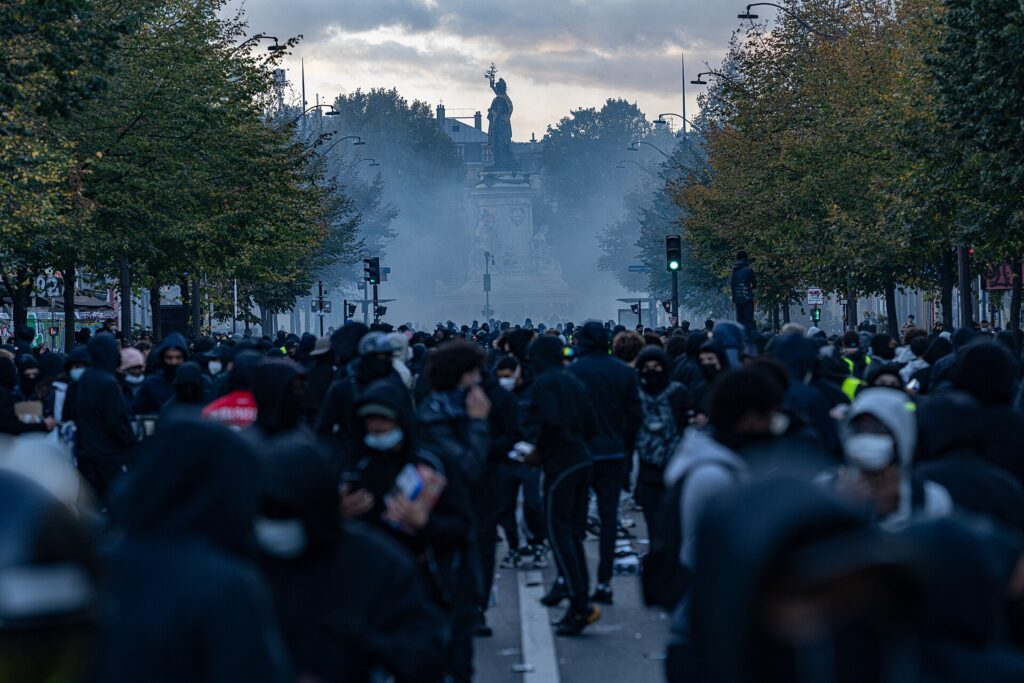
The European Commission warned on Monday against treating peaceful protesters as responsible for the violence that swept through French cities. European Parliament lawmakers have offered sharply different responses, condemning attacks on public buildings, defending students’ demands and accusing political opponents of exploiting the unrest.
“Those who demonstrate peacefully must not be conflated with those who commit violence,” Commission spokesperson Markus Lammert said. He described arson, looting and attacks on people or public buildings as unacceptable, while insisting that the right to peaceful protest “must be protected”.
The comments followed Saturday’s demonstrations against rising living costs and deteriorating public services. In Brussels, the argument now concerns both the protection of protesters and responsibility for the destruction. The Commission has backed French authorities’ efforts to maintain security, while European Parliament members disagree over whether the political response is addressing the grievances behind the marches.
Commission backs public order and limits on police force
Mr Lammert said the Commission supported efforts to protect people, property and public institutions “in full respect of fundamental rights”. Investigations and law enforcement remained the responsibility of national authorities. His statement offered support for restoring order without endorsing every police intervention.
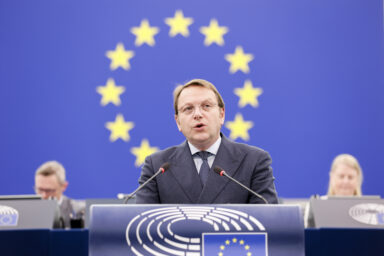
The Commission had already faced questions about France’s handling of the student movement before the weekend. Addressing Parliament on 5 October, Executive Vice-President Roxana Mînzatu said authorities had a duty to respect peaceful assembly. “Every Member State is entitled to uphold the law and every protester is entitled to expect proportionate and lawful policing,” she said.
Those who demonstrate peacefully must not be conflated with those who commit violence.
— European Commission
Ms Mînzatu also condemned attacks on police officers, firefighters and paramedics, saying no grievance could justify violence. Students had to be able to attend classes safely, and teachers to work without intimidation. She welcomed the French government’s dialogue with students and said the Commission could offer support if requested.
Lawmakers divide over violence and the demands behind it
French S&D MEP Raphaël Glucksmann condemned Saturday’s destruction while defending the legitimacy of peaceful demonstrators’ demands. “I invite the government to provide a firm response to the ultra-violent movements,” he wrote on X. Mr Glucksmann said those attacking town halls, public services and shops were drowning out people protesting over education, living costs and injustice. He called for stronger police measures.
Right-wing and far-right politicians focused their commentary on the protesters.
Jordan Bardella, the National Rally president and a French MEP in the Patriots for Europe group, took a sweeping position. He said that: “We will neutralize the individuals who behave in our midst like vandals, looters, and barbarians.” His response also placed blame on the far left.
France’s unrest fuels arguments beyond its borders
Others made a connection between the unrest and migration. Polish Law and Justice MEP Dominik Tarczyński, a member of the European Conservatives and Reformists, used the unrest to promote Poland’s approach to migration. “BE LIKE POLAND. Not like France,” he wrote on X on Saturday. In videos published over the weekend, Mr Tarczyński contrasted quiet streets in Warsaw and Kraków with scenes from France, attributing the difference to migration policy. That was his interpretation of the unrest, whose underlying grievances include living costs and conditions in schools.
Italian Lega MEP Silvia Sardone, from the Patriots for Europe group, also drew a connection with France after violence in Milan. “Some would like to bring the chaos and street battles we see in France to Italy too,” she said in remarks reported on Sunday, translated from Italian. Ms Sardone called for demonstration organisers to pay a compulsory deposit to cover damage. She argued that those responsible for destruction should bear its costs.
The Commission has left the response in French hands, offering support if requested. Authorities must protect peaceful assembly. The Commission also condemned violence against people, emergency workers and public institutions. Investigations into individual incidents will determine whether those standards were upheld.