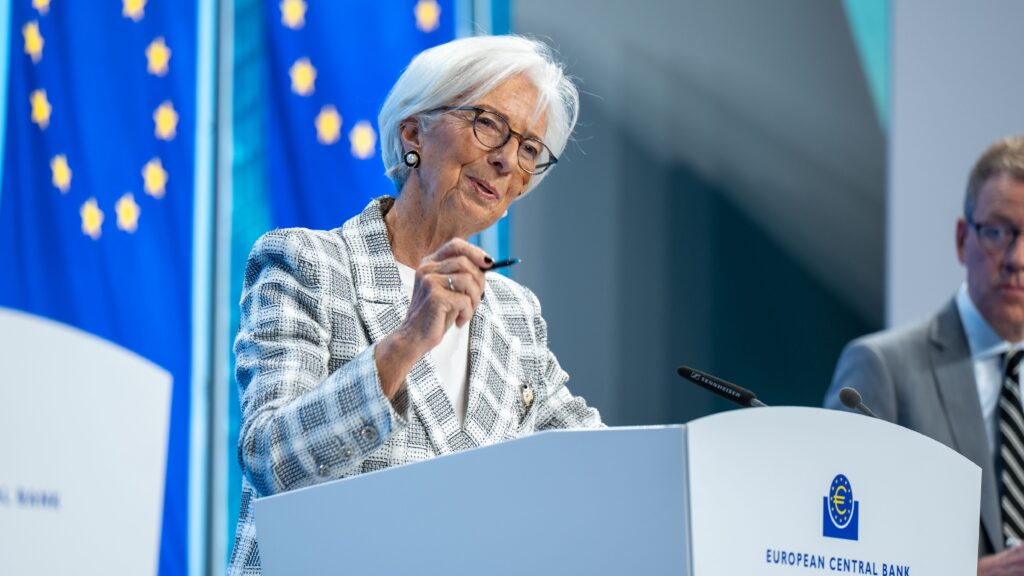
Christine Lagarde says she will leave the European Central Bank early because she wants the freedom to speak beyond monetary policy. Her announcement came as the ECB held interest rates unchanged amid rising energy prices.
“I don’t think that I can remain neutral. I don’t think that I can be comfortable in that neutrality at the present time,” Ms Lagarde said at the 29 October press conference. As EU Perspectives reported earlier, she will step down on 7 February 2027, almost nine months before her eight-year term was due to end.
Neutrality, truth, and the succession process
Ms Lagarde initially deferred questions about her departure so journalists could first discuss the monetary-policy decision. Returning to the subject, she explained that ECB leaders must remain within their mandate. “We comment on the situation with a focus on monetary policy. We are driven by one mandate. And we don’t get out of that mandate because that’s the price we pay for being independent,” she said.
She argued that her experience leading the ECB and, previously, the International Monetary Fund gave her something to contribute to wider debates. She identified concern about truth and misrepresentation among her motivations, without announcing a specific future role. “But I feel that I should say those things, and I cannot do so in my current position,” she said.
I don’t think that I can remain neutral. I don’t think that I can be comfortable in that neutrality at the present time. — Christine Lagarde, European Central Bank President
The succession process has already begun, Ms Lagarde added, insisting that her departure would preserve continuity at the institution. “Don’t worry about decision making in limbo. No, absolutely not. The institution is solid strong.” She also stressed that she would remain fully engaged until February and would lead the December and February monetary-policy press conferences.
Rates unchanged as energy risks mount
The Governing Council kept the deposit rate at 2.50 per cent, with the main refinancing and marginal lending rates remaining at 2.65 per cent and 2.90 per cent. Ms Lagarde said policymakers had debated raising rates before unanimously agreeing to wait for more information. “Actually, the Governing Council debated whether a hike was appropriate,” she said.
The opening statement showed inflation rising to 3.8 per cent in September, with energy inflation reaching 18.9 per cent. Higher energy bills threaten household spending and business investment, while rising long-term borrowing costs have also tightened financing conditions.
Ms Lagarde identified those two developments as central to the Council’s discussion: energy prices were increasing inflation, while more expensive financing was weighing on the economy.
Before December’s meeting, policymakers will receive new staff projections, inflation readings, and data on wages, employment, and lending. Ms Lagarde said the bank would watch underlying inflation closely for evidence that energy costs were spreading into broader price pressures. Thursday’s pause leaves further increases possible: “We are not pre-committing to a particular rate path,” she said.