Digital tools that track how quickly employees work can leave them drained and strain their family lives, Eurofound finds. New EU safeguards for platform workers are due to enter national law by 2 December. But some countries already expect delays.
A programme can assign the next job, prepare a shift rota, or record how quickly someone completes a task. These everyday uses of digital management are examined in Eurofound’s report published at the end of October. Its findings raise questions about how employers can organise work efficiently while protecting employees from excessive pressure.
Performance monitoring follows workers home
Across the EU, 19 per cent of employees reported computerised performance monitoring, 18 per cent automated task allocation, and ten per cent automated scheduling. The analysis uses the European Working Conditions Survey 2024. As EU Perspectives reported in August, the use of these tools varies across countries and workplaces. The new report examines their relationship with workloads, well-being, and life outside work.
Performance monitoring showed the most consistent association with poorer outcomes: greater exhaustion, lower engagement, and more work–family conflict. Employees may worry about work during their personal time, feel too tired for household tasks, or struggle to find time for family. “The findings highlight that algorithmic management is not confined to platform work, low-skilled occupations or sectors traditionally associated with poorer job quality,” the authors write.
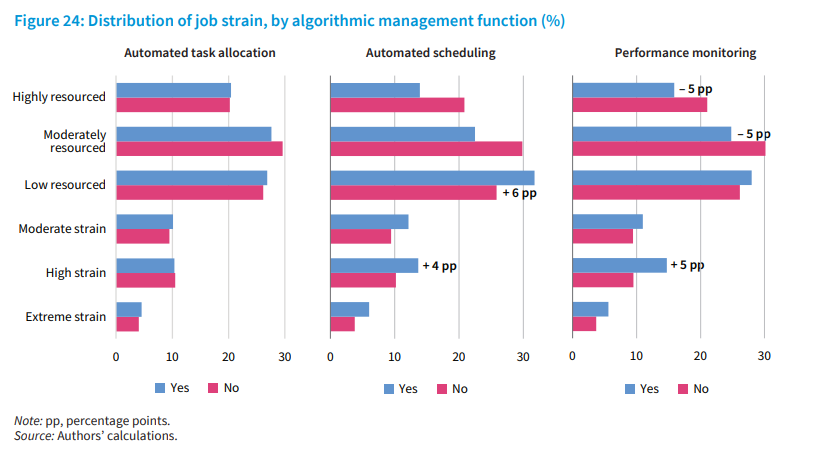
The findings also distinguish between different uses. Automated task allocation was associated with higher engagement alongside greater work–family conflict. The research cannot establish that software caused these outcomes, and the measured differences were generally small. Workplaces with heavy demands may also be more likely to introduce automated management.
Practical uses, with limits on surveillance
Location tracking can help organise work. France’s privacy regulator permits GPS systems to identify the technician nearest a broken lift or the ambulance closest to an accident. Employees must be informed, access to information restricted, and location collection disabled outside working hours. For remote work, the regulator recommends reasonable, measurable objectives and regular progress reports.
Monitoring can also protect employees. At Portuguese waste-management company Amarsul, wearable devices alert security when a worker becomes immobilised, allowing medical assistance to be sent. EU-OSHA highlighted the system in a May 2025 case study, recognising the company through its good-practice awards. Such safety systems illustrate another purpose for collecting information about workers, separate from the performance monitoring measured in Eurofound’s survey.
Workers’ representatives have also negotiated safeguards. In Germany, Deutsche Telekom and its group works council agreed principles for AI use, including protection of employees’ safety, health, and fundamental rights. Eurofound’s new report recommends that employees receive “clear information on what is tracked, how data are used, how performance is assessed and how monitoring informs decisions”.
New rights approach their implementation deadline
The Platform Work Directive requires national implementation by 2 December. It establishes specific safeguards for people working through digital labour platforms, including explanations of automated systems, human oversight, and routes to challenge significant decisions. Platforms must assess health risks and prevent automated systems from placing undue pressure on workers.
The findings highlight that algorithmic management is not confined to platform work, low-skilled occupations or sectors traditionally associated with poorer job quality. — Eurofound report
The rules also prohibit certain type of data processing. That includes automated analysis of emotional or psychological states and collecting personal data while someone is neither offering nor performing platform work. Implementation is progressing unevenly: Eurofound records warnings that France and Slovenia expect to miss the deadline.
Employees in offices and factories already have protections under data-protection and occupational-safety law. The Commission is considering broader measures on algorithmic management through its planned Quality Jobs Act, with a proposal expected by the end of 2026. For workers, the questions concern what employers record, how that information affects their workload, and whom they can ask to review a decision.