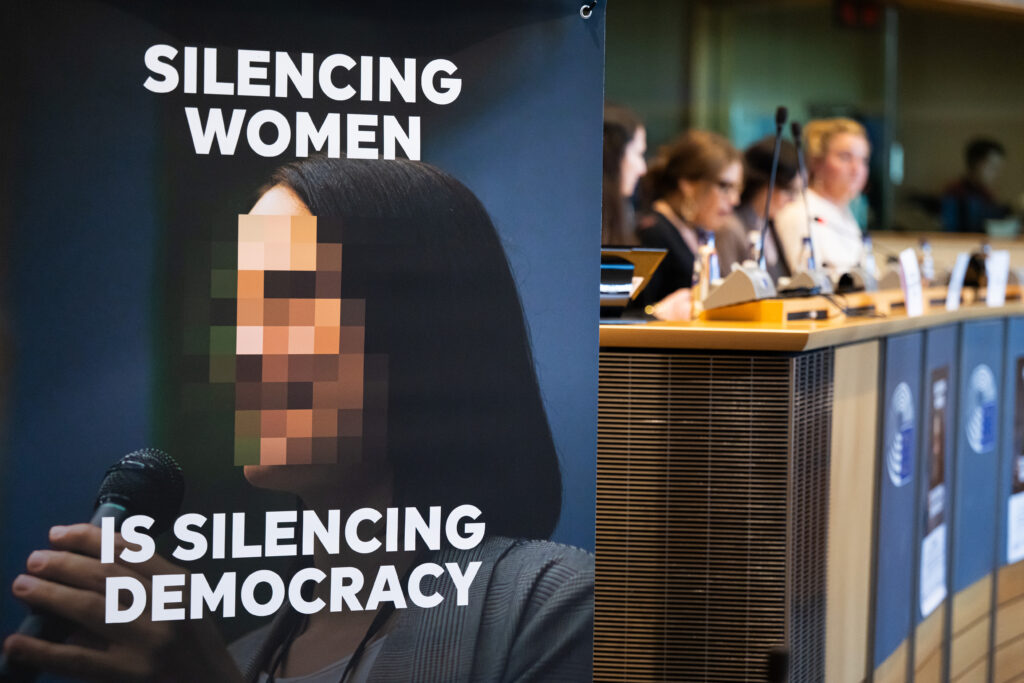
Online violence, misogynistic disinformation, and digital harassment are increasing threats to the political landscape in Europe. These issues were discussed on Thursday, 5 March, in the Committee on Women’s Rights and Gender Equality on the occasion of International Women’s Day and before the lauch of the new EU Gender Equality Strategy.
The meeting, titled “Women’s rights and democracy: combating stereotypes, disinformation and violence in the digital age”, brought together policymakers, experts and civil society representatives. Opening the session, in a video message, European Parliament President Roberta Metsola emphasised that online harassment should never be accepted as an inevitable feature of digital life. “This kind of harassment is too often brushed aside as something that just comes with social media”, she said. “We don’t have to live with it, and we will never tolerate it”.
A new EU Gender Equality Strategy
Present in the meeting, European Commissioner for Equality, Preparedness and Crisis Management, Hadja Lahbib, announced the presentation of a new EU Gender Equality Strategy later that day. The initiative is intended to guide EU action over the next five years and places a strong focus on combating online gender violence.
One of the strategy’s priorities is tackling cyber-harassment and the non-consensual sharing of intimate images, including deepfakes. Recent research shows that 98 per cent of deepfake pornography targets women. “We took action against Grok over AI generated sexually explicit deepfake. We took action on so called nudifying apps, and we moved against pornographic platforms to better protect minors in Europe (…) Tech companies are not above the law,” Commissioner Lahbib said.
Online abuse against women is not random. It is a deliberate attack on equality and on democracy. – Hadja Lahbib, European Commissioner for Equality
Another key objective is ensuring that member states fully implement the Directive on combating violence against women and the Digital Services Act. This requires platforms to remove illegal content and strengthen protection for victims.
The strategy also addresses the impact of online harassment on democratic participation. According to the Commission, nearly one in three women in politics reports abuse, often through digital channels.
In addition, the initiative plans to investigate the networks behind anti-gender disinformation campaigns. According to Ms Lahbib, anti-gender networks received more than €1bn in funding between 2019 and 2023, fuelling online campaigns.
More broadly, Commissioner Lahbib stressed that online misogyny should not be dismissed as an inevitable part of digital life. “Online abuse against women is not random. It’s not just social media, it’s a deliberate attack on equality and on democracy women. When women are silenced online, democracy shrinks”, she told the Committee.
Disinformation, stereotypes, misogyny online
According to recent UN data, around 70 per cent of women in public life have experienced online violence. Besides, 41 per cent report that digital abuse has escalated into offline harm.
Social media platforms have amplified these dynamics. Algorithms and online communities can create echo chambers where misogynistic narratives spread rapidly, and attacks against women are normalised. One emerging concern is the influence of the so-called ’manosphere’, loosely connected online networks promoting anti-feminist ideologies and male supremacy.
Digital spaces for many women become spaces of intimidation and abuse rather than empowerment and visibility. – Florence Raes, Director of the UN Women Brussels Liaison Office
Florence Raes, Director of the UN Women Brussels Liaison Office, warned that such trends risk discouraging women from public life. “Online platforms shape public opinion and provide spaces to engage constituencies”, she said.
Women politicians, journalists and activists are particularly exposed to harassment, threats and coordinated disinformation campaigns. “Digital spaces for many women become spaces of intimidation and abuse rather than empowerment and visibility. Women in politics, journalism and activists are the ones that face harassment, disinformation campaigns, abuse, threats and violence the most” Raes stated.
Global data shows that two-thirds of women elected in local government report experiencing violence. This often begins online and spills into offline harassment.