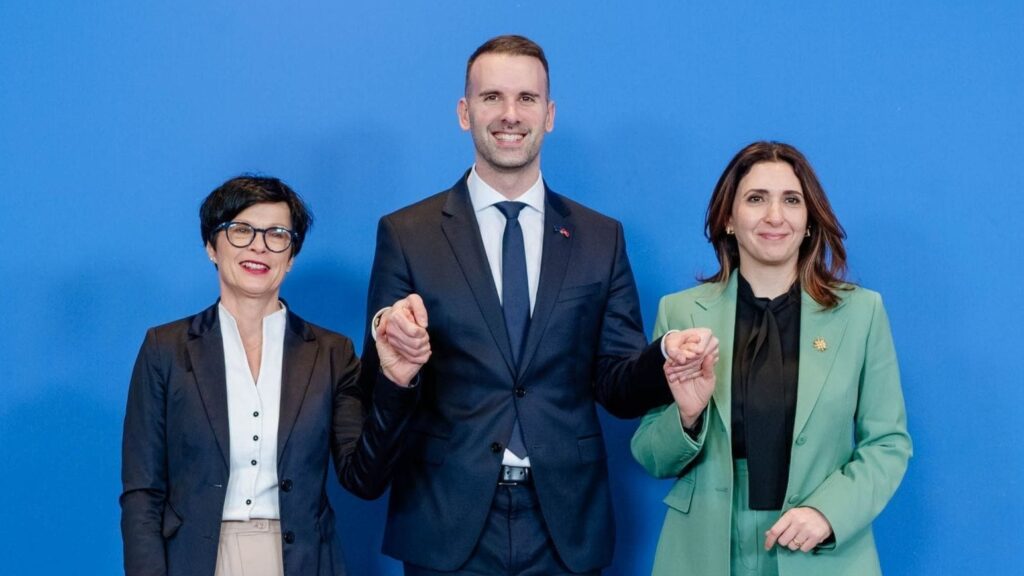
Podgorica has taken another significant stride on its path to membership of the European Union. The closure of a chapter on infrastructure underscores its frontrunner status among candidate countries. Yet the decisive phase of the negotiations—and the true test of the country’s readiness—still lies ahead.
The EU and Montenegro made notable headway in accession talks. At an intergovernmental conference in Brussels held on Tuesday, they provisionally closed Chapter 21, which covers trans-European networks — key infrastructure spanning transport, energy and telecommunications. Podgorica has now closed 14 of the 33 negotiating chapters.
The pace of progress is further underlined by the fact that this latest chapter has been wrapped up less than two months after the previous conference, at which the chapter on financial control was concluded.
The submarine electricity cable linking Montenegro and Italy already represents a strong bridge between the Western Balkans and the European energy market. — Milojko Spajić, Prime Minister of Montenegro
“Montenegro remains a frontrunner in the enlargement process and today’s progress confirms the strong momentum of its accession negotiations, which is based on own merits,” said Marilena Raouna, Cyprus’ Deputy Minister for European Affairs, speaking on behalf of her country’s presidency of the Council of the EU.
Infrastructure as the key to Europe
The chapter on trans-European networks is among the more technically significant parts of the negotiations, as it determines how a candidate country will be connected to Europe’s transport and energy corridors.
According to the EU’s common position, Montenegro’s infrastructure planning is already aligned with the Union’s objectives, particularly in strengthening links between the Western Balkans and member states. The EU has also welcomed the country’s participation in regional initiatives aimed at improving mobility and integration across the region.
“The submarine electricity cable linking Montenegro and Italy already represents a strong bridge between the Western Balkans and the European energy market. At the same time, Montenegro participates in regional initiatives aimed at strengthening diversification and connectivity of energy systems, including projects such as the Ionian-Adriatic Pipeline,” said Montenegro’s Prime Minister, Milojko Spajić, who led the country’s delegation in Brussels.
However, a Council document makes clear that closing the chapter does not imply a clean bill of health. Brussels explicitly stresses that all infrastructure projects must fully comply with EU rules, especially in public procurement — including those agreed under intergovernmental arrangements.
This emphasis is an implicit nod to sensitive projects in the region that have previously drawn criticism over a lack of transparency. The Union also makes plain that it will ‘closely monitor’ developments up to the point of accession and reserves the right to reopen the chapter if necessary.
Concerns over fiscal stability
Another significant reservation concerns the financing of infrastructure. The EU has warned of the need for careful loan planning and for assessing the impact on public finances. Montenegro will have to combine its own budgetary resources with funding from international institutions such as the European Investment Bank and the European Bank for Reconstruction and Development, while keeping a firm grip on fiscal stability. Rapid infrastructure modernisation must not come at the cost of unsustainable debt.
In the energy sector, Brussels is pressing for a fundamental strategic shift. Alongside support for interconnecting electricity grids with neighbouring countries and Italy, it is emphasising the need for decarbonisation and a reduction in dependence on fossil fuels. According to the EU, the transition to a sustainable energy system is a more effective route to long-term security than further expansion of fossil-fuel infrastructure.
The hardest part still to come
Beyond investments and strategies, the EU has also pointed to institutional weaknesses. Montenegro must strengthen its administrative capacity, recruit and train specialists, and establish structures capable of managing European projects and funds. According to Brussels, the ability not merely to adopt rules but to implement them effectively will be crucial for further progress.
Montenegro remains the clear leader among candidate countries. As Enlargement Commissioner Marta Kos has previously indicated, the small Balkan state could close all chapters by the end of 2026.
The most demanding phase, however, still lies ahead — success will hinge on tackling more challenging areas such as the rule of law, the judiciary, fundamental rights, and justice and home affairs, covered by Chapters 23 and 24.