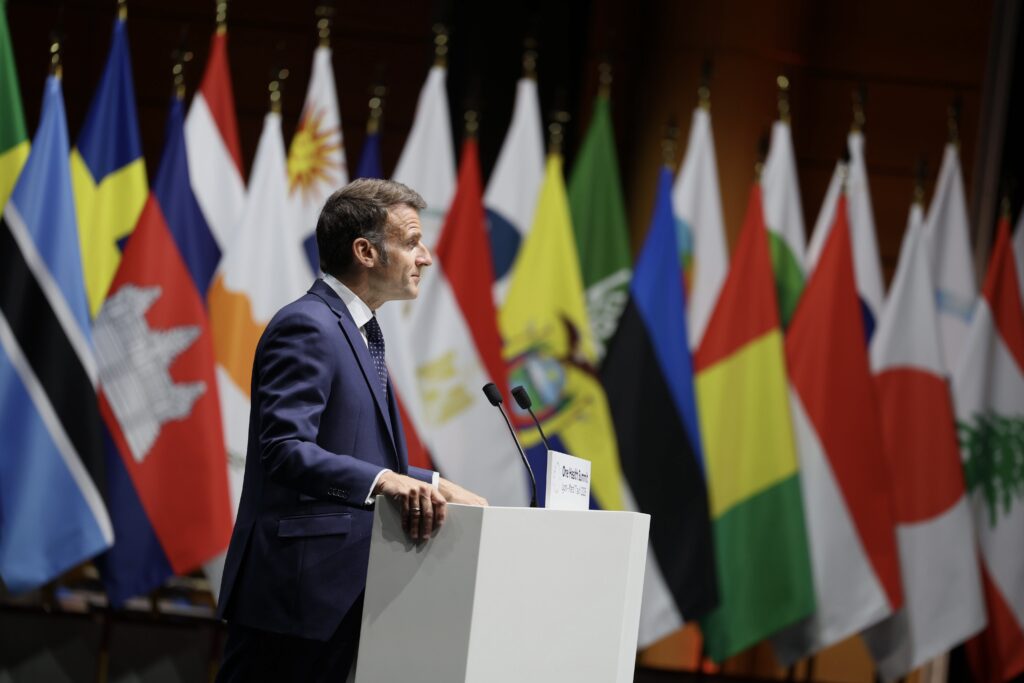
France’s president called a global health summit — and used it to declare that global cooperation is breaking down. Emmanuel Macron, hosting world leaders in Lyon under France’s G7 presidency, championed the “One Health” approach, which treats human, animal and ecosystem health as inseparable. But his core message was a warning: the structures needed to prevent the next pandemic are weakening precisely when they are needed most.
The stakes are not abstract. Around 75 per cent of emerging infectious diseases originate in animals — and once they jump to humans, no border can stop them. Infectious diseases, antimicrobial resistance and environmental pressures do not respect national boundaries, which is precisely why Macron argues they require a coordinated global response.
“It is a world in crisis,” Macron told an audience of heads of state, ministers and scientific leaders in Lyon. “We can see the challenges to world health which require greater cooperation and coordination than ever. But we are in an international situation which has completely shattered this.”
Science in the geopolitical crossfire
President Macron used the One Health approach to illustrate how deeply interlinked today’s risks have become and how dependent they are on cooperation across borders and disciplines. “We need cooperation, so that we can succeed in health. And if there is one field where international cooperation is both interdisciplinary and necessary, it is indeed in the field of health,” he said.
At the same time, he warned that the conditions for such cooperation are deteriorating. Declining humanitarian contributions and growing scepticism towards international organisations are weakening the foundations on which coordinated responses depend.
Global health will not make progress if science is subject to political pressure.
—Emmanuel Macron, President of France
More fundamentally, President Macron cautioned against the politicisation of science itself. “Global health will not make progress if science is subject to political pressure, or become an object of selective approach decided on by the government,” he said.
Europe’s fraying safety net
The challenge is not a lack of frameworks. In recent years, governments have built an increasingly dense architecture of agreements and initiatives, from pandemic preparedness mechanisms to cross-sector surveillance systems embedded in the One Health model, which aims to detect and manage risks at the interface of humans, animals and ecosystems.
The 2025 Pandemic Agreement formally integrates One Health as a core principle. It reflects a growing consensus: siloed responses are no longer sufficient. But the issue is no longer whether frameworks exist. The question is whether the political and financial conditions to sustain them still hold. Trust between countries is fraying. Funding is becoming more uncertain, even as the economic case for prevention strengthens.
According to World Bank estimates, investing in prevention through a One Health approach costs significantly less than responding to full-scale pandemics. Yet securing long-term financing remains a persistent challenge — and for health systems the implications are immediate. Early warning, data sharing and coordinated responses all depend on sustained collaboration, precisely the element now under pressure.
The coalition alternative
Against that backdrop, Macron pointed to a shift in how cooperation is organised. “This is a method… where we get a coalition of players in an international order which has been upset,” he said. The remark reflects a broader strategic pivot — away from formal multilateral processes towards more flexible, issue-based alliances bringing together governments, scientists and private actors.
Such coalitions offer a way to maintain progress in a fragmented landscape. But they also risk complicating global governance further if they remain disconnected from a broader framework. One concrete step emerged from Lyon: WHO announced plans to launch a new Global Network of One Health Institutions, designed to translate global guidance into on-the-ground support for individual countries.
France’s strategic play
For France, elevating One Health within the G7 is also a question of positioning. Since COVID-19, Paris has backed a series of international initiatives — from pandemic financing mechanisms to zoonotic disease prevention — aimed at strengthening preparedness and response. It has also supported efforts to anchor cross-sector coordination within institutions such as the World Health Organization.
By linking these efforts to its G7 presidency, France is seeking to embed health within the core agenda of major economies. Security, industrial policy and economic resilience are already there. Health should be too, Paris argues.
The ultimate test
That move turns One Health into an early test of whether cooperation between major powers can still function. The logic is straightforward: if coordination cannot be sustained in an area where interests largely align, it will be even harder in more contested domains.
We must not forget what happened in the past… it is our duty to prepare for the challenges of today and tomorrow.
—Emmanuel Macron, President of France
“We must not forget what happened in the past… it is our duty to prepare for the challenges of today and tomorrow,” Macron said. That leaves One Health exposed to a deeper political reality.
The framework assumes cooperation across borders, sectors and institutions. But in a world of competing priorities, constrained budgets and rising geopolitical tensions, that assumption is no longer guaranteed. If even shared health risks cannot sustain alignment between major powers, the prospects for cooperation in more contested areas look increasingly uncertain.