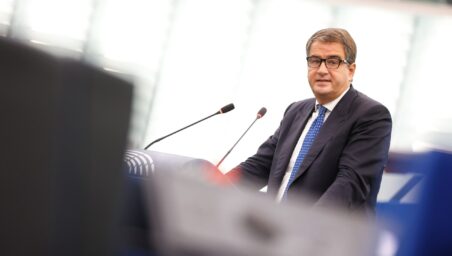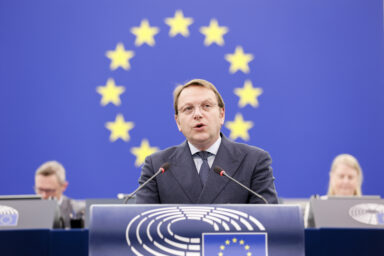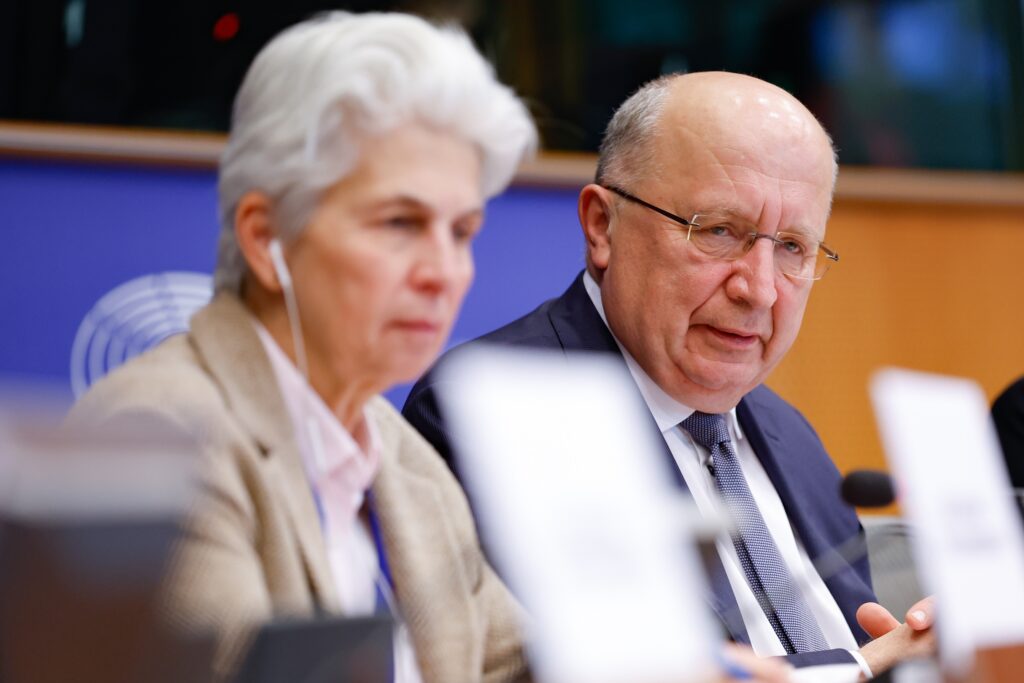
EU Defence Commissioner Andrius Kubilius floated a striking pledge on Thursday. By 2027 every euro spent from Brussels on military innovation will pass from grant to field test in four months, he told the Parliament’s security and defence committee.
Commissioner Kubilius drove home the sorest point of the bloc’s rearmament efforts: the lack of speed. He did so at the 15 April exchange of views with the Parliament’s Security and Defence (SEDE) committee which he attended to produce a formal report on the Readiness Roadmap 2030 and the AGILE programme.
“AGILE is fast and simple, delivering funding support in four months,” he told deputies, casting the new instrument as a sprint that will force Europe’s ponderous arms industry to pick up its feet. The budget is tiny—just €115 m for a pilot—but the process, not the sum, is what the Commissioner hopes to spread across the bloc’s broader Readiness Roadmap 2030.
Speed over splendour
Mr Kubilius hammered at the same theme throughout. “If we really want to deter Russia, we need to outproduce Russia,” he warned. Latest public tallies show the opposite. Last year Russia built four million artillery shells; Europe turned out two million. Russian plants produced 1,100 cruise missiles; the EU managed 300.
Mr Kubilius drew a lesson from Kyiv. “First of all, we need to learn from Ukraine how to produce not only technologically excellent, but very expensive and difficult to scale up haute couture defence production.” The alternative is “massive and much cheaper good enough production,” a phrase that makes many European engineers blanch but now sits at the core of Commission doctrine.
That doctrine shapes the Readiness Roadmap 2030, a plan that translates last year’s white paper into milestones for industrial ramp-up, joint procurement and military mobility. Parliament has still to clinch three legislative files that turn the roadmap into budgets.
“We cannot afford to slow down or water it down. We’re asking industry to speed up and we must ourselves step up,” the Commissioner said. He made the point to press national governments that remain stuck in trialogue haggling.
Muscle over paperwork
Deputies heard blunt numbers. Russia builds 3,500 infantry vehicles a year; the EU turns out 500. It manufactures 900 ballistic missiles; Europe makes none. Mr Kubilius linked slow output to thin order books and short contracts. Firms will not enlarge lines unless ministries commit to multi-year demand. SAFE loans—the EU scheme that subsidises up-front payments—help, but only nineteen states have applied and Hungary’s plan still awaits clearance.
Europe’s fix comes in layers. Industrial reinforcement actions inside the European Defence Industry Programme (EDIP) steer grants to powder presses and drone electronics. The new AGILE instrument adds an express track for prototypes from small firms.
Military Mobility regulation, now in Parliament, will fund wider bridges and stronger rail decks so the kit can move once built. “It is not enough to produce fast, but also what is very important to deploy fast,” Mr Kubilius reminded the committee.
Mapping the missile gap
Air-defence is a fresh worry. Ukraine faced 2,000 missile attacks last year, including 905 manoeuvring ballistic rockets. Kyiv told Brussels it needs 2,000 Patriot-class interceptors a year. America makes 750 and now hoards most for its own army after the Iran flare-up. Mr Kubilius has started a “missile tour” of European plants to gauge spare capacity. “Tomorrow we shall visit several very important missile producers in France,” he said, adding that permits, supply-chain finance, and luxury engineering habits all slow deliveries.
One brake is corporate fragmentation. MEP Nicolás Pascual de la Parte (EPP/ESP), a veteran of many procurement rows, argued that some capitals still treat Brussels as a cash machine for national champions. Mr Kubilius agreed. “One of the biggest problems of our defence industry is its fragmentation,” he said.
First of all, we need to learn from Ukraine how to produce not only technologically excellent, but very expensive and difficult to scale up haute couture defence production. — Andrius Kubilius, EU defence commissioner
The cure, he insisted, lies in joint projects such as European Defence Projects of Common Interest (EDPCIs), which bundle member states into consortia, and in revising the defence procurement directive this autumn to make buying innovation easier and cross-border.
Profit and politics
Left-wing deputies probed margins. Rheinmetall, MBDA and others returned hefty dividends last year even as delivery times slipped. MEP Marc Botenga (The Left/BEL) asked whether the Commission audits profit versus cost.
Mr Kubilius replied that EU funds carry strict checks but most buying stays national. He did, however, echo the concern: “Europe is investing into defense in order to defend peace. That can be achieved only with sufficient production.”
Pressed on whether treasuries will keep spending, the Commissioner sounded confident. Opinion polls rank security top across Europe and the Middle East crisis has underscored the fragility of American support. Washington’s stockpile drawdown, he said, means “Americans will be able to provide only secondary support, whatever that means.” Europe must fill the gap or watch prices soar as demand chases scarce rounds.
New command ideas
Filling the gap is not only industrial. Mr Kubilius revived his call for a standing European force to replace 100,000 departing American troops. He linked this to greater political cohesion and hinted at an institutional fix. “My proposal dealt with a European Security Council,” he said, sketching a body that could take top-down decisions rather than today’s bottom-up muddle.
Article 42.7, the EU’s mutual-assistance clause, also needs practical machinery. “The question here is European Union institutions can give some kind of assistance in coordinating that mutual (effort),” he noted, so no prime minister fights alone for helicopters when missiles fall.
Putin will not wait for us to finish the last dialogue in order to test us.
—Andrius Kubilius
That prospect drew interest from MEP Catarina Martins (The Left/PRT), who asked whether command and control must precede any standing force. The Commissioner did not dispute the logic. Whatever structure emerges, the current Military Planning and Conduct Capability will need more staff and clearer authority if it is to run large operations.
From drones to magnets
Defence now reaches into once-parochial sectors. ECR deputies from Poland and Lithuania asked about the “drone wall” promised for the eastern flank and the supply of rare-earth magnets that power small engines.
Mr Kubilius admitted detection remains weak and that dependence on China for magnet materials worries planners. A mapping exercise of Europe’s drone makers is under way; new observatories track critical inputs. The broader aim is a common market for defence products where supply chains sit inside EU law and factories can rely on predictable demand.
The Commissioner’s haul of promises—missile audits, AGILE pilots, a space-shield plan for midsummer—crowds a short calendar. Yet his closing admonition stuck. “Putin will not wait for us to finish the last dialogue in order to test us,” he said. Europe, he argued, must learn to value speed as much as sophistication, contracts as much as concepts, and volume above all. AGILE, if it works, will be measured less by its modest purse than by whether its four-month clock becomes the yard-stick.