How strictly should artificial intelligence be regulated in the EU? That question has exposed a deep split between EU lawmakers and derailed talks on the AI Omnibus. The deadlock now threatens to delay key rules on high-risk AI systems, including a planned ban on non-consensual ‘nudifier’ apps.
After more than 12 hours of negotiations, Council, Parliament and the Commission failed to reach an agreement on the AI Omnibus, raising questions over whether the EU can still ‘stop the clock’ on the high-risk provisions, due to apply from August 2026.
Previously, the Parliament voted to postpone the date for stand-alone high-risk AI systems to 2027, and to 2028 for AI systems already covered by EU product safety laws.
This is a German EPP coup together with the far right at the highest level.
— Kim van Sparrentak (Greens-EFA/NLD)
At the centre of the deadlock is a dispute over whether AI systems subject to sectoral rules, such as the ones embedded in medical devices, machinery, or toys, should be exempt from the strictest AI requirements.
Double regulation
Industry complaints about a “double regulation”. They refer to the compliance with EU product laws and a second layer of obligations under the AI Act. Changing this would mean that such AI systems would not automatically fall under the legislation scope. Critics of this move claim there’s no overlap, as the AI Act measures are not yet covered by sectoral rules.
Center-left groups blamed the EPP and far-right groups for blocking the deal. “This is a German EPP coup together with the far right at the highest level,” said MEP and shadow rapporteur for the file Kim van Sparrentak (Greens-EFA/NLD). “EPP is playing with fire. They are willing to risk plummeting European industry in a total legal vacuum of chaos, jeopardising AI-safety in Europe and the legal certainty for industry.”
She added that the move served “the aggressive tech lobby and a handful of German companies who are lagging behind”, while companies that had prepared for compliance now face chaos.
On the other hand, industry groups view the delay positively. For Cecilia Bonefeld-Dahl, Director General of DIGITALEUROPE, “this shows that the democratic process is working as it should”, she told EU Perspectives. “We strongly support the European Parliament and Germany’s push for meaningful simplification for Europe’s industrial sectors. European companies need clear, workable rules that support innovation and competitiveness,” she added.
Members states are also far from a consensual position. So far, political groups point to Germany as the perpetrator of the move. Meanwhile, Belgium, Bulgaria, the Czech Republic, Greece, Spain, Latvia, Luxembourg, Hungary, Malta, Austria, and Slovakia refuse to exempt these products from the scope of the AI Act, because of safety risks. In the middle, Ireland, Sweden, Finland, and Italy are open to looking for further clarification.
Dispute over ‘nudifier’ ban
The failure to reach an agreement also puts the ban on ‘nudifier’ systems at risk. These tools use AI to generate explicit images of real people. While both Parliament and Council support banning non-consensual use, lawmakers remain divided over definitions.
One unresolved issue is how to define the kind of intimate content covered by the prohibition. The distinction matters because AI systems can generate abusive or degrading images without necessarily depicting full nudity. A narrow definition could leave loopholes for tools to create sexualised images of women and girls in underwear or bikinis.
When EPP, teaming up with the far right, has to choose between exempting companies from AI rules or effectively protecting women and children, guess what they choose.
— Markéta Gregorová (Greens-EFA/CZE)
MEP Markéta Gregorová (Greens/CZE), shadow rapporteur of the AI omnibus, blames EPP and part of the Renew for the stalemate. “When EPP, teaming up with the far right, has to choose between exempting companies from AI rules or effectively protecting women and children, guess what they choose,” she said. “We showed openness, as the Council did. But it was clear that the industry interest to be exempt from the AI rules prevailed in EPP and part of Renew over anything else.”
The proposal applies only to non-consensual content. Therefore, enforcement would depend in part on whether consent can be verified by the platforms. That raises practical and ethical questions about how platforms, authorities and victims would prove consent in real cases.
Disagreement over compliance costs
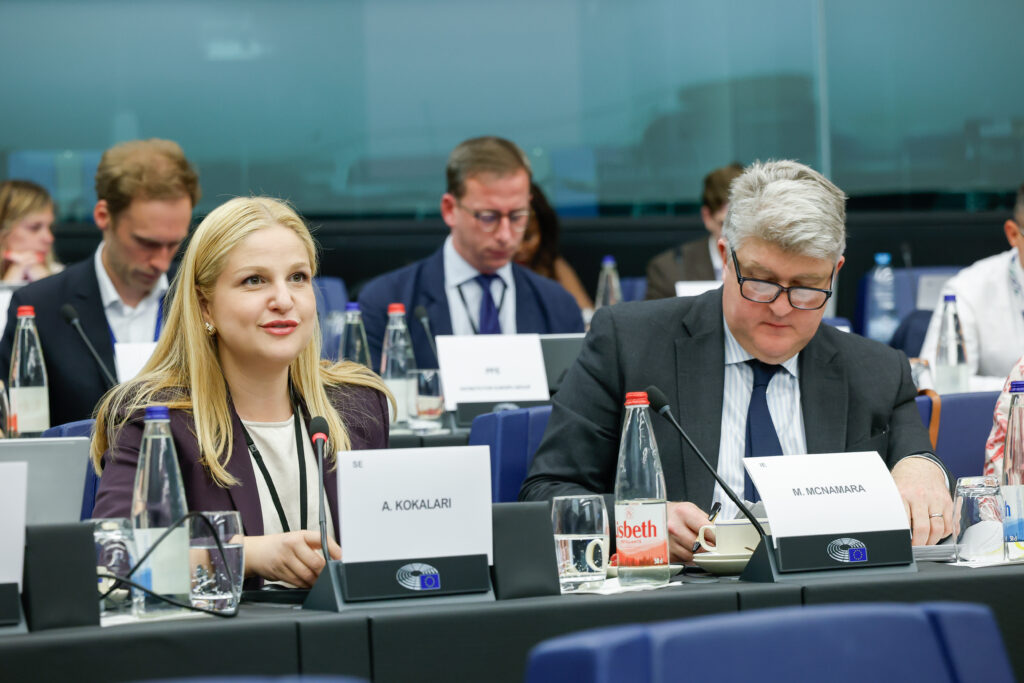
Renew MEP and AI omnibus rapporteur Michael McNamara asked the Commission to clarify estimates suggesting that compliance with the AI Act could cost between €320,000 and €600,000 for entities covered by the high-risk classification.
According to Commissioner Virkkunen, the €319,000 figure refers to an exceptional case. This is a provider of a high-risk AI system without a quality management system already in place. She argued that this was not representative of many providers covered by product legislation, where such systems are already required.
The Commission said preliminary estimates from conformity assessment bodies suggest AI Act compliance for high-risk AI systems already covered by Annex I product legislation would increase existing conformity assessment costs by 15–20 per cent. Based on earlier impact assessment figures, this would put AI Act-related compliance costs closer to €23,850–€40,400, rather than €600,000.
However, DIGITALEUROPE has cited higher estimates. The organisation cited that SMEs could face up to €319,000 in initial compliance costs and up to €150,000 annually. Further studies suggest costs could reach €600,000 when certification and staff costs are included. The values translate into 30–40 per cent profit erosion for SMEs
Is there still time for a deal?
No new date has yet been set for resuming negotiations. The estimate is a two-week delay. The aim is to finalise the file before the summer. Missing these milestones would make it difficult to delay the high-risk rules before they take effect.