War churns in Iran and Lebanon, tankers inch through the Strait of Hormuz under naval escort, and prices at European petrol stations creep upward by the day. What should Europe do? Lawmakers in Strasbourg recommend a whole host of measures, from more electrification to quicker green transition to abolishing Israel.
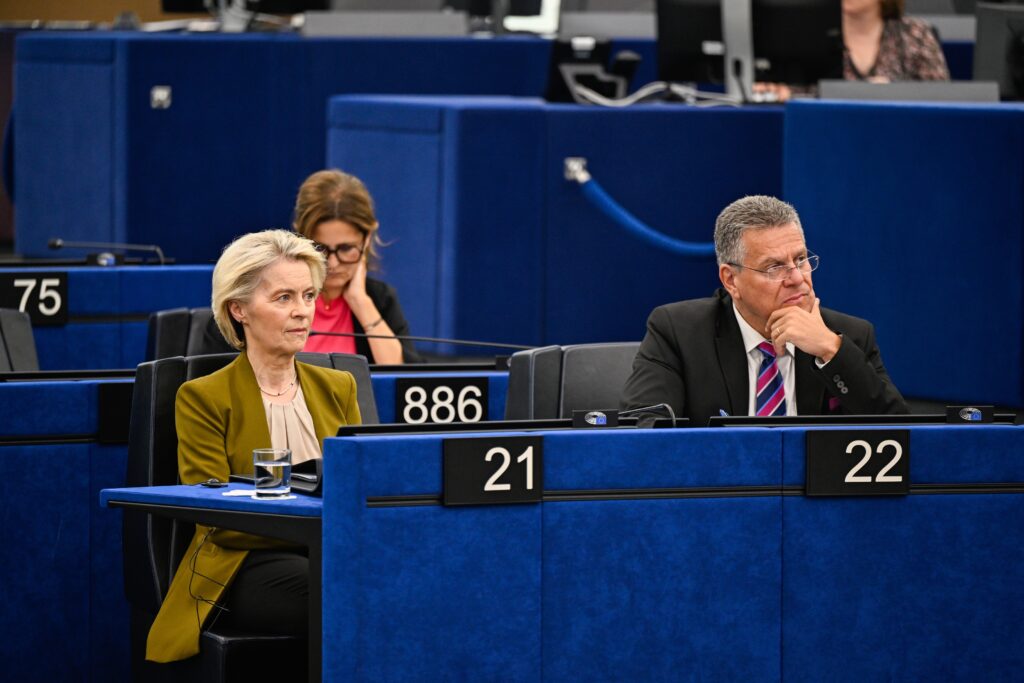
The warning lights in Europe’s energy dashboard are flashing red again. On 29 April the European Parliament convened in Strasbourg to ask how a continent still nursing the ongoing-war scars could weather a second energy shock in four years—and how that shock might curdle into a fertiliser crunch for farmers.
The three-hour debate, held under the ‘Council and Commission statements’ procedure, triggered no vote. It took place to inform the Commission’s forthcoming Middle-East strategy and signals to markets that legislators grasp the urgency. Consensus ran broad: shield households, keep sea lanes open, and step up humanitarian aid. Discord flared over sanctions on Iran’s Revolutionary Guard and over how briskly Brussels should chase full electrification — and over everything else as well.
Power, not pity
European Commission President Ursula von der Leyen framed the numbers in no uncertain terms. “In just 60 days of conflict, our bill for fossil fuel imports has increased by over 27 billion euros, without one single molecule of energy in addition,” she said. Her remedy is structural. “This is the moment to electrify Europe.” That means grids, hydrogen and—above all—coordination. “Measures should be targeted to the most vulnerable households and industries only, and we should avoid increasing the demand for oil and gas at this time.”
Ms von der Leyen’s toolbox pleased centrists but irked those who spy creeping dirigisme. Maroš Šefčovič, the Slovak trade commissioner, argued that ambition remains affordable. “We all share the same goal enshrined in the EU law that Europe will be climate neutral by 2050,” he told deputies, noting €95bn of unused energy cash in the current budget.
The Council’s envoy, Deputy Foreign Minister Marilena Raouna of Cyprus, drilled into logistics. “Disruption to energy and global trade flows and prices trigger ripple effects on fertiliser supply, on food prices, on economic growth, as well as on investment partners,” she said. Europe’s ASPIDES naval mission, already patrolling Hormuz, must now gird for longer duty. She reminded deputies why: “It is abundantly clear that the ongoing crisis in the Middle East carries profound global repercussions that directly impact the Union’s security environment and interests.”
Ms Raouna also pressed for joint planning with Gulf partners and welcomed the 9 April American-Iranian ceasefire. Yet she insisted that unity at home matters as much as diplomacy abroad.
Markets and morals
In the chamber, group leaders pulled the debate onto familiar ideological turf. MEP Manfred Weber (EPP/DEU) fused climate aims with sovereignty. “Renewable energies are the future and to fight against climate change is not anymore only an ecological issue, it is obviously an issue for a sovereign Europe,” he declared. He backed nuclear as baseload and praised a new roadmap for completing the single market in energy grids.
Most others sought villains to blame, and found no shortage of those. Speaking for the Socialists, MEP Iratxe García Pérez (S&D/ESP) identified the ultimate villain—somewhat confusingly, from a policy viewpoint—in Mr Weber. “Mr Weber if you’re going to teach lessons, then make sure they’re the right ones. The Popular Party in Spain is currently concluding agreements with the far right, with one principle, the national priority. So you’re comparing that with a xenophobic party like Orbán’s. But if you’re going to give us lessons, please make sure they’re the right ones,” she appeared to hold the German lawmaker responsible for her native Spain’s internal political squabbles.
In just 60 days of conflict, our bill for fossil fuel imports has increased by over 27 billion euros, without one single molecule of energy in addition.
— Ursula von der Leyen, European Commission President
Then Ms García Pérez linked high bills to moral hazard. “We need to act; we need leadership. We need clear, brave and fair measures,” she thundered, demanding a windfall tax on oil majors and sanctions on Benjamin Netanyahu’s government. “Suspend the association agreement with Israel. Let’s have sanctions imposed on the Netanyahu government,” she added.
Financing Putin
Conservatives also found a Spanish villain. MEP Nicola Procaccini (ECR/ITA) framed the issue of energy production as one of sovereignty. “Pedro Sánchez, over the last month, has increased by 124 per cent his purchase of liquid gas from Putin,” he said. “That’s not Orban, but Sanchez.”
The Italian conservative proceeded with his scathing criticism. “He has gone further than anybody to increase imports of gas from Russia, becoming de facto the biggest European sponsor of Putin’s war in Ukraine. Then we give a loan of 90 billion euros to Ukraine to defend themselves from the person that we have funded. Genius,” he pointed out an inconsistency in European policies.
Mr Procaccini insisted that Europe must drill, mine and split atoms at home. “I’m not demonising renewables, as I don’t demonise other sources of energy. We need all of them,” he said. “The only thing we don’t need is the left’s hypocrisy, which has condemned us to the Green Deal, to measures such as CBAM, which drives up the cost of importing those fertilisers that are actually banned in Europe in terms of their production,” he was quick to draw attention to another inconsistency.
Weakening transition
The Greens, on the other hand, doubled down on speed of transition. MEP Bas Eickhout (Greens–EFA/NLD), speaking on behalf of his faction, warned against watering down existing tools. “Going fossil free is our path to freedom.” He bemoaned mixed signals from Brussels. “This inconsistent behaviour weakens our transition and the citizens pay the price.”
(Spanish PM Pedro Sánchez) has gone further than anybody to increase imports of gas from Russia, becoming de facto the biggest European sponsor of Putin’s war in Ukraine.
— Nicola Procaccini (ECR/ITA)
On behalf of the liberals, MEP Valérie Hayer (Renew/FRA) echoed that call. She parcelled blame across decades. “Colleagues, the way to our independence is to decarbonise our economies,” she said, adding that €400bn of annual fossil imports “boosts dictators”.
On the other side of the political divide, MEP António Tânger Corrêa (PfE/PRT) hit a pocket-book note: “Increases in prices means that we are all suffering, and a Europe which is following the increase in oil prices, well, it really means we have to ask some questions.”
The fertiliser fuse
Beyond diesel and kilowatts lurks ammonia. Farmers fear that soaring gas prices will price fertilisers off fields. Ms Raouna offered scant comfort but promised focus. “Regarding fertilizers, we are looking forward to receiving the Commission’s action plan in the context of which we look to short-term measures to respond to the current circumstances, as well as measures to increase the resilience of the EU agricultural sector by reducing our reliance on imports.”
Sanctions drew sharper rifts. The EPP and Renew backed listing the Islamic Revolutionary Guard Corps as terrorists. Greens and Socialists, while scathing about Tehran’s clerics, warned against shortcuts. With sea-lane freedom hanging on fragile diplomacy, they argued, a hasty blacklisting could snap threads that still restrain Iran’s hardliners.
In the search for villains, MEP Grzegorz Braun (NI/POL) went farther than most would, referring to Ms von der Leyen as “Reichsführerin”. He then compared her electrification push to that of Vladimir Lenin, the erstwhile Soviet leader. “The so-called crisis is a permanent crisis, a result of some deeply wrong decision. The decision of November 1947, the UN Resolution 181 that enabled the creation of the Jewish state located in Palestine,” he spiced the debate with a dash of rabid antisemitism, earning himself a rebuke in the process.
Back to money
Mr Šefčovič tried to soothe the tumult. “We all want the ceasefire in Iran and in Lebanon to hold,” he said, repeating that 85 per cent of global trade sails by sea. In that geometry, the Strait of Hormuz is the eye of a storm that could yet engulf the Green Deal itself.
Colleagues, the way to our independence is to decarbonise our economies.
— Valérie Hayer (Renew/FRA)
Money, inevitably, loomed. Ms von der Leyen dangled a carrot and a stick. Brussels can still tap €300bn for energy under the current budget, she said, but future largesse hinges on ‘new own resources’. “This is the only credible way to match Europe’s priorities with Europe’s means,” she concluded.
Parliament’s tone—in the absence of a verdict—is advisory at best, yet its subtext is loud. Europe must curb demand, boost clean supply, and police chokepoints abroad, all simultaneously. Whether through taxes on oil windfalls, subsidies for heat pumps, or frigates skimming Gulf waters, voters will measure success by two gauges: the digits on the monthly power bill and the price of nitrate in the co-op yard. Sea lanes can be reopened by warships; kitchen lights and wheat yields cannot.